
• WTC MemorialWhen one reaches un certain âge, the realization dawns on you that the past is measured in events; the moment you meet your true love, graduation, your child’s birth, a parent’s death.

    But time is also measured by events of such great historic proportion that you can remember with clarity where you were and what you were doing. We mark time by the events of historic proportions. The events mark us with changes too.

    On November 22, 1963, I was in sixth grade at Huron Junior High. We had an “honors” study hall which was about anything but studying. If you can imagine it, a group of sixth grade students were allowed to sit in a classroom alone and without supervision for the purpose of doing homework. I suppose this was considered a privilege, but, as junior high students are wont to do, we spent most of the time being noisy and silly and, I believe just before we heard the news about the President, we had been threatened with loss of privilege by a teacher who was passing by the room and recognized the sounds of “un-studying”.

    I cannot recall the particulars of how we found out about the events in Dallas, but I do remember snippets of the rest of that day. It was unnaturally quiet. After that, things felt a little less safe, as if the world had made a seismic shift and we weren’t quite sure how to react. But time blurs those feelings and puts them into a back corner of our memory until the next time.

    And there are so many “next times”. RFK, MLK, Newtown, Oklahoma City, and closer to home, the Boston Marathon. And September 11, 2001. On that morning, I was testing second grade reading out in a hallway. With each tragic event of that day, one of my colleagues came out to whisper what had happened. We were directed not to discuss anything in front of our students; however, given the eery quiet with which the staff went about the day, I would not be surprised to learn from former students that they knew something bad had happened that would impact their world, as the Kennedy assassination had for me.

    Over the past sixteen years, we observe a moment of silence to remember the people and events of 9-11. And each year when that moment of silence is broken by the playing of taps, the magnitude of that day is with me and many others.  The memory of the circumstances, the events of September 11 is renewed. May we never forget.


  • IMG_0859Last Tuesday, I was able to attend the Joint Committee on Education’s hearing in Boston. I say “able” because, while I am sure the legislation before the Committee would have garnered interest and testimony from many active educators, they largely would not have been able to attend as the hearing took place the day after Labor Day, a school day. As a teacher retiree, I was not in my first (or fourth) day of a new school year and could attend, so I did.

    There were many proposed pieces of legislation under discussion last Tuesday; however, two bills, S.279 and H.304, aroused my curiosity and alarm. These two pieces of legislation appear to target teachers and students in gateway cities and,  if you are a Massachusetts parent, teacher, or administrator and your student attends school in one of these districts, you should pay attention. Your voice in what happens in your local school is being threatened.

    Bill, S. 279 unnecessarily singles out and targets urban and gateway districts. How do I know this? Because the “opportunity” to become an innovation partnership zone is based on a the results of a single high-stakes test, the MCAS and consequently the assigned school level that stems from that test. To base the worth or value of a school – or a district – on how students perform on a single high-stakes exam is w.r.o.n.g.  It is bad educational practice. No teacher would ever give a student a final mark based on one measure and the Commonwealth shouldn’t be doing this with schools and school districts either.

    Those who favored moving H.304 and S.279 forward spoke frequently about the power of looking at students’ (test) results and collaborating to determine school budget priorities, schedule/time allocations, and coordination of student needs with curriculum. My reaction to that is NO KIDDING. Why, why, why, do some in the Commonwealth feel that a piece of Legislation would make this a) any different from current practice, or b) necessary to mandate?

    Those in favor also spoke about the empowerment zone created in Springfield. The Springfield schools working in the empowerment zone are all middle schools and have done so for two years. Even James Peyser, Secretary of Education, had to admit the “data” on the success of these schools was rather green and not established. Others from this panel (two teachers and a principal) spoke about their experience meeting as teacher teams to think about what the students need.

    Sorry kids this is not a new concept or practice, nor is it one that requires a mandate from the Commonwealth. Lowell teachers, and I suspect teachers in most districts throughout Massachusetts, routinely meet to do this very same thing regularly. We call these collaborations PLCs (professional learning communities) or CPTs (common planning time). We do these things because a) we are there to figure out how to help students go from learning point A to B and b) we are professionals.
    Here’s another thought: if a school is considered lower performing according to MCAS results, H.304 and S.279 would allow the Commissioner of Education (appointed, not elected) to begin the process of designating the schools for empowerment or innovation zone status. In the case of H.304, if the local teachers’ union and the school committee cannot agree to concessions to the collective bargaining agreement, the Commissioner can just make the school a lower Level 4, and in effect, start the process of diluting local control anyway.

    Under S.279, the legislations proposes to “support” struggling schools through the creation of an innovation partnership zone. From what I can tell, the “partnership” is that the Commissioner of Education and DESE has a large stake in how the school is run. Schools are eligible to be in an innovation zone if their MCAS scores put them in Level 4 or Level 5 status. But – and this is key – in order to create an innovation zone, there needs to be at least 2 schools participating.

    Just to put that into local perspective, if Lowell has a Level 4 school (and it does) and the decision was made to create an innovation partnership zone for that school, the Commissioner of Education could pair that Level 4 school with another higher performing school – a Level 3, a Level 2 or a Level 1. So don’t breathe easy if your school’s MCAS results are great, you too could be part of this education magic show.

    When a school is “in the zone” (sorry Vygotsky fans, I couldn’t resist that), an appointed The-Zone-of-Proximal-Development Board of Directors has autonomous control over personnel, budget, curriculum and hours. This unelected board with possibly no connection to the community could decide to do anything, including conversion of the public school to a charter school through a charter management company.
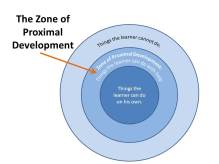
    Just for comparison, if a school is not in the zone, the elected School Committee and a combination of school administration/school site councils (theoretically) make these decisions and if you, a parent or voter, don’t agree with those decisions, you can voice that in person or you can make your feelings known at the ballot box.

    Wait. Who is missing from those groups? If you said “teachers”, you go right to the bullseye of the Zone of Proximal Development. At least on this topic. Despite the Springfield testimony highlighting empowering teachers and teacher teams, the decision-making for what takes place in a classroom is still top-down.

    The act of creating empowerment or innovation zones is different from what has happened in a few districts in Massachusetts, namely Lawrence. In those districts the state has outright put the entire district into receivership, meaning, the local governance of the public schools is given over to the Commonwealth. There is no local control over the education of the students and an un-elected “receiver” makes all the decisions. It also includes a favorable environment for education management organizations (EMO) to set up a network of charter schools. If you are interested in the track record of the charter school industry in Michigan and in particular Detroit where entire public school districts were replaced by charter school entities, read this article from the NY Times. Chilling.

    The full text of S.279 is found here, and the full text of H.304 is found here.  For now, both of these bills warrant a close watch. The Department of Elementary and Secondary Education seem to be ready to dismantle traditional public education one school at a time.

  • Author collectionTwo stories from the education world caught my attention this week, and I feel that both are worth the time to read. The first story, Why Teachers Quit by Liz Riggs, is a cautionary tale from 2013 about teachers and burn-out. The second, Silicon Valley Courts Brand-Name Teachers, Raising Ethics Issues is by Natasha Singer of the New York Times. It is a warning for anyone who worries about the possible effects of corporate America’s influence in schools and school materials.

    The Atlantic recently reposted Liz Riggs’ 2013 article Why Teachers Quit which was originally printed in October 2013. Even with a 4-year time gap, this is an article that is relevant and worth reading for anyone interested in retaining educators. The turn-over rate cited in the article, 40-50%, refers to the numbers of teachers leaving the education profession within the first five years of their career.  While I believe this attrition rate to be lower in 2017 thanks to strong induction and mentoring programs available to beginning educators, many beginning teachers continue to leave education for other fields.

    Although many of the teachers Ms. Riggs interviewed were from charter schools, the conditions which lead to decisions to leave education are often some of the same expressions of discontent heard now from both novices and experienced teachers. The responsibilities of educators don’t end at the dismissal bell. Planning, assessing, writing reports – those workloads are often overwhelming and makes for an unhealthy and out-of-balance life.

    Even when one goes into education for all the best reasons, the reality of the profession can become overwhelming. With all of the emphasis on teacher quality, there continues to be a need to ensure that the extracurricular demands on talented educators are not overpowering.

    The second article, Silicon Valley Courts Brand-Name Teachers, Raising Ethics Issues, was recently published in the New York Times and describes a new trend in education: recruiting teachers to promote edu-products. While understanding that obtaining “free stuff” is a way for classrooms and educators to afford enhancements and the latest in bells and whistles, I think this pathway is a very slippery slope. It makes me more than a bit skeptical about the motives of corporate American forming relationships with educators to obtain favorable product placements.

    As a retired educator, I can still recall the disproportionate amounts of time spent each evening writing plans, pulling together materials, researching, contacting parents, and grading student work. I am not quite sure how Kayla Delzer, the third grade teacher chronicled in the Times article finds enough time to attend to teacher responsibilities; blog, tweet, and post on Facebook; and sleep. I wonder about the cost to her students.  Is her objectivity in evaluating appropriate materials compromised? Are her students missing out when their expert teacher is away to promote these materials?

    Two tales for the week, both cautionary. Anyone out there listening?


  • “Creativity is allowing yourself to make mistakes.

    Art is knowing which ones to keep.”

    ~Scott Adams

    Educators and staff in my community start the new school year tomorrow. And as they do, there will be the usual pressure to be perfect. Perfect in pedagogy, perfect in understanding students, perfect in everything that has to do with school, in the finger-pointing education environment under which we teach and learn.

    Does it seem as if somehow no one in public education is allowed a misstep?  I think so; and I think that toxic expectation of perfection can interfere with the art of teaching.

    In teaching, there is an underlying expectation that all should go according to plan without stumbling or error. This is an unrealistic expectation, and it creates an environment of canned, scripted and safe lessons that do not necessarily serve students. Unrealistic expectations of flawless lessons create an impediment to teaching creatively.  As any experienced educator can attest, every day there will be moments when all goes smoothly, and moments when nothing does. This is to be expected. Teaching is an art filled with glorious highs and magnificent lows; sometimes this takes place within the same 60 minutes.

    As you all return to school and to the important work of creating a community of learners, I urge you to embrace both creativity and the mistakes that are inevitable.

    Do the research. Read professionally. Participate in discussions with colleagues. Take chances. Take advantage of opportunities for creativity in teaching and learning. Teaching is an art and you, my friends, are the creatives.


  • flipoutThe Lowell High School project is, without a doubt, the biggest thing going in Lowell. I mainly stay out of the discussions about siting this project, mainly because, aside from being a taxpayer, I have very little skin in the game – no children/grandchildren in the school system. I do have an opinion, however, that is not based on tradition or the often-cited “that’s the way we’ve always done it”. That is one of the advantages of being a Blowellian.

    In my opinion, soliciting community support for this massive project has been ass-backwards from the start. My recollection is that, until there was some blowback from community groups like CBA and CMAA, there was very little effort to include all the stake-holders in the decision-making.  Did the rush to get the project in front of Mass. School Building for project approval preclude the necessity for a referendum vote on where to put the school? I think it has.

    But while decisions and debate about where to put a new high school have become the focus point, there are other equally important issues that are getting pushed aside.  One of those issues is the inadequate school funding support coming from the Commonwealth of Massachusetts.

    Thanks to cuts in the state budget and cuts coming from the Federal government, Lowell Public Schools needs to cut the previously approved 2018 budget by nearly $1 million.  At the last School Committee meeting, there was plenty of debate surrounding the cutting of positions. Some of those proposed cuts are positions that directly impact students.  The loss of anticipated Chapter 70 funding is somewhat complicated, but in my mind, these are the issues:

    • The lowering of  tax revenues at the State level has resulted in the need to make last second reductions in school budget line items.
    • The state’s budget and funding formula for Chapter 70 has not been fully funded (currently presumed to be underfunded by over $1 Billion) for many years.
    • Education funding formulae are based on 23-year old calculations. The Foundation Budget is is dire need of updating (see TracyN Foundation Analysis).
    • The continually increasing expenditures for charter schools.

    Brockton, Worcester, and other gateway cities, those who are impacted most critically by Chapter 70 underfunding and under-calculations, have joined together in an attempt to force the Commonwealth to rectify Chapter 70 funding issues through a lawsuit to address the inequities of funding. Because of Lowell’s focus on the high school, the effort to fix the funding, and possibly get some relief for our local school budgeting, isn’t even a blip on the radar.

    Yes, the high school facility and a building that will serve the students in this community is important, but it is not the only thing.

  • Donalyn Miller recently tweeted about a recording sheet she uses for the 40 Book Challenge she not only “invented” but practices with her students in her classroom.  As I’ve recently added her book “The Book Whisperer” to the book study portion of a course I’ve developed, Donalyn’s tweet caught my attention:

    Screenshot 2017-08-17 20.30.30

    My curiosity over why Donalyn Miller would feel compelled to tweet an endorsement of  Debbie Ohi’s collection of forms led me to read this post from August 2014:  The 40 book Challenge Revisited.

    Her point this:

    … the original thinking behind an instructional idea becomes lost when it’s passed along like a game of Telephone. You heard about it from a 60-minute conference session. Your teammate attended a book study and she gave you the highlight reel. The teacher down the hall is doing something innovative. You should try it. We’ve all seen the quick adoption of shiny, new ideas without a full picture of how these concepts fit into best practices (or don’t).

    I’ve frequently heard fellow educators reference that they are “doing” the Daily Five or the Daily CAFE. However, digging in a little deeper, misinformed yet well-intentioned educator’s idea of the “doing” is more likely to be incorporating some of the “centers” (sorry Gail and Joan, I know that’s not what you intended) or using some printable for students downloaded from one of the educator enterprise sites.

    The Daily Five practice is based on developing a trusting relationship between learners and teacher. The development of this trusting relationship is every bit as important as the student activities.  A gradual release of responsibility leads to developing students independence and accountability.  Joan and Gail’s commitment to research and development of their own practice is the powerful glue that, in my opinion, holds the Daily Five and CAFE together. This becomes the basis for educator changes that lead to best practice.

    Shiny new ideas are terrific, of course. That is the basis of being “green and growing”, as one of my former administrators used to say.  However, without fully understanding a method for management of teacher, the practice become so simplified that it often becomes just another tedious fill-in-the-blank task to keep students occupied.


    And that, is not a best practice of any kind.


  • My favorite weekend of the year is always the last weekend in July. The Lowell Folk 2017-Jul-29_Folk-Festival-2017_1195_edited-1Festival – a free (!) and frenetic amalgam of music, food, and culture – is worth planning around, which is, exactly what we do.

    2017-Jul-30_Lowell-Folk-Fest-2017_1323Over the 31 years that the festival has been here, it seems to me it has developed into a better and better version of itself. This year, with stellar weather, not too hot and most definitely not too humid, was one of the best.

    The music is naturally one of the biggest draws. 2017-Jul-28_2017-LowellFolkFestival_1031Where else can you go to sample everything from Armenian to Zydeco? I mean that literally.  When we first started coming to the Festival, we would carefully plan out which bands to listen to, and that’s not a bad strategy, really. But what we’ve done in recent times is move from place to place listening to music that is not necessarily in our cultural comfort zone. Doing so has been a great way to get some exposure to music we wouldn’t necessarily listen to on Pandora or iTunes.  Great stuff.


    Over the years, we’ve also come to appreciate Friday nights, the first night of Folk Festival. While the crowds and 2017-Jul-28_2017-LowellFolkFestival_1036excitement of Saturday and Sunday of Festival weekend are energetic, there is a different kind of vibe to Friday. There is a goodly amount of community pride when the 6:30 parade kicks off. Representing many – not all – of the cultures of Lowell, it causes this Blowellian to realize what a special community we have here in Lowell. The diverse cultures making up our community fabric is a great source of pride for all of us. Long-established cultures that immigrated here during the hey days of the mills or newer immigrant groups establishing homes – all were represented in the kick-off to the weekend. 2017-Jul-28_2017-LowellFolkFestival_1039

    But there was a little something more this past Friday: there was a feeling of kind togetherness and consideration. A festival-goer, a stranger to me, insisted I take a cushion as I knelt down on the grass of Boarding House Park to photograph the parade. Random concert goers started up and 2017-Jul-28_2017-LowellFolkFestival_1100_edited-1carried on conversations, enjoying the music and the collegiality.  I think this shift in attitudes must have become contagious. One of the Park Rangers we spoke with on Sunday was delighted to point out his radio had been 2017-Jul-28_2017-LowellFolkFestival_1153very quiet all weekend because, in spite of large crowds, everyone was well-behaved.

    An event of this size takes lots of organization and many, many dedicated volunteers – from fundraisers to recyclers to people who run the cameras for broadcast.  If you were at this year’s festival, you may have run into a few of them from the Bucket Brigade. 2017-Jul-28_2017-LowellFolkFestival_1111In order to put on a festival of this size, there is a huge financial commitment from community partnerships to donations large and small.  You can continue to donate to the Lowell Festival Foundation’s fundraising efforts and, in doing so, get ready for the next festival.

    Next summer, on the last weekend of July, the dedicated volunteers and sponsors who organize Lowell Folk Festival will do it all again for the 32nd time.  I know where I will be, and I hope you’ll join in the fun too.

    2017-Jul-28_2017-LowellFolkFestival_1067


  • 2016-Sep-10_FiddleBanjo2016_1362Is STEM the only thing? I’m asking for a friend.

    It occurs to me that in the rush to turn out worker bees for business sectors, the focus in education is more than a little skewed in favor of science, technology, engineering and mathematics. Yes, these are all important studies and part of a well-rounded balanced education. However, I am questioning that the focus on STEM has over-shadowed other content and curricula that, in my biased opinion, should be equally important.

    Because I see education in terms of an avenue toward a pursuit, observing the march of the bureaucrats toward the next great crisis in education is equally frustrating and alarming. Our educational goal should be to “hook” students into becoming life-long students, to foster curiosity and questioning and the drive to know more.

    And maybe that pathway toward becoming lifetime learners is through a STEM discipline, and perhaps it is not.

    As a student, my personal pathway into learning was through something quite different. I was a more-than-adequate reader, not a particularly skilled writer, and a horribly incompetent math student.  What fired me up to become more disciplined about learning and more successful as a student, was a love and pursuit of music. The irony of this statement is that, as an adult, music has taken a backseat to the very disciplines that catch all the attention today – technology and mathematics.

    To me, it is more important to teach students to think critically, to process logically and, yes, even scientifically. Science, math, and technology are important and great ways to get to those problem-solving and thinking skills. But other disciplines can be a means to this end – and toward the goal of fostering and enduring desire to learn – too. And for the student whose interest in learning lies in arts and humanities, exclusion of such pursuits leave them flat.

    So while our education policy makers direct a refocus on science, technology, engineering, and mathematics, I hope there might also be a similar pursuit of arts and humanities. Because, in my opinion, there is a need to balance educational pursuits across all disciplines.

  • IMG_2154About six months ago, Adrien and I came to the realization that, despite 200+ channels offered by our favorite cable provider, we were more often than not finding little entertainment of value on television. Mostly we ended up watching television to “kill time” – not a particularly compelling reason for sitting in front of the tube after dinner.  And then, there was the over $200 a month bill.

    So with that realization, we started to become intrigued with the idea of cutting the cord – getting rid of our cable television access. And yes, I do know boomers are notorious for not quite being on the cutting edge of technology. Yet we persisted.

    The television we gravitated to really was a short list. Once we started to keep track of what we really wanted to watch on television, it was fairly easy to match up streaming providers (Hulu, Roku, etc.) to our habits. Although we had an older Apple TV, we upgraded so that we could take advantage of DVR capabilities offered by streaming providers like Hulu-live.

    What we discovered was that we might lose one of the local (Boston) channels (WCVB). We also let go of local cable access coverage of meetings (yea, I was that person), and watch local PBS affiliate,  WGBH, via the Internet.  By choosing the more costly live-streaming packaged offered by Hulu (Hulu-live) we can still access local sports coverage (Red Sox!). Another advantage is that any changes to account types (i.e., from regular Hulu to Hulu-live) so far do not incur any penalties or change of service charges.

    The feature we’ve had to get accustomed to is queuing up programs that we are interested in rather than channel surfing.  Our previously acquired Netflix account is easily accessed through an Apple TV app. Using Amazon Prime is naturally a little more difficult, but with a little more effort (Airplay and playing through an iPad) still accessible.

    We kept the same Internet access speed (200 Mbps), curtailed landline and cable. By doing so, our monthly “entertainment” costs are about $60 a month less – nearly $1,000 savings a year. At this point we are still evaluating whether the “live” feature of Hulu-live is worth the $40/month charge; regular old Hulu (with limited commercials) is $12 a month. If we discover that live TV broadcast is not something we regularly watch, we’ll be able to cut our entertainment charges even more.

    In my opinion, however, the greatest advantage for us is that when we do sit down to watch television, we’re doing so for a reason or with a particular show in mind. Reading, conversation, and dinnertimes are a lot calmer.  So far, so good.

  • 2014-11-25-lincoln-024One of the texts I’ve reviewed for a course I’m leading this summer is Jan Burkins and Kim Yaris’ Who’s doing the work: How to say less so readers can do more

    What do you, as teacher, do when a student is stuck in their reading? Do you go into wait-time mode or try to move things along with hints or suggestions of strategies? And if you do either of these, what is the student’s response or reaction?

    Sometimes when we think we are moving responsibility for learning to our students, the shift is not as significant as we think. Case in point: when a student successfully uses a decoding strategy to uncover a challenging word, does the student look to you, the teacher, for affirmation.  Surely that’s something I was guilty of doing.

    However, when students come to rely on that affirmation and teacher praise as an indication of whether or not the word was called correctly, that is scaffolding that has over-served its usefulness in steering students toward a gradual release of responsibility.  We set the students up for dependency, not independency.

    In real reading – the kind that students engage in on their own either in school or later in life as adult readers – what happens when a decoding challenge the meaning of the print breaks down? Will a teacher always be there to nod a yes or to give hints?

    The end game for reading instruction is to enable a reader to develop so that he or she knows that to do when confronted with reading challenges.  Instead of leading a student through the use of a specific strategy (get your mouth ready, think about what makes sense), what if the prompts from a teacher were more open-ended:

    What do you notice?

    What can you try?

    There are undoubtedly times when explicitly teaching strategies for decoding and comprehension are not only appropriate, they are essential. How else would a reader learn about them? But once the strategy has been introduced, practiced and become part of a reader’s repertoire, shouldn’t we, as coaches, allow the reader to decide what to do?

    Over coaching developing readers is something I became aware of as an active and as a retired teacher.  More open-ended questions and less controlled coaching not applies to reading. Think of the implications for problem-solving in math.

    So I ask: are we empowering our students to truly be independent? Or, as Yaris and Burkins point out, are we creating learners who are dependent upon our affirmation and approval? Are we allowing students to be independent learners?