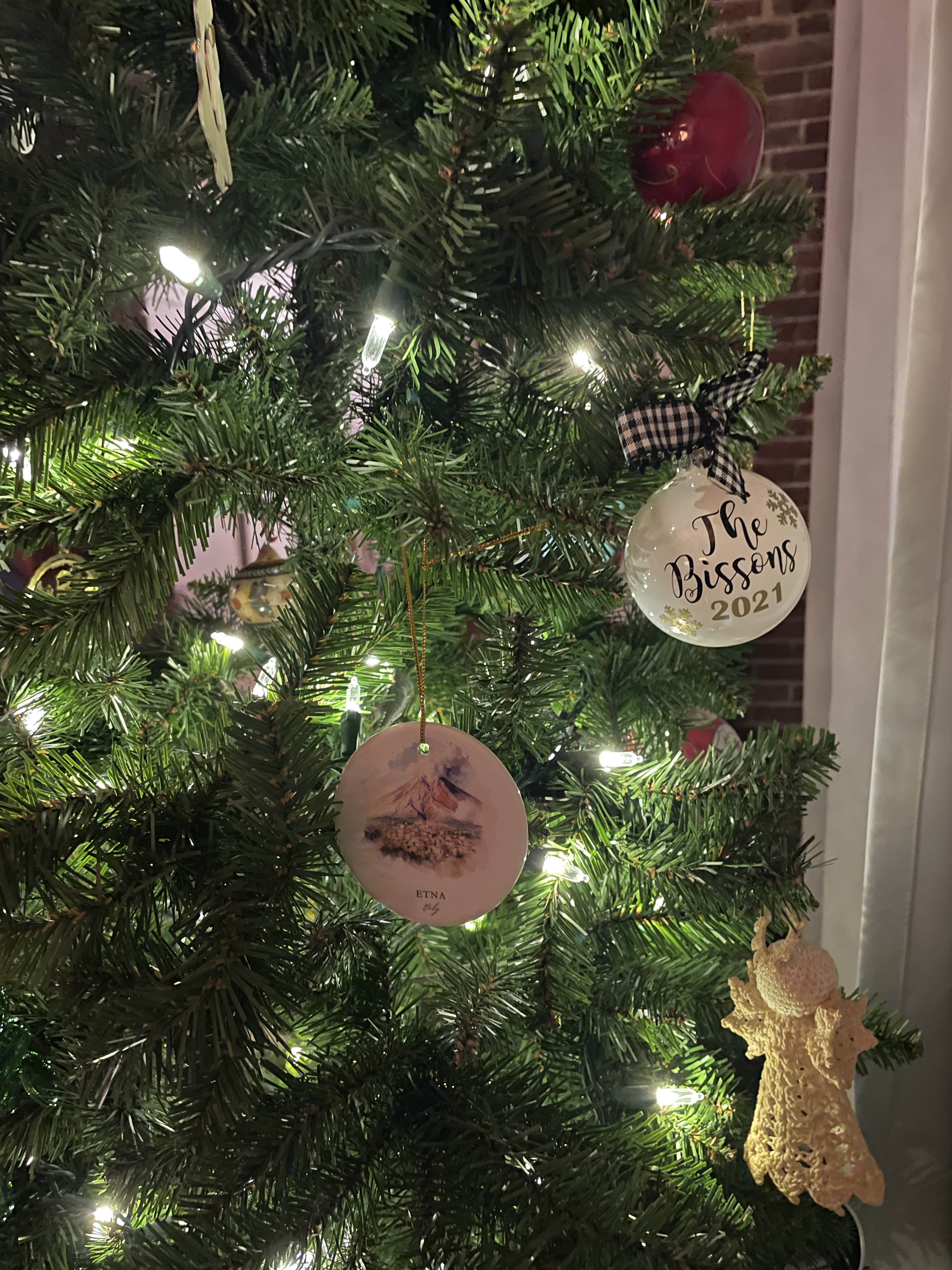
• I’ve been dragging my feet about putting up our Christmas tree. Usually I’m on top of holiday decorating starting with the second Sunday of Advent which has been our traditional tree trimming day. This year? I put it off and then off some more. Finally, today, a week until Christmas, I pulled out the ornaments that we have collected over time and finished trimming the tree that stands in our living room.

    Many of the ornaments on our tree this year are souvenirs of past travel. The ornament we collected this year was from our travel to Sicily, and to honor both our travel and the connection to my ancestry, I chose an ornament depicting Mt. Etna. Unwrapping others – the Eiffel tower, Montreal, Quebec, New England – each ornament stirs a memory of good times exploring and experiencing new places.

    When we weren’t traveling, which has been the case more often lately, we’ve collected ornaments from the places in which we made our home. Our 20 years in Westford, and more recently a spindle from the Boott Mill; all conjure memories of the different eras of our life together.

    Today, as I placed ornaments on our tree, I also hung the memories of some special people who have been part of my life. My dear friend and mentor teacher, Ellen who passed away this Fall gave me several ornaments over the time we taught together. The blue ornament from my friend Gayle, who brought me a beautiful handblown glass ball as I recovered from a serious illness. A pinecone shaped ornament painstakingly constructed by origami, given to me by Maria, a wonderful admin who taught me much about English language learners. There are handmade ornaments from former students that are treasured reminders of my life as a teacher. Touching each one brings back a rush of memory.

    The glass ornament I bought in 1976, the year before we were married. A blue teddy bear commemorating Matt’s arrival in the world. A cross stitch from my Mother. A paper cutout our Matt made in preschool. A handprint in clay from our granddaughter.

    Despite my reluctance to put up our tree, I am glad that I finally did. For just a little while, in place of the troubling world I find myself perseverating about, my mind hovered fondly on better times and cherished friends. And with that, the hope that the magic of Christmas will provide respite for us all.

  • One of the most important things that I felt I should do as an elementary teacher was to encourage children to learn to love reading. Along with the myriad of skills needed to learn the process of reading and comprehending, finding what clicked a child’s interest to learn to read was the catalyst. Interest built the basis for skill which I think is true for adults too.

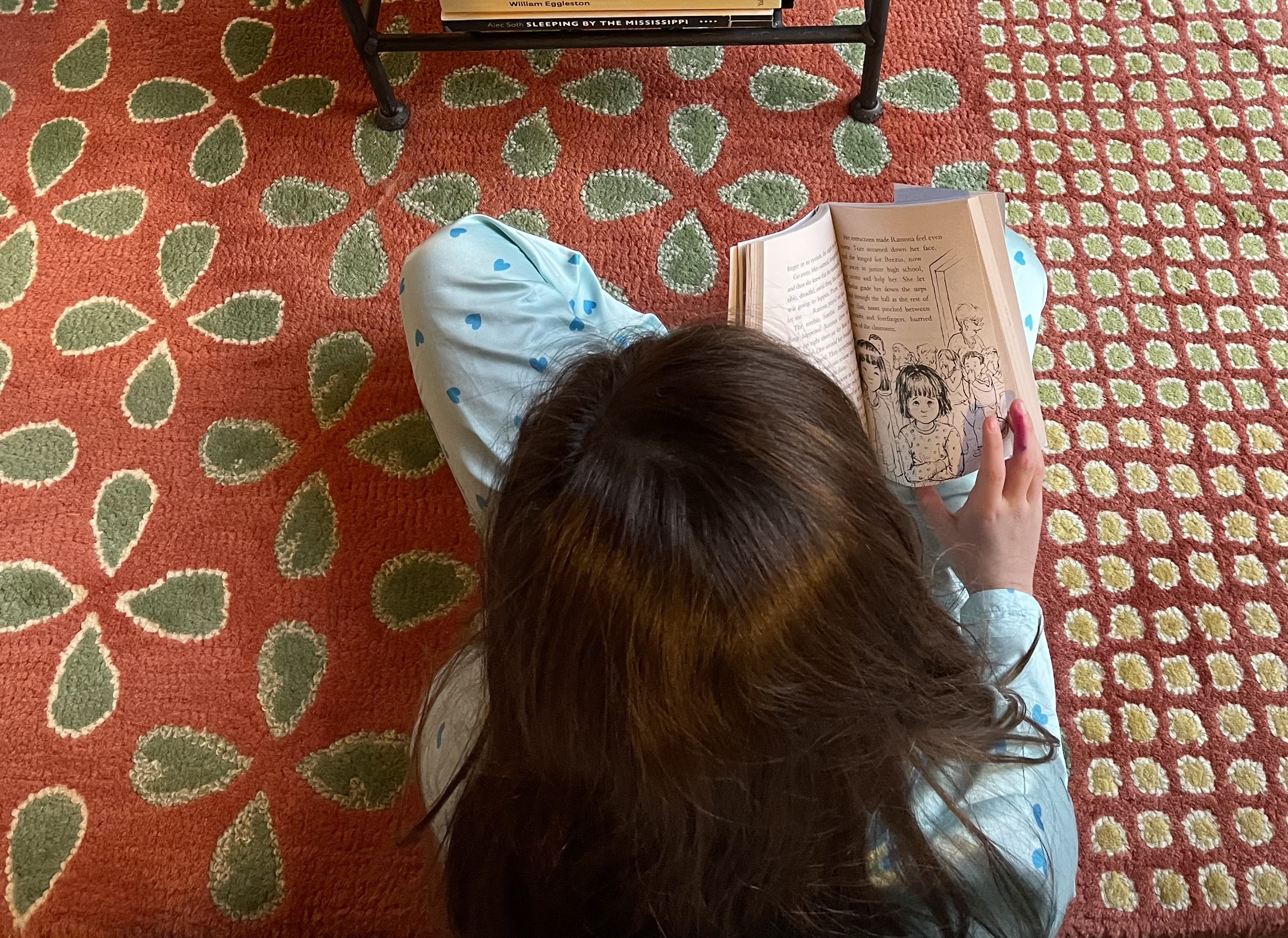
    Our granddaughter, age 7 now, has been immersed in reading and literature since she was born. And now, more independently, she turns to books willingly. Her parents have always encouraged and supported this, which is why she treasures books and reading so deeply. Right now, she devours graphic novels, like Dav Pilkey’s books along with nonfiction books about animals, but she also willingly tries other genres.

    Whenever she is visiting, she heads right for the ottoman where we keep picture books that may have started as read-aloud favorites when she was young. Over time, as she’s learned to read, she often reads them for herself. Our granddaughter always knows there will be a new book to read in the ottoman; it’s become a family tradition to share those with each other.

    This time I tucked a copy of Beverly Cleary’s Ramona Quimby, Age 8 in the stack.

    As a second grade teacher, my partner teacher and the two third grade teachers who were across the hallway from me, used to gather our students in one of the classrooms – the one room with the TV – to watch Ramona every Friday. We’d spend the last 30 minutes of the school week enjoying the antics of Ramona, one of the most relatable and realistic characters in children’s literature. Oftentimes, after being introduced to Ramona and her family through video, students would seek out Beverly Cleary’s books in our classrooms and libraries.

    While sometimes adults may forget what it can be like to be a school-aged and learning to negotiate school, life, and newly-discovered independence, Beverly Cleary does not. Most kids find the appeal of Ramona irresistible, even 40 plus years after it was first published. Negotiating life as a school-aged child seems pretty universal and timeless.

    With some fond memories of Ramona (and Beezus and Henry Huggins) from my active teaching days, I hoped that my 7-year old granddaughter might find a character that was relatable and enjoyable. Given that she finished reading the book before our weekend stay ended, I think she did.

  • Photo by Krivec Ales on Pexels.com

    NYT’s columnist Michelle Cottle’s Op-Ed from today (24 November) should be required reading for the adults in the room. I’ve gifted it at the end of this post.

    As the Trump Administration targets those workers who are willing to work in elder care, options and the care itself become limited. It will not matter whether an elder enters into assisted living, a nursing home, or attempts to age in place with at-home providers, we will all feel the impact of not enough workers for an ever-growing elderly population.

    I worry about this for myself and my husband. We’ve made plans as best we can. But I also worry about this for my mother who currently lives in assisted living.

    The concerns we have are about making sure my parents’ hard-earned savings and the proceeds from the sale of their condo cover the costs of living in a safe environment. This keeps me up at night. Two years ago, when my mother, now 102, began falling and needing more assistance with daily tasks, we convinced her to move to assisted living in a nearby town. Calling this suggestion a hard sell would be generous, and there was much resistance. But after multiple falls, Mom’s PCP, a doctor for whom she had a lot of respect, had a serious sit-down and convinced Mom to agree to move from living on her own and independently in a town 60-plus minutes away from me, the closest sibling, to assisted living with 24/7 care options. 

    This was as rough a transition as one can imagine it might be for someone who has not only lived independently for 100 years, but who also managed my Dad’s care (COPD) until his death 20 years prior. 

    When Ms. Cottle calls out the Trump Administration’s penchant for going after resident green card holders, she does not hold back and neither should any of us. Many of the caregivers in Mom’s assisted living facility have legal status, but I wonder how many of them are in fear of random arrests and deportations. Who will be willing to do this work?

    Caring for elderly is hard work; it’s physically challenging and mentally exhausting. There is the cantankerousness that comes from life not going the way it has always gone before; changes are hard. There’s the loss of independence. There are social changes; suddenly you are eating in a dining room with 50 similarly aged people. Things don’t taste the same and the cooking is almost universally not your style no matter how good (or bad) it might be.

    So yes, I have concerns that the people who are willing to fill positions in care-giving facilities are dwindling, even as the need for more facilities, more personnel are exponentially increasing.

    And then there is the question of Medicaid. Should my Mom outlive her money, what will happen? At nearly $11,000 per month which is the cost for the least amount of support at this facility, what happens when private funds run out? That worry keeps me up at night. As the Administration makes Medicaid more difficult, as placements in Medicaid eligible facilities become more competitive, what will happen to our vulnerable elders if there is no safety net?

    To Michelle Cottle I say, please keep shining a light on these dilemmas. To the rest of us similarly placed, keep speaking up. And to those who have not yet encountered elder care concerns, please read and picture your self similarly situated.

    Read this. Read it slowly and thoughtfully. Imagine YOU are the caregiver in this situation. Whether your elderly relative has dementia, serious illness, or other needs. Who will be there to care for our parents, grandparents, aunts, uncles, siblings? Who will care for us?

    A little louder for the folks in the back: we are all headed in the same direction.

    Link to gift article: We Had No Idea What Was Coming: Caring for My Aging Father

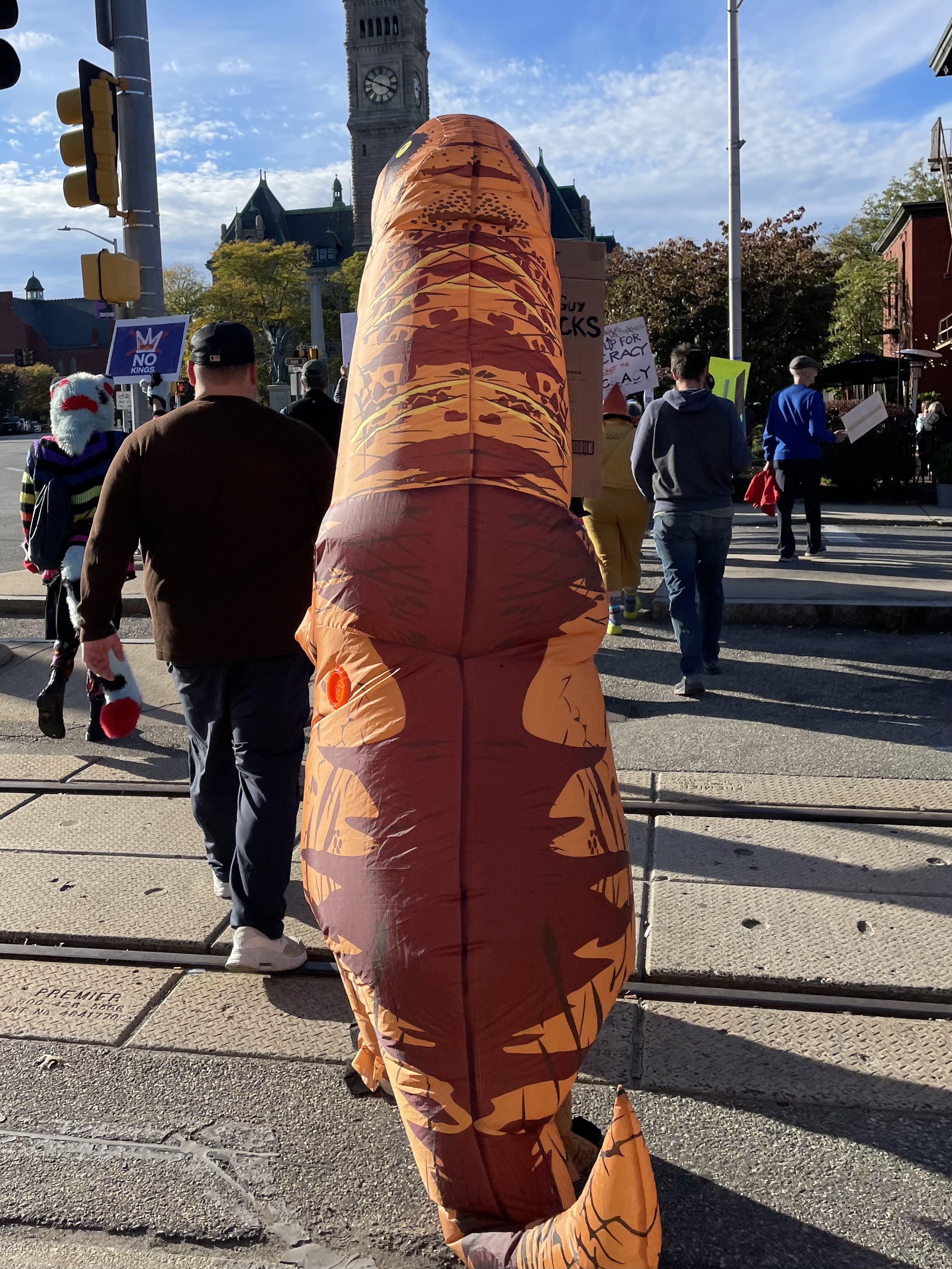
  • After attending rallies like yesterday’s No Kings (October 2025 version), the take-away is that there are a lot of like-minded people who are unhappy with the way things have been going. Here in Lowell, Massachusetts, a respectful crowd listened to speakers, music, and cheered and chanted. Afterwards the group wended their way from Boarding House Park, up Bridge Street, down Merrimack around Arcand and back to the Boarding House via French. Everyone stayed on the sidewalks, which can be a feat by itself, no pun intended.

    I don’t have a clue about the size of the crowd, but by observation, I do know the demographics were wide-ranging. And no one was paid in case you were wondering.

    One of the speakers spoke about one power of a group like this which has, to date, seemed untapped. That is the power to VOTE. A voter needs to have reliable information in order to make informed decisions. And from what I’ve been reading, the act of voting is going to be a challenge in and of itself, not so much here in Massachusetts, but perhaps in other states where the right to vote, the act of voting, is slowly being eroded.

    But, as one of our Lowell speakers stated, what if every person of voting age in group assembled in Lowell along with people assembled for No Kings across the United States, were to vote what would the US government look like today – same or different?

    There’s a very detailed analysis of who voted and how published in this Pew Research Center article. What I have difficulty wrapping my thoughts around is the juxtaposition of election analyses like the Pew Research Center’s report and the number of people who, just yesterday, seemed to be unhappy with the direction of the government. Did all of these people vote? Were they eligible voters, but passed on voting because of frustration, alienation, or another reason? Have minds been changed in the short time the Trump administration and MAGA Republicans have been in power (at this writing that’s 10 months).

    There is a lot to think about in the days and weeks that follow yesterday’s No Kings protests.

    Often many people rightly assume that news sources are skewed one way or the other, and as an avid reader, I feel that much of the time, this is a truth. While I find myself gravitating to viewpoints I support, reading opposing thoughts can be informative. However, often unchallenged information stated as indisputable fact is reported without substantiation. This firehose of information makes fact checking difficult, yet still it is absolutely necessary.

    I do believe that an informed, educated voter might have made a different decision, and if yesterday is any indication, there is a sense that change is imminent. There are many factors of course that influenced this past presidential election, so what would have been most impactful? Would a change in the way our citizens vote have made a difference? Or would it be the need for better sources of news that appeal to younger voters? I don’t know the answer, but I do know that, if the turnout yesterday is any indication, our government does not really reflect the minds of many of the citizens it represents.

    What is one take-away, one action item, I can latch on to? I’m not sure where oldsters like me can be an effective change agent. But being open to opportunities that will transfer the enthusiasm and energy of yesterday’s No Kings rallies and marches is at the top of my list.

    Here’s a place to start: What’s Next? No Kings

  • Fun fact: In my youth and for much of my early adulthood, I was a musician. That was my identity: accompanist, pianist, music teacher. I don’t often speak of it because while I have an undergraduate degree in music, I wasn’t much driven to practicing or the discipline required to be a successful performer.

    However, until recently, I still owned two of the instruments I learned to play, not master: – a Yamaha piano and my open-hole Gemeinhardt flute. I still own the piano; the flute was donated to the local high school where I hope someone is still playing it. My piano, one of the first items Adrien and I bought as newlyweds, was purchased “on time” at what I remember being $25 a week. For two people with zero dollars and not a clue about long-term saving for retirement, that purchase was an extravagance. We did it though and, while currently in sad need of an overhaul, “my” piano gives me some comfort simply by being in our living space. It is a reminder of a time when the often overwhelming frustration at physical limits of talent, brought joy.

    That I have abandoned years of learning to play (not master) the instrument that brought me to a degree in music is something I want to rectify. I have no delusions that the physical limits of playing can be overcome, and I’m certain that some of the abilities I had in my earlier life may never return. Also I have a lifelong allergy to practice. But now, in the last part of my life, I feel driven to return to music.

    To return to this thing that provided a sense of purpose feels increasingly important. And so, I reach back into my love of music as I experienced it. a part of my identity as a human, lost over decades.

    Listening to music, allowing the beauty of sound to wash over me, and digging deep to find my way back to playing music for myself is my way of finding inner peace.

  • Some times, the serendipitous nature of the universe awards you with an invaluable gift of a lifetime. For me, that gift was being partnered with a Ellen Lisi, a mentor long before mentors were “invented”, and a treasured friend. 

    In 1987, my first year as an elementary teacher, Ellen became my partner teacher in second grade. She had been my own child’s second grade teacher, so I already knew something about her. Kind, empathetic, a patient teacher, Ellen was loved by her students. She understood and nurtured those fortunate to be part of her classroom in ways that were fun and welcoming.  And so, when I was assigned as a second grade teaching partner to Ellen, I knew I had won the teaching lottery; little did I realize how Ellen’s influence would stay with me throughout my own teaching career and beyond.

    Mentoring wasn’t an actual thing when I began teaching; a new teacher might truly end up with no one to talk with when things didn’t go according to plan. But sometimes one lucks out, as I did, with a teaching partner or nearby classroom colleague willing to listen to frustrations, dry tears, set an example, even when the newbie has strong, mostly theoretical, ideas. I’m sure some of mine were eye-roll worthy. In that first year, I had the privilege of developing as a teacher from a trusted and respected friend, emphasis on friend.

    Ellen became ill over the last few years and the cruel progression of dementia stole her personality from her family and friends. The loss is deeply felt, but there is consolation in remembrance of things I learned from Ellen. Here are a few that stay with me:

    I learned that back-to-school teacher shopping is best done in a group. Oh how we had fun on our jaunts to teaching supply stores, loading up bags of bulletin board sets and decor!

    I learned that teaching friendships can and should also include excursions outside of the work day. Going to a movie with friends after a long week makes everything all right.

    I learned teachers can laugh at themselves in front of the kids, especially true when the ridiculousness of a moment strikes in mid-lesson. Nothing should be so serious that there isn’t room for humor and laughter, especially at something you, the teacher, have done.

    I learned the importance of accepting help and offering to help when needed. Sometimes a few moments to pull yourself together makes the difference. But even when you need a bit more time, the ability to lean on colleagues is key. We all need to lean on each other from time-to-time just to get through the hard days.

    I learned that freshly picked strawberries are best with sour cream and brown sugar sitting on the back porch on a summery June day. 

    I will miss my friend, more than ever. As they say, may her memory be a blessing. Well Ellen, my mentor and most importantly my friend, your friendship will continue to be a blessing to me now and forever.

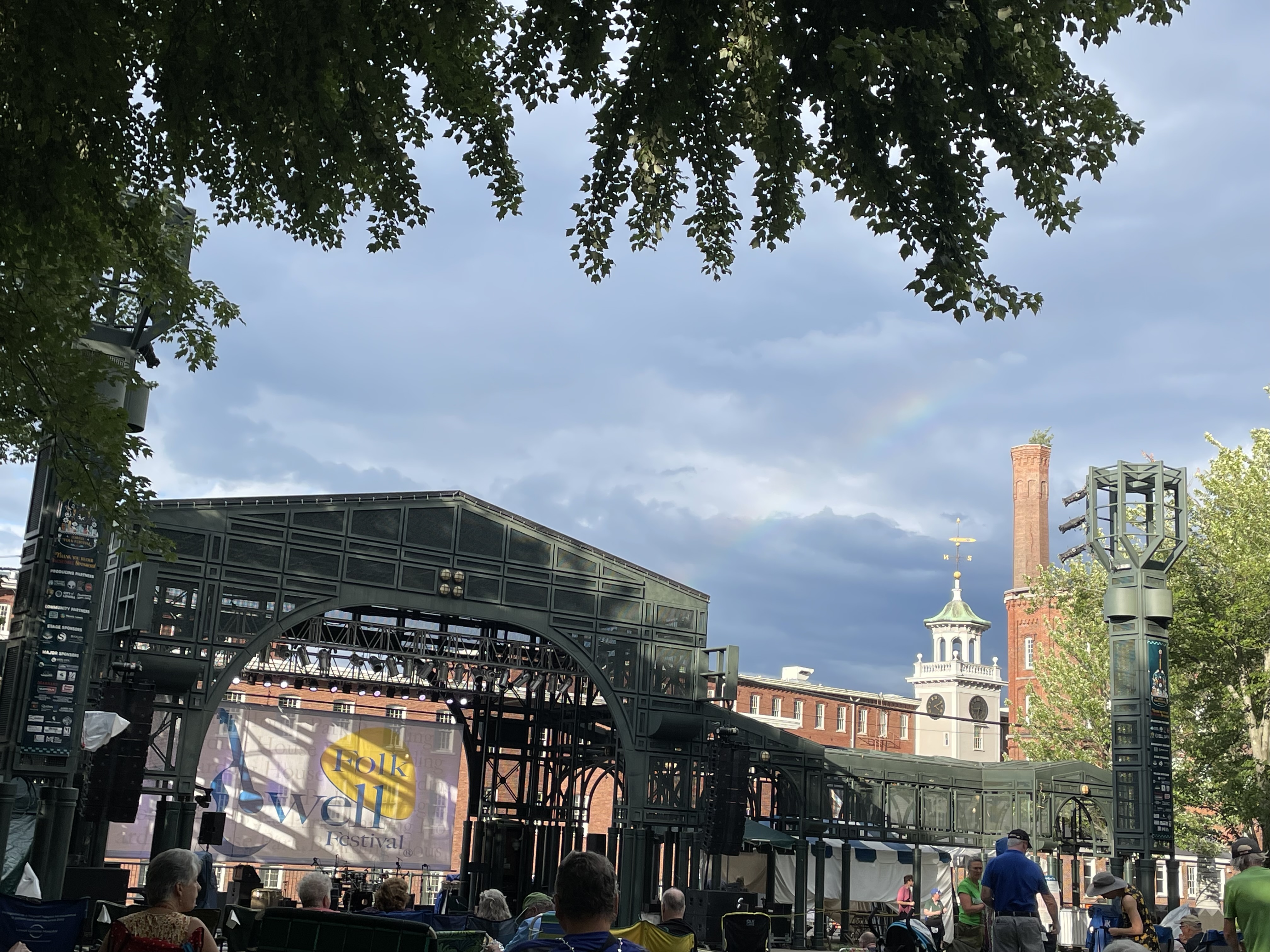
  • It’s the last weekend in July, and for us, that means it’s time for Lowell’s celebration of diversity in music, food, and culture, Lowell Folk Festival.

    Adrien and I have been coming to Folk Festivals for decades. Even when we lived nearby, we’d come for a Saturday or Sunday of music and food. More recently, as Downtown residents – bLowellians since 2014 – we can walk out our front door and take it all in, the “inconvenience” of being penned in by street closures, notwithstanding.

    For me, the best part of this weekend is Folk Fest Friday because while today and tomorrow my “front lawn” will be filled with music and culture enthusiasts from all across the US, Friday’s kick-off feels more local. We run into neighbors and friends that we may not have seen for a while, the crowd is heavy on families with young children, and of course the local political types are out en force.

    Each year the Folk Festival begins with a parade of nations, and for me that’s the highlight of highlights: a visual reminder of the diversity of our community. Many of the parade participants wear ethnic dress from their cultural history; the chanting, singing, and dancing is contagious. We may not always understand each other, but in this moment, there is recognition that Lowell is a special amalgam of cultures.

    Sometimes I’ve been privileged to run into former students, now adults. I’ve been long-retired from teaching, but it has always been special to run in to former students who participate in the Friday events. (Kennis, if you see this, it’s never officially Folk Festival until I see you.)

    Today, in its 38th iteration, the Folk Festival brings over 100,000 people to Downtown Lowell and the Lowell National Park. If you’ve never been, it’s not too late to experience the 2025 version as the Festival is ongoing through Sunday evening.

    Coming to the Lowell Folk Festival is free which makes it wildly accessible and approachable for everyone. Despite the sudden loss of over $20,000 in federal grants for this year, the organizers are pledging to keep this wonderful event going. So when you see some of the hardy volunteers from the Bucket Brigade roaming the Festival, be sure to drop in a buck, or two, or three.

    And be sure to circle the last weekend in July on your 2026 calendar.

  • You’ve heard this one, right?

    A budget is a moral document. We fund what we value.”

    As attributed to Rev. Jim Wallis, this quotation has been on my mind a lot lately. It applies to what happens in local government, in state government, and in federal government. It applies to me too.

    Wherever the origination of this quotation, it speaks to me with an unrelenting voice on this Independence Day, 2025. What do decisions for allocating funds and defunding efforts tell about our values toward humanity? What is supported – and in contrast – what is ignored and unfunded?

    If you know me, you know I spent the majority of my teaching career working in a higher poverty, lower socioeconomic urban school district. To teach and to engage with families in that environment gave me some insight into dispelling myths about families living with food, housing, and healthcare insecurity. Am I an expert? No I am not, but I will tell you that I gained a large amount of respect and empathy for the families of students I was privileged to encounter.

    Poverty goes hand-in-hand with the lack of basic healthcare, food, and the cost of housing. If you’ve not encountered a family for whom food insecurity or housing insecurity is a major concern, you are indeed fortunate. I will never ever forget the young child we discovered was sleeping with her family in a minivan on a nearby street. Luckily, with the aid of a savvy social worker the family was connected with housing resources. Another former student had not ever been to a dentist. Her rotting teeth were not just a dental problem; she had other health issues resulting from the abscesses that had formed.

    Listening to very wealthy people justify cutting their personal tax bill by defunding programs like medicaid makes me wonder about values. It seems more than a bit off-kilter to be protecting and adding to the wealth of a very few when millions of our neighbors cannot, through no fault of their own, take care of their health. Or find shelter. Or have enough to eat.

    The measure of a society’s compassion is how it treats its most vulnerable members.

    Clearly the actions that I witnessed in Congress over the past days show little compassion. The delight with which our Congress heralded this country’s moral document, its budget, has unleashed what will no doubt be painful decisions for many people.

    And so, as my family reviews our own budget, our own moral document, we consider what we can do as well. We do not need more “stuff”.

    On this July 4th, as some in the Congress advocate for ripping away programs that support families in our community, I am recalling that quote from Rev. Jim Wallis. If the federal budget does not reflect my own values, I need to do as much as I can to counteract that.

  • The climb to Taormina seemed endless. At the beginning, the coach passed easily through coastal towns where we could catch glimpses of the sea, but then we began to climb. And climb. And climb until the bus was prevented from going further. A caravan of mini vans took our group of 28 travelers the rest of the distance to our hotel, which was as it turned out, not at the peak of beautiful Taormina.

    For most of our time in Taormina it rained, sometimes softly but often with a vengeance. Despite the weather, the draw to this part of Sicily was obvious: it’s beautiful. And crowded with tourists, even in March.

    In Taormina we learned about Greek theaters and ancient city streets.

    We learned about the power of Mount Etna.

    We learned granita topped with crema and accompanied by a brioche was a great way to start the day.

    We learned it takes days, not hours to make an authentic pizza dough. That last one? That was amusing. My paternal grandfather who left nearby Linguaglossa in 1903 always insisted that pizza was not Italian. Maybe not in 1903, but certainly it was in 2025.

    Nearing the end of our time in Sicily in the same area as my family’s origins created a special connection and emotional connection. So many unasked and unanswered questions and places left to explore another time. My grandfather may never have wanted to return to the Sicily, but I certainly do.

  • This part of our journey brought us to Siracusa on the eastern coast of Sicily. Our stay for this part of the tour was on the island of Ortygia. Connected to Siracusa by bridges, Ortygia is not only a tourist and shopping area, but is also a residential neighborhood. The sea was churning and so, after breakfast, we walked along the sea wall each morning, enjoying the roar of the water.

    Sicily has a very vibrant puppet theater culture, and one of the most famous of these puppet theater companies is located in Ortygia. We were fortunate to be able to attend a puppet show at the Teatro dei Pupi where I understood not a word of the play, but still managed to get the gist. 

    One of my most favorite activities when visiting towns and cities in Sicily was to walk through the open air market in whatever town or city we were visiting. The culture of these markets can be intimidating; some of the vendors clearly are performers trying to get tourists and visitors to part with their euro. It’s loud, it’s crowded nearly all the time, and snaking through the aisles and aisles of vendors is exhausting. But when people ask me what I liked most about Sicily, while learning about the history, seeing the landscape and visiting cultural sites, was unforgettable, experiencing the foods of Sicily is at the top of the list. 

    The weekly farmers’ markets or visits to farmstands in the US can’t compare to the bounty found daily in these open air markets where stall after stall of fresh produce, meats, fish and cheese are arranged to tempt shoppers looking to prepare meals. It is an incredible array that unfortunately is tough to replicate in the US where food shoppers are more accustomed to giant super markets and agri-business.

    In Ortygia the market is quite well-known. On the day that we visited, it was teeming with tourists, of course, but also locals who were buying the ingredients they needed for meals. It was sad to pass up the beautifully ripe tomatoes, or fresh-from-the-boat seafood, so I consoled myself with some peppercorns to bring back home as a reminder.

    While our US love affair with big box grocery stores will never go away, there is one thing I feel drawn to after visiting markets in Sicily, and in Ortygia. I need to prioritize getting my own foods sourced from smaller, local growers.