• School started a week ago.  I can already see the work ahead of us – and that is NOT a reference to academics. This group of students has lots of trouble transitioning, especially outside of the classroom. And there are a lot of them this year – my class size is at what used to pass for the maximum in this district. Any wagers on when it surpasses the maximum? I’m thinking maybe tomorrow is the day.

    In the mix this year – 2 students who are living at shelters for a variety of reasons. I guess given the economic conditions, this should not be a surprise.  One parent that I have been able to conference with told a heart-wrenching story of being forced to move from another state, being forced out of an apartment, losing furnishings…. matter-of-factly, the parent revealed that the family was on the way to pick up furniture from our local WISH foundation (a group providing furniture to transitional families). In another place and time, would picking out your new sofa from cast-offs have been so nonchalantly revealed?

    Domestic violence and the trauma resulting from students who witnessed this violence also impacts a couple of my students. Sign of the times? Another parent reveals the story behind her son’s acting out – the grief in this woman’s voice is palpable.

    And of course there are the “usual suspects”. Students for whom academics are challenging, for whom language acquisition is in the beginning stages, students whose self-worth has been wounded nearly beyond repair.

    This is the group that has been thrown together. We are working at attempting to become a community – a caring, sharing community of learners.

    So far figuring out the puzzle has been more than a bit challenging for me; the pieces that need to be in place are not there yet. We are working on it, but it will take time. Before we can begin our work on the curriculum, we need to build our community. There is simply no other way.
  • With the Common Core Standards, we — that means teachers — are bracing for new and improved standardized testing.  An article in the Boston Globe this morning (link here) floats the idea. MCAS may or may not be replaced by a new Common Core test, presumably aligned to the new standards.

    If you read the story, take a close look at Paragraph 4. Yes indeed, the vision for the new test is that all students will take the test electronically.  Ponder that for a minute, does anyone else see a problem?

    I teach third graders. I know younger people do not have the same adjustment to reading directly from a computer, but developmentally speaking, I just don’t see 8 and 9 year olds being able to focus on a screen, read the test, scroll around, scroll to the question, in a perfect world scroll back to check for accuracy of the answer chosen, click, and repeat ad nauseum. And that’s just a reading based test.  Let’s talk about math.  I’m picturing lots of guessing because using a scrap paper to figure something out accurately will be too much. Eye-hand coordination issues? Tough darts.

    So that’s just the developmental/mechanical issue.  I suppose that the expectation might be that teachers practice the mechanics of electronic test taking. So now we should teach taking the test?

    Then there’s logistics.  I have one aging iMac in my classroom, 2 if you count the one I use for personal work and to connect for demonstrations for the larger group. So with a classroom of 24 student – normal for my district – I can accommodate 2 students at a time while the rest of the class does….. what? We have a lab – without an Instructional Technology Specialist this year due to budget cutting. Now one entire classroom of students could take the test at a sitting, but they are right on top of each other. And we have 8 classroom vying for computer time – 4 thirds and 4 fourth grades.

    Don’t even begin to think about technology failures.  ALL of the equipment, even the latest and greatest in the lab, is subject to failure: network, electronic, power. I believe there is ONE network guru for the entire system’s multiple elementary schools. So when the system goes, or as happened yesterday, equipment is slowed to the point that a screen refresh takes 60+ seconds, that won’t affect the testing?

    Keep reading this article and you’ll probably discover more. The Commissioner of Education also floats the thought that the new Common Core exams could be used to progress monitor student achievement in addition to MCAS.

    Maybe the first and second grade teachers won’t mind taking over the third grade curriculum so we can get all this testing accomplished?

  • The first weeks of school, as every teacher will tell you, are spent setting up and refining routines.  I find our school’s decision to use the principles of the Responsive Classroom provides lots of guidance and reminders on building a classroom community.

    This morning, I watched a refresher on one of the most basic of routines: moving through the hallway. This video of Caltha Crowe talking, modeling, and practicing transitioning in a hallway reminds me of the essential teaching that takes place those first days: watch here.

    Teaching students acceptable routines for behavior in school (and out!) is an immense undertaking. Explaining the reason for the rule, engaging students in the rule’s creation, modeling and practice-practice-practice — all is exhausting during those first weeks when we, too, are getting used to a more structured routine.

    Is it worth the time and effort? I believe it is. Whenever a class routine disconnect happens, I can usually trace the problem back to the source – me! I wasn’t explicit, I didn’t provide adequate modeling or practice.

    And the process will begin next Tuesday at 8:30.

  • I’ve been at this for 23 Fall startups now and I’ve yet to find the “perfect” room configuration.  Over time, I’ve managed to get the task of setting up – at least for Day 1 – down to a two-day affair, but it is not without angst.

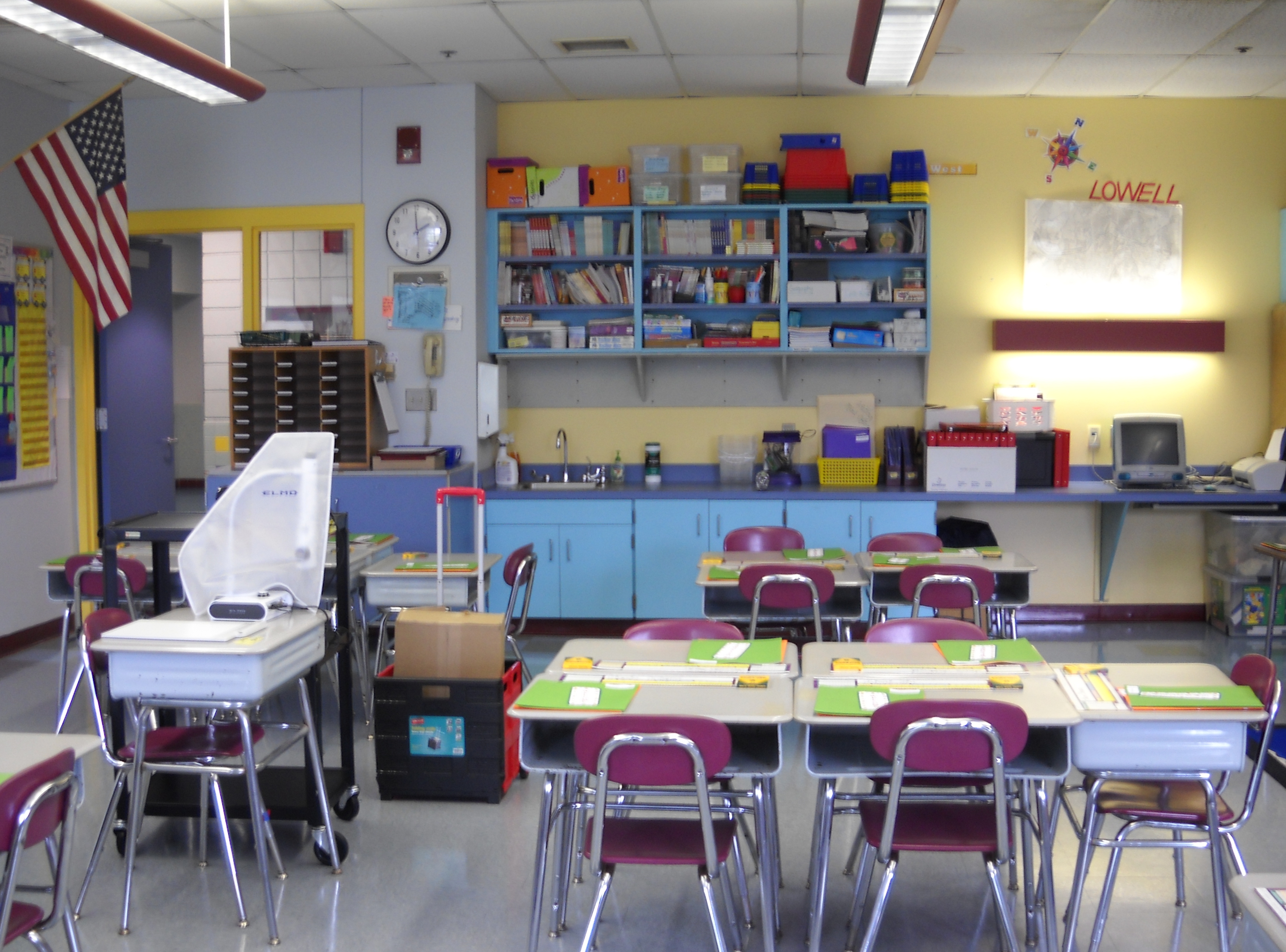
    My students do not sit in rows – they never have. I’ve been an early adapter for collaborative or cooperative learning and have just never let go of those concepts.  This year I have 24 students on my (current) roster. That number will probably not be the final count of students. I currently have 5 groups of 5. While that’s not an ideal configuration of students in a group, I dislike have so many clusters of desks around the room that the walking flow is impeded. Here is a wide shot of how the desks are arranged at present:

    The desks for the students are arranged in the front 2/3 of the classroom space. This year I have an ELMO and projection equipment to include for whole-group lessons or for sharing examples of student work.  The classroom already has a pull down screen at the front of the room over the white board.  Off to the side there are some shelves and cabinets for storage and a sink (big smile).

    At the rear of the room, opposite the white board, I have placed 5 2-shelf units that comprise the Leveled Library for the classroom.  There is a tack board above these shelves.  In this area, I have a large gathering rug, a sizable rolling easel,  and a rectangular table (doubling as extra small group instructional space and a listening center area).

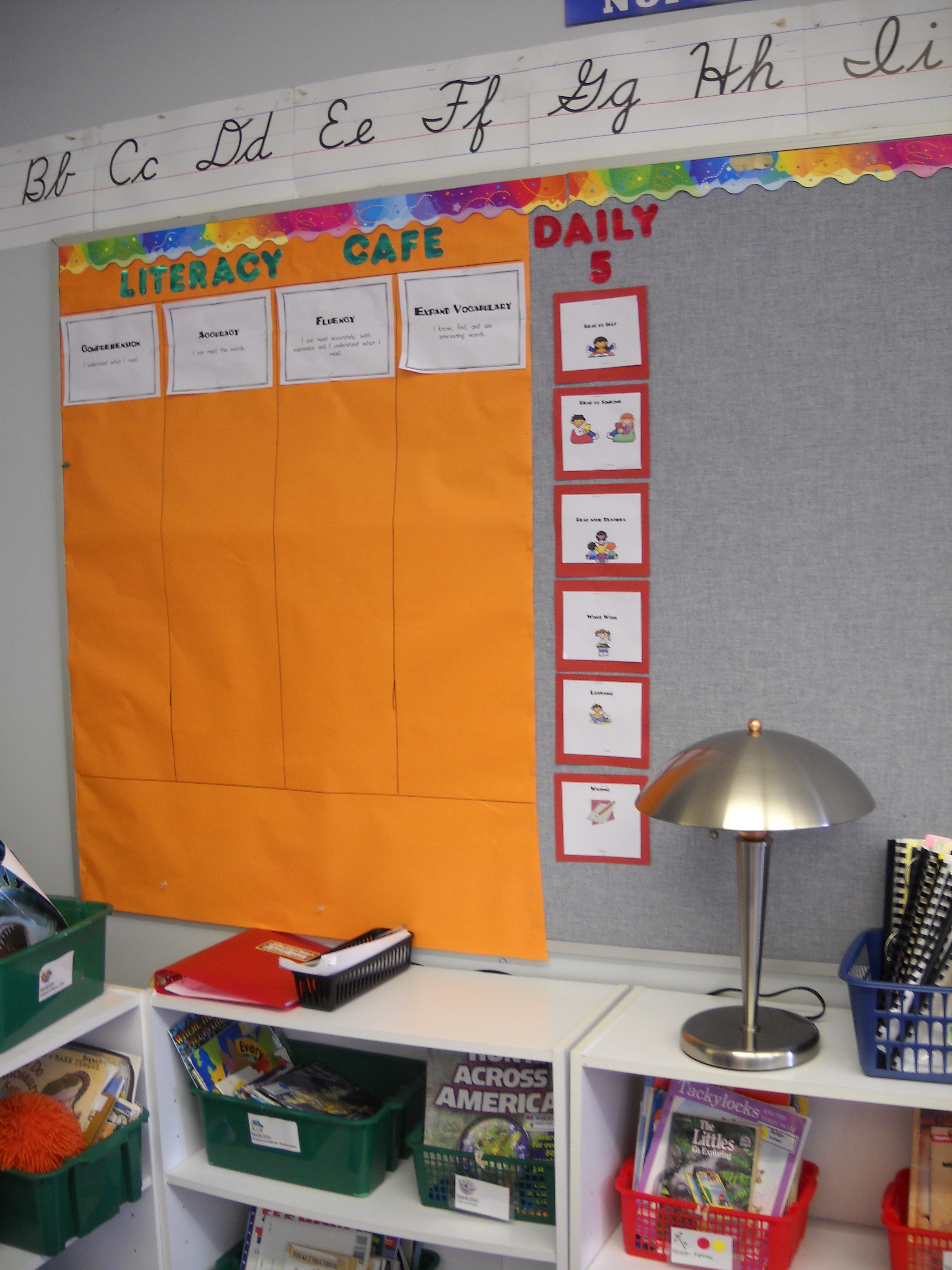
    The alphabet chart is above this board. I generally have the students help decide where the wall displays are going, but in the case of the alphabet chart – a royal pain to hang on a good day – the decision is fait accompli. This year I am implementing the Literacy Cafe along with the Daily Five as a management tool. The Cafe strategy board is to the left of the image.  I’m still struggling with where to put a Choice chart for students.

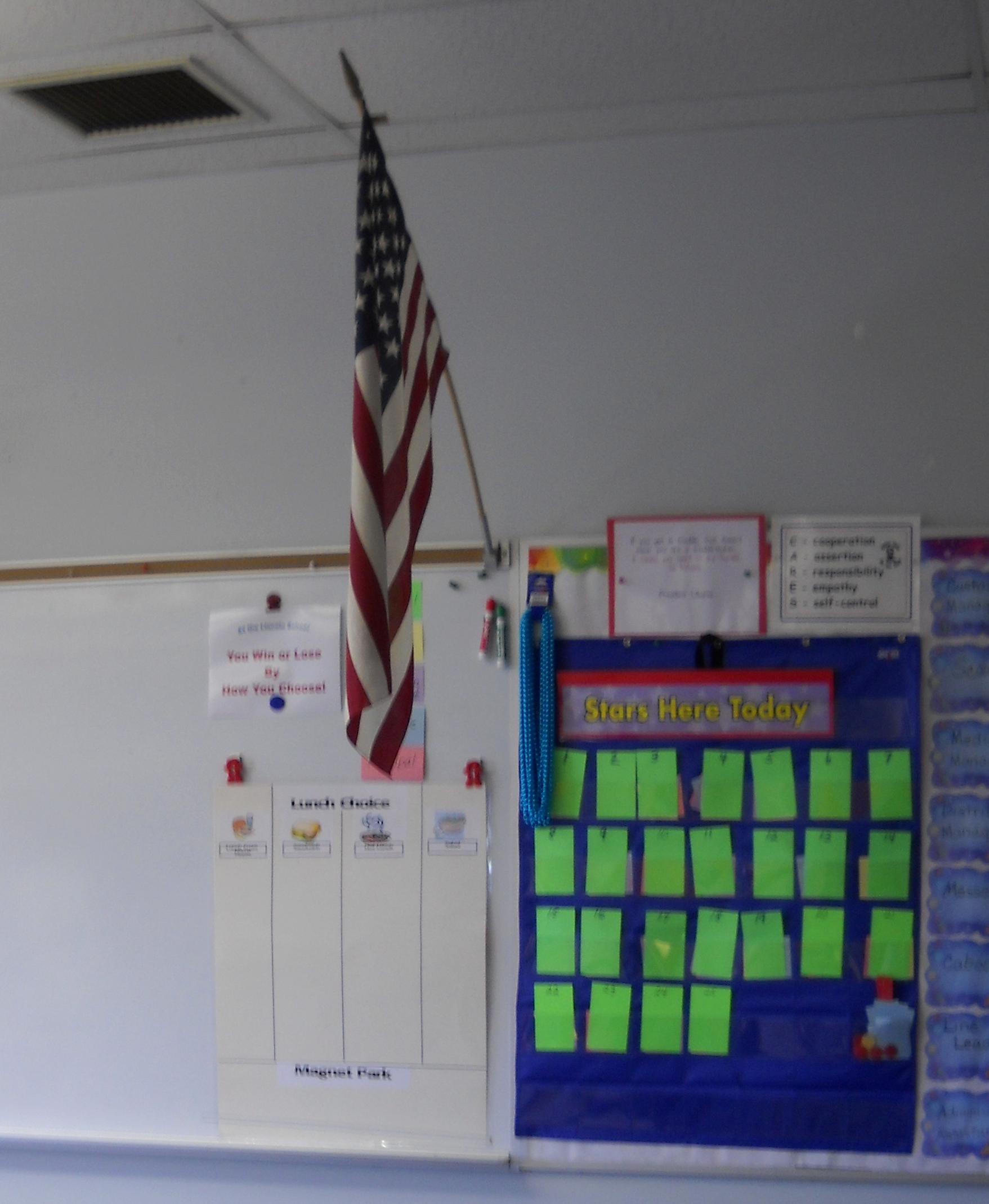
    Another important area in the classroom is our Behavior Tracking area near the exit door.  This is a spot for students to monitor their behavior color and it is also where the daily schedule will be posted.  To the left of the behavior chart is a lunch choice board. Students are expected to make one of 4 lunch choices as they enter the classroom by placing a personal magnet under the choice for the day.  This choice board doubles as an attendance check-in for me.  If the meal magnet hasn’t moved from the ‘parking lot’, then the student is absent – otherwise I get to choose lunch for them. Since I teach Third Grade, this routine is pretty reliably run by the students.

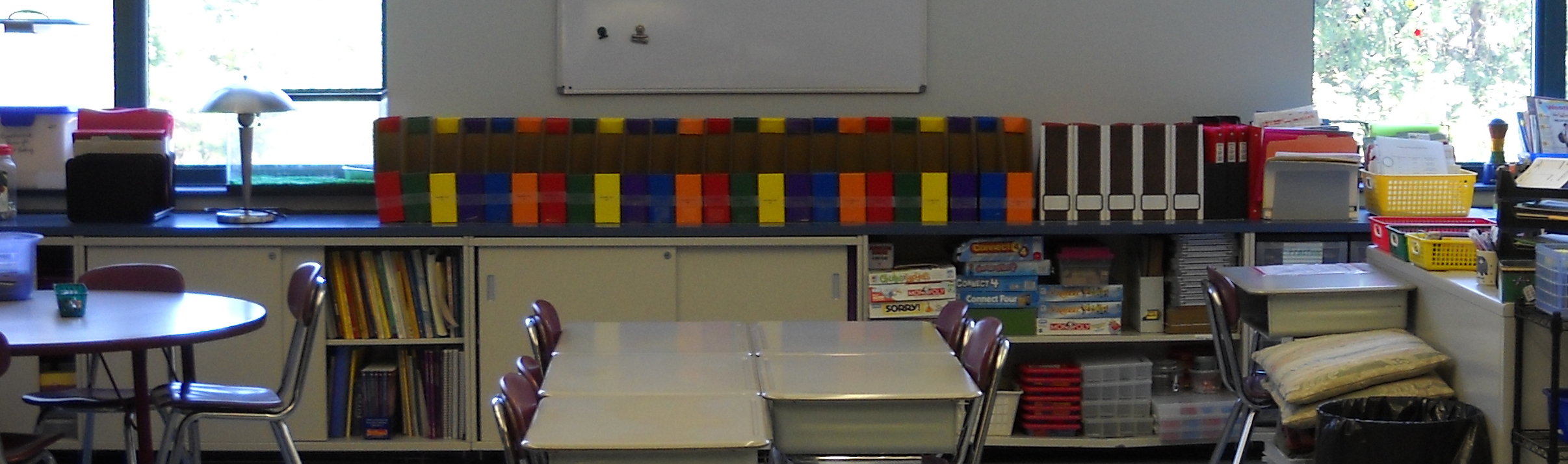
    I use magazine boxes to store students’ reading materials. Those boxes are stored on the counter top between the classroom’s windows. When it is time to begin reading activities, student retrieve the magazine box and keep it on the floor next to their desk or wherever else they may be working during Reading Workshop.

    So will this work? I sure hope so. I keep my requirements pretty simple:

    1. students need to have the ability to work in groups
    2. clutter, especially mine, is keep at a minimum – the space needs to be clean
    3. traffic flow is easy and everyone can be visually monitored

    Now for the test: students arrive Tuesday and we will see how successful this room configuration is.

  • I’ve put it off for nearly as long as I dare. It is time to start getting ready for a new school year. Completing my list for summer has suddenly kicked in to overdrive: there’s still much (re)painting to complete, sorting and throwing to do, cleaning and gardening/landscaping. But suddenly, there is a pressing need to squeeze it all in quickly — the students return in about a week.

    I used to get pretty worked up about starting room preparations as soon as we turned the calendar to August. This year for the first time in my career, I’ve managed to make it all the way to the last 10 days before school begins. I suppose that’s growth. Hopefully it’s not burnout.

    I love what I have chosen for my life’s work. But sometimes, more often now than in the beginning of my career, there are far too many experts telling me how to do my job. And demanding proof that I am doing it. This week,  I am in the processing of completing my self-assigned professional reading: The Cafe Book by Gail Boushey and Joan Moser – better known as “The Sisters”. Reading this book is helping me to find the balance between all the frenetic demands made on teachers today and a calm and purposeful learning experience for my students. Here is a quote from Debbie Miller that the Sisters included in their book (page 60) which caused me to sit up and take notice:

    …when getting done takes precedence over the doing, when finishing becomes more important than the figuring out, we’ve lost sight of why we became teachers in the first place. (Miller, D. Teaching with intention: Defining beliefs, aligning practice, taking action, Grades K-5. (2008). Portland, ME: Stenhouse. p 106

    As I read and reread Debbie Miller’s words, I realized that this is what has been causing me unease with what I do. In the rush to turn in this, that, or the other evidence, I have lost my bearing: why I am a teacher. I chose to teach because I believe that it is important to give every child the opportunity to soar to heights neither of us imagined possible. I do this on a selfish level because, when that moment of connection happens, when child and teacher both realize that something wonderful has happened, it is the most exquisite of emotions that makes all the hard, hard work worth everything.

    This year, my personal goal as teacher, will be to refocus on why I teach, to not let outside forces undermine why my students and I are here, working together. And if I let some of those demands for evidence slip, if I’m late with something someone somewhere wants in order to show that I have been working, that is what will be.

    You can find me here in Room 207 helping my students figure out how to take the next step in their learning path.

  • One of the ongoing creative projects Adrien has been working on is photographing some of the farmers working and learning through the New Entry Sustainable Farming Project. We receive a weekly share of the farmers’ bounty through World Peas CSA and, so far, it has been a wondrous adventure in fresh local veggies – and fruits.

    This morning, Adrien set out to try to catch up with some of the farmers working their plots in Dracut. And, in my new role of photography assistant, I went along with him. Near Richardson’s Dairy, where many of the new farmers work, we met up with Justine, a farmer who immigrated from Cameroon.  Justine was a bit unsure of us at first – who wouldn’t be at 7 in the morning! – but remembered Adrien from an earlier introduction by McKenzie Boekholder, a coordinator for New Entry Sustainable Farming.  Justine also remembered that Adrien owed her a photograph ;-).

    Adrien convinced Justine to pose for him near her plot. She was very tolerant of both of us interrupting her morning chores. Here is one of the shots from this morning:

    Photography by Adrien Bisson Photography

    One of the most fun things about this morning was the friendliness we were shown. Justine clasped my hand and walked us to a covered framed building. She not only insisted on giving me a beautiful bunch of collard greens, freshly picked before our eyes, she gave me directions on how to best prepare them for tonight’s supper. I’m hopeful I won’t screw it up!

    Meeting new people and learning about where my food comes from is turning out to be a wonderful adventure. One that is full of reminders of the generous goodness of humanity.

  • Maybe it’s been around for a while and I’m just catching up on my reading, but I just learned about a new “tool” for students. Lucky for my budget it won’t cost anything more than some manila file folders, tape, and time.

    The new tool is called the Mini-office. I was intrigued by the term when I went Googling for literacy stations after reading Debbie Miller’s Practice with Purpose. I like the thinking behind a mini office: the most often used or referenced tips – in my case for Writing – are posted strategically on the manila file folders. The folders are arranged to form a three-sided display keeping those tips right within eyesight of a student. What I like about this tool is that, depending upon the writing project, the references posted on the mini-office can be customized to fit the writing or generalized for any writing.

    Mini offices are on my shortlist of ideas to try out this Fall. Now to think about what essential information will help my students.

    Links for Mini Offices:

    Busy Teacher Cafe

    ABC Teach

    Teaching Heart

  • Summer hiatus is a challenge for me ; I am compulsively obsessed with education. However, this summer I have made an effort and, until today, have left my pile of things to consider in a far corner of our spare bedroom.

    This week, the Massachusetts Board of Elementary and Secondary Education approved implementation of the National Standards. Standard based education – and the testing that goes with it – is nothing new. We’ve been working with standards for years. The new standards – like it or lump it – will be tied to testing and most likely funding. Isn’t that the SOSDD?

    There seems to have been a lot of debate about the merits of adopting the National Standards in Massachusetts. I don’t know for sure because 1) teachers are seldom invited to be part of the debates, and 2) most of this happened in the Spring when teachers are too busy with actual teaching to engage in investigations of new standards.  That would leave the politicos and “think tanks” to debate the merits. And despite the predictions of watering down the education (and testing!) of students, the Board adopted the National Standards.

    So, we in Massachusetts, have something new to consider. As a grade level Math Lead, I downloaded the National Mathematics Standards for my grade level (thereby breaking my summer hiatus) and to be honest, they seem to be exactly what we focused on with just the Massachusetts Curriculum Frameworks . This is hardly a surprise. The Massachusetts Mathematics Frameworks have historically been based on National Council of Teachers of Mathematics (NCTM) Standards and, if what one reads in news outlets is correct, the National Standards are heavily influenced by the Massachusetts Frameworks.

    Some who oppose(d) the adoption of the National Standards have predicted that this will mark the end of MCAS testing. Puh-leeze. If a single high-stakes do-or-die test is done away with in this state, I’ll fall off my chair. MCAS or something resembling it (and possibly dictated by the Feds) is here to stay. For those who think that a single test tells whether or not a child has a good education, whether or not a teacher is qualified, whether or not real estate can fetch top dollar because students score well (oops, let that little piece of sarcasm slip), relax! We can and will continue to spend inordinate amounts of time testing the students.

    So what is all the uproar about? Maybe I’m missing something, but what I’ve seen doesn’t appear to be education Armageddon.

  • This is a quote from John Muir who advocated for preserving the natural beauty in our country.

    Every so often I need a head slap from nature to gain back perspective.  Last week, I was lucky enough to do just that when Adrien and I traveled to Mount Desert Island for a mini-vacation. The Island, long a summer destination, is the location of Acadia National Park.

    The first item on my bucket list was to be at the summit of Cadillac Mountain for sunrise. Cadillac, being the highest point on the Eastern Atlantic Seaboard, is easily reached by foot or by car. Obviously at 4:30 am – the time we would need to start out in order to be on the 1,532 foot summit for the sun’s morning appearance – car travel would be my preference over a hike over unknown terrain in the dark.

    We arrived just as nature was getting ready to put on the show. Even with 50 or more people at the mountain top (and no small percentage of them with camera equipment), we were easily able to find a spot on the bare rocks so that Frenchman Bay and Bar Harbor stretched out below us.  The air was still damp and chilly even though it was July, and most people huddled in heavy sweatshirts or fleece jackets. Some had the foresight to bring coffee.

    A continually drifting blanket of clouds and fog enveloped us while, visible mid-horizon, a swath of puffy cloud stretched horizontally.

    First view from Cadillac Mountain.

    Then bit by bit, the hue of that cloud changed as the sun began to make its presence known.

    Minute to minute, the sky changed its hues from cool blues to warmer, oranges and pinks until at last the sun washed us in the first light of July 16th.

    In that moment, watching the universe play out its opening scene as it

    has for millions of years, the grandeur of the morning overwhelmed me. How precious is this gift of time on earth! How glorious a greeting the sun gives the mountains!

    we are washed in gold.
    And little by little
  • It is no secret that politics in the United States are a puzzlement to me. Things I believe in – the common good, generosity and understanding in treatment of those who are not like me, a belief that freedom is a treasure that should not be eroded – these things are often not valued, if one can believe what gets reported by the fifth estate.  Can the media today be trusted to report on the facts, to dig deeper than the public relations of a situation? It is all so confusing, and often discouraging. Often I don’t know what to make of things.

    Last night, however, I was watching a program on the History Channel about the Revolutionary War. As a matter of fact, this program was in the middle of the series and mostly what I learned was about how the United States came to have any kind of government at all.  Post 1776 was a chaotic time; a slight change would have taken this country down a different path.

    As you might expect, the emotional fervor with which colonists became part of the Revolutionary War turned into a “now what?” situation once the outcome of the the actual battles became apparent. By 1781, Cornwallis had surrendered to General Washington, but an actual Peace Treaty with England would not be signed until nearly a year later. The Continental Congress would form a government which little by little gained recognition of other countries – first Spain, then Denmark and then Russia. It must have been quite difficult to fly in the face of England, a world power, in support of this newly formed United States.

    Obviously everyone did not give this new United States much of a chance for success.  In fact, in 1783, General Washington had to persuade the remains of the Continental Army not to rebel against the newly formed government. When I consider all that happened after the battles, after the Declaration of Independence, it is a miracle that this country indeed exists as it does.

    So how does this history connect to the current state of affairs? For me, it is hopeful that over 200 years ago, despite all that could have gone awry, the United States came into being. It became the great and welcoming country to my ancestors, the country where differing views could be tolerated, where it wasn’t a crime to think – and to say – what you believe.

    The United States is still a place where you can disagree and not end up in jail. And despite the discomfort with some of the politics of our time in history, I am glad to be here in the United States. If our country could endure the chaos of its beginnings, then there is hope. Hope that we will speak out when personal rights are challenged, hope that we will speak up against wrong and not just accept what is reported by those who may have an agenda. And hope that we will continue to be that welcoming place for all.

    Happy Fourth.