• The local newspaper, the Lowell Sun, seems to just love to stir up the locals  by telling about half the story – if that.

    Normally I don’t read this rag – reading inflammatory and sensationalized news is not how I care to spend my reading time. However, this morning, we were having a discussion about who was running for elected office in Lowell (outsider, can’t vote, but still interested); I heard that there were candidate statements on the Sun’s website and went searching for them.

    However, I was stopped by an article claiming that the UTL – the local teachers’ union to which I belong – had categorically rejected a 3% raise offer made by the school committee at the last negotiation session. I stopped dead in my tracks as I read the anonymous contribution by a school committee member who a) asked to remain anonymous and b) was violating executive session by speaking to a reporter.

    What kind of a moral compass must someone have when that same person has agreed to the rules of executive session, but violates that trust by speaking to a reporter and “sharing” — by sharing I mean telling only the part of the story that makes one look good to the electorate? Is there an agenda here?

    The Sun tried to get a comment from the UTL  president who took the moral high ground and would not comment. The reporter also asked another school committee member who also refused comment citing executive session. Thank goodness for people who operate under acceptable behaviors and do not hide behind “anonymous” super secret conversations with a reporter.

    As a union member, I know that this is not about money alone. That much has been shared with the general membership. There are other issues – issues that probably wouldn’t sit too well with the regular Sun readers if their employer tried to pull the same stunts. But I do not know the exact conversations – I am not a negotiating member, am not privy to detailed conversations held under executive session, and even if I were, I would not stoop to violating those executive session expectations.

    Too bad anonymous didn’t have the intestinal fortitude to say what they wanted to say without the cloak of anonymity.

    The local paper posts what suits them in order to sell newspapers.  Their agenda is their agenda. And I don’t have to read it – even online. Will I ever learn that?

  • It’s a time of year that I dread and a time that is necessary. I am a breast cancer survivor. A yearly mammogram is not an option, it is a necessity. Some bean-counter in a medical or insurance facility, far far removed from real humans can designate my mammogram as a “screening” all they want. It is a stress-filled hour when I relive the moments 20 years ago when I first learned my body had betrayed me. For me, it is an hour of fear.

    I rely on the reassurance of that first radiologist reading to quell the demons that cause my mind to race ahead with the what-ifs. What if they find something? What if it IS cancer again? What if I have to endure chemo again? What if I don’t make it? Maybe this is self-indulgent. It is what it is on mammogram day.

    This year, the empathetic technologist offered that I could wait – even though I was “just” a screening – for the radiologist to read the mammogram. I understood that waiting would mean that there could be others ahead of me; I had a book, no problem. She even came into the waiting area about 15 minutes later to tell me that there were a couple of people ahead of me. “Not a problem” I responded.

    Imagine my surprise 5 minutes later when another technician – who seemed to be overseeing the Friday afternoon events, asked me to step into a next door room. With her finger shaking at me, she told me I shouldn’t even be there, that I might have to wait another 45 minutes. There were people ahead of me. If you’ve ever been called into the principal’s office, you know exactly how I was feeling.

    I explained I understood that, I had no intention of bumping other patients and I didn’t mind waiting. Apparently that was not satisfactory because the next thing I was told was that it was late, the facility was closing soon and that my mammogram may not even be read. I shouldn’t bother waiting. Has the medical world changed so drastically that even the doctor is “on the clock”?

    This insensitive woman then went on to lecture me about making my appointments early in the week and early in the day. That did it.

    I cannot come during the day, I teach. I also don’t care to have anyone outside of my family speculating about my personal health issues (already experienced that when I was on chemo) so I do NOT make medical appointments during the school day.

    The fact is, my original mammogram – the one when the cancer was found – happened in June, right after school had gone on hiatus. Due to our crack medical system in this country – the one where yearly means 365 days + 1 and where diagnostic facilities are so overloaded that you cannot schedule appointments conveniently, my “yearly” mammogram has slipped from year to year until it is now 3 months later.

    So when I get accused of princessing up because of the time of my appointment interferes with getting the weekend started, I take offense. Lucky for me, my internal medicine doctor is in the same building. I was able to walk up to the office and, reduced to tears and barely able to speak, told my story.

    I hate that my one bout with serious illness has changed me so that every change in health, every “routine” diagnostic sends me into a panic.

    Is it possible that our country’s medical system has become so insensitive that professionals on the front lines become so concerned about quitting times, that they don’t notice the human in front of them.

    Has the US healthcare system been given the assembly-line, CEO, best business practices overhaul? I am afraid of the answer.

  • Caught a news article in today’s Boston Globe – which you may or may not be able to read depending on whether or not the Globe is instituting its $16-a-month subscription fee.  Here it is, just in case: State aims to test its youngest students (October 2, 2011).

    I’m relieved to hear that this is not an “early MCAS”, that kindergarten students won’t be tossed out of kindergarten (really? that was on someone’s radar?), that Kindergarten students won’t have to fill in bubble sheets or write essays.  If the Globe article is correct, the assessment will be used to determine what resources early childhood students may need. And while this is laudable, I agree with the Boston Public Schools director of Early Childhood education – we already assess students quite a lot – in Boston’s case, there are 14 other assessments; is there really a need for another? It appears the answer is in making the state eligible for grant funding offered through RTT…. hmmm, is that reason enough to put 5-year-olds through another battery of tests?

    The Globe article continues to point out that 3rd grade MCAS scores are flat; that scores in high-poverty cohorts haven’t improved much.  Well, there’s a shock; and here’s a factor that won’t require anyone to test a 5-year old. Poverty and the traumas students deal with are a gigantic factor in whether or not students in the urban school districts cited as not performing can test as well as more affluent peers.

    You see, when you come to school hungry you can’t think. When your family has been kicked out of your apartment, when the power is turned off, when the world around you is one big sh**storm, you probably won’t do well on a standardized test. Dare I say that test-taking may not be the most important part of your day?

    Until we get serious about providing a social safety net for those who are most vulnerable, you can test kindergarteners, third graders and any one else you want. The results will be the same – and all that will be accomplished is that a company who writes and provides scoring for a test will get rich.

  • Last week, we created our last I-Chart; the one for Listen to Reading. So now we have all the components of the Daily Five in place. It’s an exciting yet frightening time .It has not always been smooth sailing. I find I have to keep pinching myself as a reminder that one of the most important parts of the Daily Five is that the responsibility for our classroom environment, for developing independent learners, is for me to give up control. Kind of a challenge for an obsessive, compulsive control-freak.

    This week I’m identifying some of my barometer kids – I have 3 – those kids who have difficulty maintaining stamina and who need to build their independence with smaller steps. Each of these children have difficulty throughout the day with attending/listening; their hands are always in motion (I’ve never seen a third grader disassemble a pencil sharpener before!). This is going to be a challenge.

    Now with all the components in place, it is a matter of logistics -though  my students concept of time is somewhat off reality. What some students feel is about 20 minutes – the time I would ideally like them to spend Reading to Self each day – falls somewhat short; the students like to move through all five choices. We are working through the intermediate Daily Five structure and some days there isn’t enough time to complete 5 activities.

    What is gratifying is to have students choose to read, choose to write. There is a subtle change in attitude that makes all the hard work we have been doing to build independence worthwhile.  There is a lot of work we have to do yet, but the Daily Five is making a positive difference in transferring the responsibility for learning to my students.

  • We are still laying down the routines and expectation for the Daily Five. Here’s how my morning goes: Get up (usually before the alarm), start coffee, sit down with my laptop, check email (and Facebook, okay I admit I’m addicted) and then watch one of the Sister’s videos on the Daily Cafe website.

    Most of my students – with the exception of two who are exceptional in that they have significant developmental delays – are able to sustain 15 minutes of Read to Self  followed by 15 minutes of Writing.  I don’t suppose it is that unusual at this point in the year to find my students can sustain stamina for nearly 30 minutes for the first choice session, but the stamina in the second choice session  is about 2/3 of that.

    There are a few glitches. I can hear my students using Check for Understanding when they Read to Someone. But the voice levels are so loud – or at least I think they are. Coming from a background in constructivist mathematics where the classroom can be a noisy place, I am torn about stopping and restarting the students – they are talking on topic after all.

    Next week we will add Listen to Reading — without the benefit of a listening center. (shameless plug: I’ve written a proposal on Donorschoose.org if you are feeling supportive). We will be using our boombox for that… wish us luck!

    What I am seeing is a powerful transfer of responsibility to my students. They are starting to feel empowered by choosing what they will work on. And I am delighted that I was able to give a complete Fountas & Pinnell benchmark test without waving off at least one student who didn’t know what to do next and who wanted to interrupt me.

    I think we’re getting somewhere.


  • I’ve been working – really working – at the conferencing table for the last several session of D5 choice. Up until this point, I have been “fake working” — monitoring students without their knowledge — so as to regroup if and when stamina for an activity is broken. We are nearly pros with Read to Self now and becoming much more independent with Writing; just a few missteps in the “”work quietly” department.

    Word Work is still a work in progress as is Read to Someone. The kids are getting very accustomed to setting their goals for independently working (hurrah!) and are starting to verbalize why we do what we do in the classroom (extra hurrah).

    When I hear other educators talk about the Daily Five, it is often said that D5 is simply an organizational structure. Well, yes, there is that aspect. However, for me, the beauty, the benefit of working with this structure is the explicit guide for creating independent students – students who become responsible learners.

    It is not enough for students to comply in school just because teacher “said so.” Think about it: when you were a kid, you were probably often told to just do something. When you didn’t understand the point of the activity or the routine, did you find it easy to remember and to comply? I didn’t.

    Building stamina for independence has been a painfully slow process. It is natural to want to get the show on the road, to be able to get in the routines of the day – all of them – as quickly as possible.

    Independent habits of mind take time. We are building our stamina this year and already the payback is becoming obvious.

  • We have been in session with our students for 3 days now. At one point yesterday afternoon I came to the realization that these third graders are funny and likeable and want to learn. Being somewhat superstitious I’m a little nervous about saying that out loud so early, but there you go.

    We started our journey with the Daily Five on our very first day of school – just like the Sisters advocate.  I picked out one of my favorite read alouds, Knuffle Bunny by Mo Willems and began by asking students about the ways they thought this book could be read. That resulted in a blank look that telegraphed, “Lady, if you don’t know how to read a book, we’ve got a big problem here.”

    It took some coaxing, but we finally came up with 2 bullet items to add to our anchor chart. We tried reading the pictures for Knuffle Bunny first and then I modeled reading the words. I have quite a few students for whom reading is a challenge, the permission to read by pictures gave them a sense of accomplishment — just as the Sisters said it would.

    We continued building the anchor chart for 3 Ways to Read on the second day of school by adding “Retelling the story”.  We’ve been talking about good fit books and will continue to develop that concept over the next week.

    Working on developing the I-Chart for “Read to Self” was quite an eye-opening experience for me. It took a bit of coercing to get kids to realize that reading to yourself can be fun — but it also makes you smarter.  That’s a term I use a lot with my students as I am a big proponent of using attribution theory in developing habits of mind for effective effort. So instead of “becoming a better reader”, I’ve tweaked the sense of urgency to get smarter by reading.

    As teachers, I think we assume that children intuit that we are working hard when they are working hard. my students had absolutely no clue what I might be doing while they were reading to self… really.  Blank stares followed by tentative guesses that I might be walking around the room.  So we stopped and took the opportunity to talk about teachers listening to students read, coaching students to improve their reading, and meeting with a small group.

    I’ve paid close attention to the purposeful use of a good model and a  not-good model of nearly every routine we are working on. What a powerful way to get my barometer kids to buy in to successfully participating in focused and meaningful reading activities!

    I find it is challenging to resist the urge to just dive into a fully developed schedule; I want to get everything rolled out all at once, but I know that doesn’t work. This year as I implement the Daily Five more purposefully, I am resisting the urge to rush building stamina and go right to sustaining a block of reading for 15 minutes. I learned from experience last year that even though I felt like the kids could sustain their attention, in reality, they could not. We’re up to 5 minutes as of today; five minutes when they are truly independent, when they are truly employing those 3 ways to read a book, 5 minutes when they are totally ignoring me because they are focused on reading. Awesome!

    So far…. so good.

  • It is terribly difficult to keep one’s focus on the things that are important – the “prime directive” for those of us who grew up on Star Trek – no matter what your profession.

    For me, the prime directive is to encourage children to be curious, to encourage them to take learning risks, to encourage them to love learning new things, whether or not those things are academic. In current times, education has taken on an air of desperation as policy makers try to jam every child into a one-size-fits all curriculum. What we gain in test scores, we lose in creative possibility.  But I digress.

    How easy it is to lose sight of what is important! We have been in school (officially) 2 days and here it is, the morning of the 3rd day (4:30 in the morning to be accurate). So far the things that are occupying my mind are schedules, logistics, paper management, and directives. “When your up to your ass in alligator, it is hard to remember your original objective was to drain the swamp.” I don’t know who said that originally, but it wouldn’t surprise me if it was a teacher during the first week of school.

    Before any magic can take place in my classroom, I need to put aside these distractions. The outside influences that are impeding what I would like to accomplish – my prime directive – need to be shut out.

    Energize.

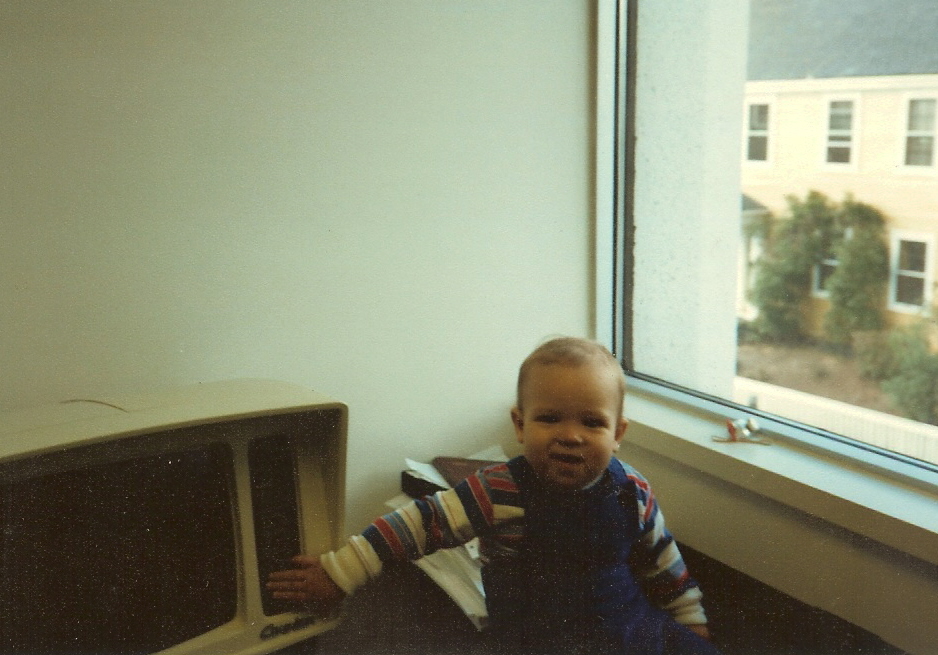
  • They say it’s your birthday….. click the picture:

    August 27, 1979 was the day we met you for the first time. And every day since then you have kept us on our toes, amused, and amazed.

    1980
    Fashionista
    Always interested in the latest technology

    I will resist doing this: Angel Birthday Boy.  Happy Birthday Matt! You are one heck of a good guy!

  • My colleagues and I were taking a break from dusting, washing, organizing and throwing yesterday to commiserate on what every educator knows is true: if you don’t get some stress-related malady just as school is starting, you must not be paying attention.  Hello insomnia.

    I used to feel like I had some character flaw because this happens to me every year. But my first year in public education, when my new principal – who had 25 years of administration experience AND classroom experience on top of that – openly admitted at Staff Orientation that she never sleeps the “night before”, it was somehow comforting. Maybe this behavior is normal after all.

    Holding on to a more relaxed summer lifestyle is not easy to let go of. No matter how much I promise myself – and my spouse – the craziness starts up the minute I start working on my classroom. Some people buy new shoes, new clothes, new school supplies. I buy melatonin in the hope that I’ll sleep through the night. Never works.

    Law and Order at 3 anyone?