• Two disasters – or near disasters – this week: First, I’ve been updating the Excel database file that I copied onto my school computer (a MAC).  That seems like a reasonable thing to do when adding books that got missed on the first pass through a book box.  I also have been bolding the titles of books as the labels are attached so that I can tell which books have been fully labeled and accounted for and which books might be squirreled away in a student’s desk.  Seems like it should work, right?

    Well, wrong.  I am admittedly a PC person – outside of dealing with Macs in the schools in which I work, I don’t use Apple hardware or software.  I don’t remember when I first used Excel, but I’m guessing I’ve been using it since about the first version of it and definitely know my way around the PC version.  What happened to me in using the MAC version is that the save button in the tool tray didn’t actually save the file — you’d think that might be a requirement, but I guess not.  The only way this file was getting actually saved on the MAC was through the dropdown menu. By the time I figured out why  changes and inserted cells/rows were all messed up (my technical term), the entire file was a disaster (sigh).  I believe it’s now been righted — had to compare the PC Excel file on my laptop to a printed hardcopy of the MAC version.  Lesson learned: don’t get too cute by having multiple files going back and forth between operating systems and software versions.
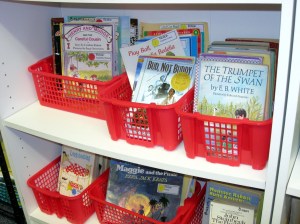
    First sort of Fiction Books.
    First sort of Fiction Books.

    The second glitch this week was in the color coded baskets.  There are WAY too many books — can you believe it — for the baskets I have.  And the small stacking baskets, while just the right size for paperback chapter books, are too small for the picture books unless I turn the basket on the long side.  This means I lose some shelf space and will probably mean the goal of getting books off of the counters in not reasonable.  I’ve noticed that Really Good Stuff has recently begun selling sets of 12 medium-sized baskets all in the same color so there is a solution, but not a cheap one.

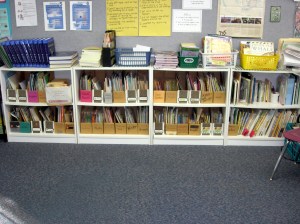
    I’ve started a preliminary sort of some of the labeled books as you can see from the image at the left.  The decision of which books are in the baskets hasn’t been carved into stone of course, but it seemed like progress was being made when some of the new baskets finally appeared on the bookshelves.  I still need to make labels for the baskets so the students will be able to replace books when making trades.  That will take some planning.
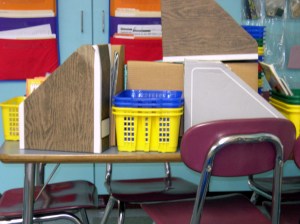
    The old cardboard magazine boxes are cluttering up every available surface!
    The old cardboard magazine boxes are cluttering up every available surface!

    Now, what to do with those cardboard magazine boxes?  They’re too good to throw away (and if you are or live with a teacher you know throwing things away just isn’t something we do).  I’ll need to come to a decision soon as they are starting to take over the table and desk space!

    So on the To-Do list for the coming week is to finish labeling the rest of the newly categorized library, solve the basket issue, and, oh yes…. get rid of the clutter before it drives everyone crazy.
  • With about 400 books that were previously unleveled now identified by genre and reading level, I was feeling pretty good about the progress in the classroom library.  Machine-like, I’ve been able to go through 2 or 3 boxes of books on the white book shelves each morning.  Last night, however, as I was checking on the category for all the math-themed books I used to support our math series, I began to have my doubts.

    Within Mary Brown’s website is a category I had been ignoring – picture books.  Reading over how this website defines a picture book gave me that sinking feeling – had I actually categorized much of this library incorrectly?  Were the books I had assigned to other genres really picture books?  If the illustrations are as important as the prose, which of “my” books aren’t picture books?  As Ms. Brown points out, books can fall into more than one genre category.

    I have no clear answer here.  For me, at the grade level at which I am teaching, I’d like my readers to grow so that, even with some of the exquisite illustrations found in books (Jan Brett, Trina Schart Hyman, Susan Jeffers, Tomie DePaola, Chris Van Allsburg— too many favorites to name) students are using visualization skills to turn the words in the text to the pictures in their heads. So my executive decision (it’s a classroom’s library after all) is to use the genre identification of Picture Book only when it applies to wordless (or nearly wordless) books.  I’m sure there is some basis in library science to disagree, but this makes sense to me.

    So with 400 books now in the database and another 10 baskets of leveled books to sort through, I can report progress is being made – slowly.

  • The lists of books that need to be leveled has been completed!  That would, under normal circumstances be something to celebrate; however, right now things feel pretty overwhelming.

    The nightly task of typing a book title into, first Scholastic Book Wizard, and then one or more of the other databases is quite tedious.  Many of the older titles have a vague grade level assigned to them.  The topics seem too good to let go and I am having trouble justifying putting them into a browsing basket of unleveled books.  Face it — I’m just not going to be able to let go of books very readily.

    This morning, I began working with a printed copy of the most current book database and started to apply the genre and level stickers to the front covers.  Since the genre library in my classroom is still being used — a disadvantage of taking on a reorganization while school is in session — I had instructed the students to check with me before putting a book box marked with an X (meaning that I’ve listed the books in that particular box).  The students have been very conscientious about this “checking” process which usually leaves me with a pile of books to check on.

    Anyway, I’ve firmed up the genre organizations firmly enough that I feel comfortable in creating a batch of 8160 Avery Labels (see previous posting) and this morning I began applying the labels to books.  How cool is that?  First the white genre label is applied, then the colored sticker and finally I put a piece of clear packing tape over the label.  This last step is one that I hope will save me from dealing with stickers that fall off the shiny covers of books.  Once the new label is on the book I check the title off the leveled library printout and replace it in the library.  With the label attached I can be sure that I’ve listed the book in the database — can’t wait to get labels on everything that’s been listed!

    The biggest problem I’ve run into is that some of the books in boxes that were marked as being listed, did not show up on the printout.  So either I’ve lost some data — possible but not likely; lost some handwritten sheets before they were input — possible AND likely; or some formatting problem with EXCEL has caused data to be dropped.  Hoping that I can resolve that issue this weekend and get back to making progress.

  • This week – and most likely next – has been spent in the tedious exercise of listing any book in the classroom that will remain in the students’ library. Coming from a lower grade level, I am amazed at the quantity of books that I have for Reading Levels A-J…. too many in fact. So the issue will become, which to save, and which to “recycle”?

    I feel as if, given the circumstance that I most likely will continue to be one of the special education inclusion classrooms, I should hold on to an amount of books at the lower reading levels so that struggling readers can still find a “just right” book. However, the coding system I’ve adopted goes no lower than “J”. There will definitely be a weeding out of many of those books; some I will put up for adoption by the lower elementary teachers who may find them useful, some – the more worn copies – I will donate either to the Lincoln Lenders (a trading library at our school) or give directly to children who do not have books at home. The books I keep will be stored separately unless I need to use them. A set of baskets simply marked “fiction” and “nonfiction” with a purple sticker will mark them.

    Using the databases that were mentioned in a previous post and one new one — from a teacher at McCarthy Towne School in Acton, MA — have been helpful in leveling most of the books.  Some books, while not leveled according to Fountas Pinnell, have either an approximate reading level or lexile associated with them.  For those books, I am using a conversion chart.  Here is one from Southern Utah University that is quite extensive (be sure to back up one level to see the other reading resources they’ve collected) and a PDF document from Tassajara Hills Elementary in Danville, California.

    Still, after exhausting all of these resources, about 10 percent of the books will need leveling. I know that current thinking encourages teachers to leave  “some” books unleveled.  It’s that unquantified “some” that is bothersome — how much is that? If you are reading this blog, and you have a suggestion, I would welcome it! I am considering taking the easy way out though — if I can’t find the book in either a leveled database or through correlation with lexiles, it just may end up in a browsing basket of unleveled books.

    For now, however, I’ll keep working on the seemingly endless task of inventorying, leveling, and adding the books to my Excel database.

  • Recording titles and determining genre is a piece of cake next to leveling books, at least that’s what I think.  Last week I generated about 10 pages of titles — all of which need to be leveled.  As my good friend Mickie pointed out — it is a massive amount of work.

    My current strategy is to try to locate the book titles in online databases — preferably the databases that are free.  Yes, I know Fountas Pinnell has the Cadillac of levelled book databases and I actually subscribed to it once upon a time.  What I discovered was that, unless I had a significant amount of time to just punch in book titles, I quickly ran through my subscribed visits.

    Now I am trying a more economical way to level which of course means I’m relying on someone else’s skill at leveling books. Considering the number of titles that need to be leveled, I’m okay with that — any huge disagreements/discrepancies can be addressed later, if there are any.

    With this in mind,  I’ve located 2 databases which are quite helpful, if not as extensive as Fountas Pinnell.  The first, is a database of leveled books available through Beaverton Oregon Public Schools.  This database allows the user to search by title, author, guided reading, reading recovery, etc. While the newest titles in my classroom are not always listed on the database, I’m finding a lot of books that have been in the library a while.

    The second database I’ve been using a lot is from Scholastic Books. Since Scholastic has such a large piece of the publishing pie, many titles are included in their database.  The books that are published by Scholastic, but not leveled according to Guided Reading principles at least have a grade equivalency and/or Lexile attached — that will make my own leveling a little easier as there will be at least a ballpark benchmark.

    With 10 pages of handwritten notes, it is clear that very quickly the scribbling will get out of control, so some thought needs to be given to a way to keep the book inventory electronically.  Some who have been through this process have made recommendations for online book databases, but as I have mentioned, I am trying to do this project with minimal expenses — and I don’t like having to pay subscription fees to keep records.  There are database programs available through both Appleworks and Microsoft Office.  However, my database requirements will be quite simple — record the title, level, genre and the ability to sort and print.  For this application, I am going to set up a database in an Excel worksheet.

    There’s much to consider and do.

  • I love the picture that is the banner for this website.  Somehow, this image symbolizes how it often feels  when learning or trying something new — like blogging.  Clearly there is a pathway that can/should be followed, but often that pathway is partially obscured.  The way is not always clear; there can be expected and unexpected barriers.  And sometimes one of those barriers just happens to be a thing of brilliant beauty — like a red maple leaf that serendipitously attaches to a windshield.

    Now in the interest of full disclosure, I must add that I am quite familiar with the photographer and his work — my husband, Adrien Bisson.  Although Adrien’s main focus at Adrien Bisson Photography is portraits and headshot photography, he is, as you can guess, a very talented landscape photographer.  He captured this shot on an autumn visit to Vermont.  And here’s the shameless plug from his proud spouse:  If you are interested in seeing more of his work, he is represented by the Loading Dock Gallery in Lowell, MA along with many, many other fine artists.  And, each 1st  Saturday, artists in his studio complex, Western Avenue Studios, open their doors to visitors.  If you’re in the Lowell area, you should visit this amazing collection of artisans.

  • So many interesting ideas for categorizing books! I have, however, come to a decision about how to categorize the literature in 207’s classroom library.  An important component of Third Grade Literacy is exposure to different genres.  For me, I need to know that after giving a book talk or exposing children to a particular genre, students can select book from that genre and try them out.  While I’ve seen many proponents of color coding baskets according to picture book/chapter book, my decision is to label books by standard genres found in Children’s Literature.

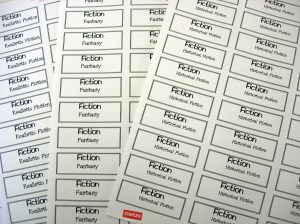
    8160 1x2 5/8 inch Label
    8160 1×2 5/8 inch Label

    As I was trolling the web this morning, doing a bit of research, I came upon Southern Connecticut State University’s website by Mary E. Brown, Genre of Children’s Literature. Trying to teach Third Grade Learners (50% ELL), whose grasp of abstract and nuance, that biography books are a category under the umbrella of non-fiction is often challenging.  So, I’ve adapted the individual book labeling system as you see in the image.  The larger category is then broken into subcategories.  So, the larger category “Fiction”, encompasses “Fantasy”.  Within each category, depending on the quantity of books, I will possibly separate picture books from chapter books.  The blank area on the left of the label will be for a leveling sticker (thanks to Beth Newingham for this brilliant strategy!). Simplifying the level coding from 26 to 14 levels just has to result in a higher percentage of books being placed back where they belong!

    As I mentioned in the previous post, I am making a listing of every title in the library — those purchased by the school, those left to me by my predecessor, and those I personally have accumulated.  I used to guard my personal books, taking care to label them.  Lately, I’ve reached the conclusion that, what-the-heck…. when I finally do retire, will I really take all these books with me?  Absolutely not! So for me, including personal books in the classroom book inventory is no problem.

    Painstakingly recording each book in the classroom has several purposes for me. One, I am able to compile a comprehensive inventory (required as part of our end-of-year closeout);Handwriting the List two, I am able to see where I have duplicates of books that could be shared with students who may not have books at home; and three, the list will result in a closer look at where there are gaps in levels and in genre.  I’m able to inventory one leveled basket and a couple of genre/category book boxes each day.
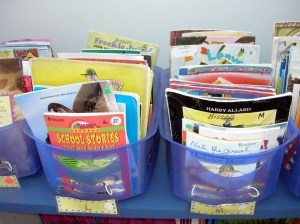
    Little by little the organization is taking shape. Lots of work, but in the long run, worthwhile.

  • What is that expression?…. No good deed goes unpunished.  This morning — March 9, 2009 — I had intended to arrive a bit early in order to start taking stock of the classroom books.  Full of energy and fresh off of a beautiful spring weekend (temperatures in the 60s), I was committed to doing a little each day in the hopes that the reorganization would be ready within the next 4 weeks.

    However, what greeted me on this fine Monday morning in New England was a barrage of ice pellets hitting the house followed by a late spring snowstorm…. you know the kind of snow: heavy and wet, clinging to the branches like so much confectionary sugar.  Add to the mix (pardon the expression) is the quaint little tradition of turning the clocks forward for daylight savings.  Meaning – I drove to school in some of the slickest driving of the winter… in the dark.  The commute itself – normally about 10 minutes, took much longer as even the Interstate was snow covered. So much for my plan of doing a little every day.

    I have, however, made a list of some of the unleveled books in the classroom genre library.  Tonight, while watching some benign television, I will look these titles up either in Fountas Pinnell or some other database and begin assigning levels to the books.

    I’ve been pleasantly surprised at the range of books in one of my lower level book baskets — fiction and nonfiction titles, plays (!), poetry…. all of these genres are fairly well-represented.  And I even have found some multiple copies of titles — something I can put together in a Buddy Readers’ basket for students who would like to read the same text with a partner.

    While the surprise of the snow this morning put a crimp in my well-laid plans and schedule for getting the reorganization of books underway, I suppose I should not be surprised.  New England weather is probably the least obnoxious of the impediments to getting things done in the morning.  There’s always something.

  • Thinking about how to organize books for students and figuring out the best way for your classroom is quite a challenge.  Many people are pretty adamant about what should and shouldn’t be done; it makes my head spin sometimes.

    I’ve been reading a couple of interesting websites about how other teachers have decided to organize the library. I like this posting from Mandy Gregory

    …..I still want my kids reading.  Alot.  Especially in the beginning of the year.

    To reach a compromise, where students are reading but not destroying my carefully collected and maintained classroom library, I compromise.

    It struck me as those words jumped out from the page.  I must stay mindful of the fact that this reorganization is not about neatening up my classroom.  The overarching goal must be that students find the book area accessible; that the literature in the library is attractive and appealing to them in the hopes that my readers and nonreaders will always find something they can pick up and read.

    Mandy Gregory has many ideas for organizing a classroom library (and other management ideas too).  Just reading her marvelous website encourages thoughtfulness.  Another great resource I’m co-opting comes from the Hill School in Troy New York where Ms. Newhouse and Ms. Gordon share a third grade classroom. So much to consider!

    So I’m getting ready to make that first cut — and measuring once, twice, maybe even three times.


  • I have no clue as to how things got so chaotic. Well, that’s not entirely true…. I think my organizational systems are so complex that the average 9 year-old might just have a tad bit of difficulty deciphering just what that organization is.

    Too many lower level books for Grade 3.  The baskets are crammed.
    Too many lower level books for Grade 3. The baskets are crammed.

    Here is the “ugly”: I have 2 main book areas for the children. The first one is a leveled library of books. Pretty standard stuff, huh. However, having come to Third Grade 3 years ago from second grade (did I mention I taught second grade 15 out of the last 23 years?), I have lots and lots of lower level reading books. Sometimes that is advantageous as I am the classroom teacher in a special education inclusion classroom — there’s quite a range (this year from Level aa to Q/R). Goal #1: I’d like to whittle down the baskets so there’s a one- or two-level range of books to choose from.

    I have a lot of books from my very generous predecesor who retired. I am noticing that the age of the books, the amount of wear and tear, sometimes causes “classics” to go unused. Goal #2: Improve the display of the books in the library.

    Most of these books are organized by Genre, Author, or some other category.
    Most of these books are organized by Genre, Author, or some other category.

    Finally, having previously personally purchased (is this a surprise to anyone outside of education?) most of the books in my classroom library for my classroom in another school, (yes indeed — all of those books on the white shelves plus about a third of the ones in the blue leveled baskets) I know I have too many “categories”. All of the books on the white shelves are sorted by “genre” or interest or series. Goal #3: Consolidate the book selections so children can easily locate a just-right book.

    Yesterday I encouraged the students to start making suggestions for reorganizing this choas through suggestions made intheir response journal. I got my first feedback this afternoon:

    Dear Mrs. Bisson,
    You should make a catagory for Jack Prelutsky books. You have too many of them.
    Love,
    S

    Well, S, I will definitely take that under advisement — however, I can’t imagine I’ll ever have too many Jack Prelutsky books 🙂