• I have a love-hate relationship with the first week of school.

    I love it because it is a time for a fresh start, a do-over; everything about the start of the year is new and exciting.  And to be honest, after 10 weeks away from teaching, I miss it…. even the most annoying of personalities has made the changeover to endearing in my most human of memory banks.  Honestly, what other profession allows one to have a “new year” in September (and then another in January)?

    Meeting students for the first time and building that community of learners out of so many differing personalities is challenging and fun.  As a Responsive Classroom, we often start our year with a Human Treasure Hunt (see page 2 of this link).  We learn much about our sameness, and our differences and begin to build a tolerant classroom together.  Will we falter? Most likely, but then we will regroup, rethink and begin again.

    This year I have finally taken my principal’s advice to move slowly and not give in to the pressure to get the show on the road.  We have spent 3 days learning and practicing routines that will become part of my students’ mental “muscle memory”.  We practiced the quiet chime signal until students can stop and listen without reminders, we have learned important emergency routines and other essentials. And, using ideas from The Daily Five, students learn what is expected during Independent Reading — this is the routine I am most excited about.  By slowing building my students’ “stamina” for reading independently, I hope for once and for all (well, it’s a hope), that my students will be able to work independently thoughout the 60-minute Reading Workshop Block so that my focus can be more on instructing and conferencing — and not so much on behavior managements.  We are well behind diving into academics this year.  I am trusting that the time and effort spent in setting routines and expectations will pay off in the long term.

    So, what don’t I love? Well, for one thing I don’t love the paperwork that comes with the start of school. Yes, I realize it is part of the territory, but starting, updating, and creating lists in cumulative folders, record cards, gradebooks, and so on is tedious.  Did everyone change phone numbers this past summer — I’m beginning to think they did! And, it does not seem to matter how much I’ve anticipated returning to my school hours and routines, I am one disorganized mess during that first week.  I’m still not sure if we have food in the house.

    However, this weekend I am determined to enjoy the beautiful end-of-summer weather with which we’ve been gifted.  And next week we’ll begin again to build our community of learners.

  • Hours put in since the last post:  6+

    Yesterday I met with our Team’s new Special Education Teacher, Melissa.  I don’t know about Melissa, but I am definitely feeling the overwhelming panic that encompasses the start of a new year.  The weird dreams have already begun.  It will be good to get back to school and find out the students are NOT throwing spit balls around the room while I chase after them in my nighty 🙂

    I wrote a sketch of what I hope to accomplish over the first 3 days of school.  Trying to find a balance between the procedures and routines I feel are necessary to creating a classroom community and some fun stuff so the kids don’t feel overwhelmed is always a tightrope walk.  I like order; accepting that “things” won’t be perfected (or as close as they’ll get) until a good six weeks into the school year always gives me an uncomfortable feeling.

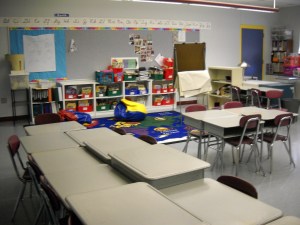
    slassoverviewI did change the desk arrangements around, partly to accomodate a student in a wheelchair and with a wheelchair accessible desk and partly because I just don’t want to give up on cooperative groupings of 3 or 4 students.  I like grouping my students heterogeneously so that they can talk to each other when they are stuck, need help, don’t remember what to do. As you can see from this shot, a large meeting area takes a good part of the classroom.  It’s important to me to get down on the floor on the same level with the students and this is one way I achieve that.

    At this time, there are minimal supplies on the students’ desks.  The empty red writing binder and 5 tab dividers, a word studydesktop test book, a spiral notebook used as a math journal, crayons and a bookmark.  Once my class list is fairly final — on Monday during Staff Orientation — I’ll add a personalized materials.  Working in urban schools for the last 20+ years has taught me to be cautious about personalizing materials until the students actually arrive in the classroom.  Over the last week my class roster has fluctuated from 18 to 20 to 19 as students move around the district to another elementary school.  Students will continue to enroll in the District through the week after Labor Day as not all parents will be familiar with the early start date.

    Melissa and I read through the cumlative folders and IEPs of the incoming students.  It is good to think and plan ahead for these students: How can we adapt and change materials so that everyone feels successful? There are so many questions that need answers.

    As of today, the physical space is prepared. The first 3 days of plans have been sketched out, and I am as ready as I can be at the moment. Waiting for the first bell on Tuesday with lots of First Day Jitters.

  • Time 4.5 hours

    After cleaning and arranging the large items in my classroom, it is time to start prepping for the students’ arrival.  I purchased an additional 10 cardboard magazine files to be used as book boxes. That makes a total of 24.  I am prepping for 24 because that, in theory, is the maximum number of students that may fill the classroom — however, there’s always the possibility that more students arrive than anticipated.

    After assembling the magazine boxes, I used some large format Avery shipping labels and created book box labels.  I use numbers, not student names, to label the boxes.  The student will use their “number” as their address at the mailbox center and for the book boxes.  Finally, I placed a line of yellow painter’s tape on the countertop so that the students can replace their book box on the counter at the end of the day without interfering with the countertop vents.

    Each book box has the bare bones of a Readers’ Notebook and a baggie filled with essential reading supplies.  The baggie idea came about as a result of reading To Understand by Ellin Oliver Keene — and it’s one of those “why didn’t I think of this long ago” moments.  Each baggie contains a pencil, a highlighter, and some sticky notes.  After I assess each student using the F&P Benchmarks, we will make a Reader’s License and that will also be put in the bag for reference.  The Reader’s License has the student’s name, picture and a color dot corresponding to the student’s independent reading level.  This has proved to be very helpful in reminding the student — and me — where the student will find books that are “just right”.

    After seeing the Fountas/Pinnell Reader’s Notebooks — and calculating the cost — I make my own version of a Reader’s Notebook for my students.  I chose a red 1-inch flexible vinyl notebook (it bends and fits right in the magazine box) and have been able to recycle these notebooks now for the 3rd year.  Inside the notebook are 5 dividers labeled “Record & Goal” (daily reading record and a recording sheet of what the students & I agreed would be a next step), “Genres” (defined genres and a monthly tally of the genres student has read), “Interests” (books and genres that student would like to read at some point), “Responses” (weekly letters about how reading is going/teacher directed responses to a shared text), “Reference” (mini lesson reminders).  I have a different organization system for Literacy Circle materials and storage which uses a plastic see-through box.

    Once we have our Reading Workshop up and running, it is my expectation/hope that students will be able to take this book box with them to any corner of the room without scrambling to find all the necessary materials for 5 minutes.

    Next up, I needed to check to see that all the materials I need for starting school are available.  We have particular requirements for our academics:  a composition style notebook for recording Buddy Tests (Fountas & Pinnell, Word Study), a math journal (I use a spiral notebook and have students paste or copy a problem onto a blank page before solving), and a Writer’s Binder.  Having worked in school districts where ordering and budgets are frequently challenging, I have been in the habit of replacing the essential school items with a portion of my previous year’s classroom ordering budget.  Luckily, last year was no exception and I have all the essentials that are needed.  Our ordering for the current school year was delayed and, had I not stockpiled, it would be a bit less than organized for start up.

    Finally, I looked through the masters of essential printed materials that I use in the notebooks — things like the students’ reading record and the conferencing/goals forms.  I organized these items into folders so that, if copy assistance is offered, I can take advantage of it. These are mostly materials that will be introduced to the students during the first month of school as we build both the Reader’s Notebook and the Writing Binder.

    On the way home I stopped in the office to get an updated roster.  Our class lists can be pretty fluid from June to September so expecting the unexpected is always a good idea.  However, I like to write to my incoming students about a week before school starts to welcome them to Grade 3 and, if nothing else, help them to remember their new teacher’s name!  But my main goal in writing to the students is to begin the process of opening communication between home and school — and this is the first step of many.  I keep my letter to the students brief — welcome, a few hints of the exciting things we’ll be doing in Grade 3, and a reminder about bus passes and dismissals on the first day.

    Feeling a little better about being ready for the First Day, next up will be some long-range planning with my new Special Education partner and some specific planning for the first week of school.  Lots to do!

  • DUST!
    DUST!

    Time Spent: 4 hours

    This morning I loaded up the Jetta with our new shop vac — more power! — and began cleaning up the dust from the floor replacement.  Here’s what was all over every surface, nook, and cranny of my classroom (even behind closed cupboards – this stuff goes everywhere).

    Cleanup meant first sucking all the dust with the shop vac and then wet mopping it with paper towels and cleaner — sometimes twice.  It was nasty stuff.  The floor installers left some panels off and the floor vents took a major beating as well as one of the built in metal shelves.  That’ll all need fixing by the pros.

    By the end of the four hours, The room was cleaned up and all the decorating that I plan to do completed.  We are a Responsive Classroom school and one of the things we do to build community is to decorate (reference charts, etc.) together.  The only exception I made for myself this year is the alphabet chart. Due to a shoulder injury, I didn’t take that down — but if the students have some preferred spot, I will and with help put it up according to the consensus.  So here are a couple of shots of the classroom configuration right now:

    Meeting Area Rug:  The classroom library and a large bulletin board abut this area.  I have put the easel at one corner (my coat cloMeeting Areaset and 2 storage closets are beyond that) and I keep the snapcubes for our math investigations in a crate under the easel.  Also against the wall I have shelves that hold supplies for Writing Workshop (editing/revising pencils, forms, paper, art supplies), a listening center CD player, and a crate of cushions and 2 large beanbags.

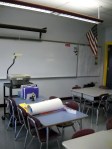
    Longer view of backHere’s a second view from the front of the room.  My desk area, 2 clipboard crates, and my collections baskets are to the right.  The table barely visible in the foreground is a round table which I use for conducting small group reading or reading/writing conferences.
    My current thinking (I love that phrase!) is that I will have students keep all reading materials — independentBinder boxes

    book selections, reading binders and any small group materials in the recycled cardboard magazine files (why are the recycled? See the Leveled Library Organization Project) you see on the window shelf. I also will have students keep a reading supply bag in that box – highlighter, stickynotes (cutting a 1/2 pad of 3×2 notes should be enough), bookmark, pencil) – things that take time to locate when moving around the room for Reading Workshop.  We create our own Reading Binders using floppy vinyl (red) binders and dividers (more on that later); I’m proud that my students have been very conscientious about taking care of the binders and with one or two exceptions, these are the very same binders I purchased new three years ago.     Because there’s a very important air flow vent built into the counter directly behind those boxes, I will lay masking tape to mark where the front of the box needs to line up.  The blue space behind those boxes is where we generally put a word/vocabulary wall.

    Front of Room The front of the room looks the most bare at the moment.  Usually on one end of the white board we record homework assignments and on the other we keep a magnetic chart tracking where students are in the writing process.  I also hang a daily poster of our Reading Workshop Schedule at the front of the room.  I do use an overhead a lot.  Storing it at the end of the second reading/conference table and rolling it into position works for me. I have a rack of frequently used materials (Venn diagrams, blank story maps) on this table so that students can take them independently.

    When I moved from the Bailey School to the Lincoln School I was excited because of the shelves!  The Lincoln was Sink areaconstructed one year after the Bailey and the architect apparently didn’t think shelf units over the sink area would be all that useful.  Luckily, when the Lincoln was constructed a revision was made and the shelves are well used!  In fact, I wish there were more of them — but then that would just encourage teachers like me to hold on to more STUFF.  I have a rolling “art cart” in which I keep a minimal amount of construction paper and lots of composition and math paper.  On top of that cart, I have a 24-section sorting file that is used as student mailboxes.

    Greatest Invention EVER This final shot is a closeup of the coat/storage closet area.  Over the first 2 doors are pocket folders from Really Good Stuff. The first one holds reading and spelling/Word Study materials so that the students can help themselves.  The second holds math game and other such materials for our math program (Investigations).  Door Number 3, however, is the prize winner.  One of my former colleagues, Patty Myers, shared how she kept the little “stuff” she always needed in a clear plastic over-the-door shoe hanger.  This has been the coolest tip ever!

    So now the room is clean, minimally set up, and ready for the first day.  Now all we need are the students!

  • It’s a good news/bad news thing…..

    At the end of the school year, there was a rumor that our ratty carpeting would be replaced by tile.  Good news: the carpets

    New Tiles

    are gone!  Bad news: the replacement required some serious sanding before the new tiles could be laid.  Everything in my classroom is covered with a fine, white dust.

    The new floor, however, looks outstanding.  No more wheezing – I hope!

    From the doorHere’s what the classroom looked like after being packed away for the summer and after the custodians removed and replaced all the furniture – including my 5 bookcases full of classroom library books. I don’t envy them having to do this each summer.

    Yesterday was spent surveying what needs to be done so the room can be put back in order before students arrive on September 1.  The dust is hopeless — a wet towel just created cement and didn’t really clean off the surfaces, so next trip back I’ll bring my shop vac from home.  I did manage to wipe down my desk, replace my desktop shelf unit and wipe down the bookshelves.

    I had left a map of where I wanted furniture replaced after the summMore mess!er cleaning and Kevin, Delores and Mark did a great job of following my map!  I’m still playing with the desk arrangements; however.  I’ve always had students sit in cooperative groupings; the U-shape that I mapped just seems strange to me — so I’ll probably revisit the desk configurations.  And I will have a student with a motorized wheelchair so I need to rethink the room spacing to accommodate.

    I’m hoping 2 days will be enough time to get all the classroom layout completed, computers reconnected and dusting completed.

  • About a week ago, I finally finished reading Ellin Keene’s new book, To Understand.  Originally intending to blog about the book as soon as it was finished was in reality impossible to do.  Things that Ellin has to say about teaching, about thinking, about maintaining a balance in education have been turning around and around in my mind for the past week.  One of the hardest ideas for me is to let go of the idea that, full-throttle teaching to the exclusion of any other interests is neither helpful or healthful. It is one of many themes emerging from reading this book.

    The frenzy that has been in my classroom for the last two years needs to change.  One of the most powerful ideas that Ellin Keene proposes is developing a culture of calm and quiet.  Giving students the opportunity to practice thinking — the wait time, the expectation that students will take time to form their ideas before sharing them — seems like an idea that my students (and I) need to develop.  So often the pace of the classroom, the frenzy, the multi-tasking, the divided attention, detracts from all of us providing thoughtful commentary. And in listening to others’ commentary and questioning, growth.

    Using the Making Meaning materials mandated in this district, our students have begun to learn how manage appropriate discussion behaviors.  Stopping at set points in a text, students learn to share ideas with a partner and report out to a large group.  It has been helpful in guiding students who have little confidence in their discussion abilities nor practice in socially acceptable discussion norms. However, this program has unfortunately taken the choice or what to discuss, the teachable moment away from the professional.  How frequently we teachers find this happening — instead of allowing a teacher to exercise professional judgment, the scripted materials box us into a set of skills that our students may or may not be ready for.  In the climate of high stakes testing and accountability, teachers and administrators often dare not deviate from the prescription for “success” lest their students not meet the predetermined benchmark.

    Why I relay this anecdote is to illustrate the overarching theme I believe runs through To Understand.  While we know we must be accountable for certain achievements, skills, standards of education, we need to trust our professional compass. We need to stop at points in a text that will engage our students thinking and that point may or may not coincide with the prescribed prepackaged curriculum.  We need to have the courage to trust what we know about teaching and learning, about curriculum, and about our students to teach with rigor. We need to teach our students to develop their Renaissance thinking.

  • To Understand is author and teacher, Ellin Oliver Keene‘s new book; and it has been on my list to read for several months.  I began reading this book earlier in the school year and adapted Ellin’s idea for Literacy Studio (crafting, composing, individual activities and reflection time) to encompass the teaching day. Defining each of these according to student and teacher/leader responsibilities worked across the curriculum in my class last year. I am anxious to use this model again next school year.

    When school demands became overwhelming, I had to put aside reading To Understand and have only recently picked it up to read again.  Keene asserts that we, as educators, need to advocate for what is essential to our curriculum and teach that in depth.  There is so much pressure today to try to “cover” topics that this is hard to imagine.  I find myself easily lured into teaching to a checklist of what someone else has deemed third grade curriculum which leaves little time for developing the fun stuff — topics that the students want to explore, discovery through student inquiry, developing thinking.  It worries me that I am contributing to a culture of fact regurgitation — my students need to develop thinking and discernment skills.  Will my students be part of a “can-do” or “can’t-do” culture?

    So as I’ve picked up Ellin Keene’s book again, I’m particularly struck by her words in the chapter about creating “renaissance learners”. We have long been exposing our students to a catechism of learning: ideas and facts that must be committed to memory and then tested and retested to ensure “quality control” of our “product”.  There is no need for creative thinking here — we need to turn out students who can pass standardized tests.  Sadly, not many of the students who are learning under such contraints become “passionately interested” in topics .  To quote Keene:

    But in schools, are we set up to create Renaissance kids? I worry that with schedules driven by different subject areas, curriculum created around tests, and a society that demands perfect completion of everything kids attempt, we are unwittingly contributing to the demise of the Renaissance person — creating our own medieval age.

    Frightening? Indeed it is.  And Keene continues:

    If we live in a society that values Renaissance thinking, but in schools that work against it, is it possible to help young children sustain and older kids rediscover the Renaissance person in themselves? Do all young children come to us with those qualities? Is it possible to devote time to the pursuit of pressing questions on a wide range of topics? Can we encourage kids to wonder, to pursue new ideas through their own discovery and research? And, if we decide that it is important to promote the notion of Renaissance learners, where do we begin, given the constraints of our professional and personal lives?

    Many questions, much to think about.

  • I find that the longer I am a teacher, the more I am blown away by the intelligence and thoughtfulness of colleagues across the US.  Here is a blog I recently came upon Two Writing Teachers.  Even though the two bloggers teach grade levels higher than my current teaching assignment, the process and their craft as literacy teachers is thoughtful and practical.  Check out the section on mentor texts — I was amazed to find some of the very same texts I use with my third graders mentioned as exemplars for narratives and other genre of writing.

    Also within the same blog is an interview with Stenhouse author Mark Overmyer.  Check out Mark’s response to a question about assessment.  God help me if Two Writing Teachers move these links!

    Lots to think about and catch up on and summer has just started!

  • This morning, I finished my duties for 2008-2009 by taking a qualifying exam for MELA-O administrators.  I have to wonder why I bothered….. the MELA-O qualifying test requires that I determine where a LEP student’s language acquisition lands when compared to Native English speakers of the same grade level.  Here’s the catch: I am certified to teach grade 1-6, but 60 percent of the QMA exam was an assessment of 7th grade and up!  As a teacher in a multi-lingual school district, I truly believe in the process of language acquisition and determining a student’s language leve is part of the process. However, it seems the process  to become a QMA is destined to ensure that I will fail.  I am expecting to have to take a retest in order to qualify, but it seems unfair that the original qualifying test is so skewed to grade levels that I am not certified to teach and never will teach.

    The local school committee recently finished what can only be described a draconian cuts.  At one point in the budget process, there was a need to cut over $9 million dollars.  An entire middle school will close this year. Teachers and students ended their year with trepidation about the future.  But not just the teachers in the school which has closed — the “bumping” process has impacted nearly every school in Lowell as teachers who had not yet received professional status found themselves at risk for displacement.  Add to job insecurity from a closed school the ritual of pink slips that must go out by June 15 when the budget is uncertain,  the agenda of the local daily newspaper in portraying any spending on schools or teachers as a waste of money, makes for morale in the hopper.

    The energy has been sucked dry.

  • Like many teachers in urban districts, many of my students come from backgrounds that are less than idyllic.  This year has been no exception and in many ways, it has been worse. Is it the economic upheaval? Is it the learned selfishness of our society? A social scientist may have answers – all I know is that a good percentage of my students are in crisis most of the day.

    We come to teaching with the optimism that we can change things, we can make a difference.  While I still feel that passion, I also feel the exhaustion from waves of crisis each day, all day long.  Can I really make a difference? Does what I say or do matter at all?

    Getting ready for a summer self-study on the ways violence in its many forms and trauma effect students, I’ve come across a term I had not considered before – compassion fatigue or secondary trauma.  Do we get so wrapped up in our drive to change the unchangeable that we become dysfunctional adults? What can be done to avoid burnouts?

    Lots of questions, not many viable answers. And making matters more intense is the current economic crisis and the impact on my beloved profession.  As of today, any teacher with less than professional (tenured) status — that’s less than 4 years experience — is receiving a pink slip.  Now we worry about job security, overloaded classrooms, no materials, while we attempt to teach children who may come to us from unfathomable home situations.

    Teaching is hard. Trying to support students who have experienced trauma in its many forms is hard.  Summer vacation will be a welcome respite and perhaps a time to figure out a way to manage my own secondary traumas so that, come September, I am better able to help my students.