• It is my — and their — nemesis:

    3.N.8 Select and use appropriate operations (addition, subtraction, multiplication, and division) to solve problems, including those involving money.

    My students can perform computation into the thousands. We are pretty darn good at it. But toss a word/story problem in their direction and everything falls apart.  Why can’t these kids figure out an appropriate equation and operation from the words? It is really quite a pain.

    Remembering the challenge of second language learners — and the nuance of the English language — partially explains why these kids have such a tough time deciding what operation and equation makes sense. I’ve resisted the urge to teach key wording because it doesn’t always fit the situation. And the standardized testing we foist on these kids often doesn’t follow the “formula.” Besides, I want them to think and to know what they need to find a solution.

    So this week, I’ve started applying a teaching strategy we used to teach in another school for visualizing. Explicitly teaching students to visualize seems to me like the only way they are ever going to figure out if the answer – the result – should grow or shrink. Which I hope will lead the students to a reasonable equation for that computation they seem to do so well. It just so happens that the students are not very strong visualizers when it comes to reading either.

    What I do know is that unless I can convince the students to thoughtfully consider the action in a story problem, to visualize what the situation is, all the computational skill that they have acquired will mean next to nothing.
  • Junia Yearwood wrote in an OpEd piece in the Boston Globe this week that it takes a culture that values learning to educate a child. I couldn’t agree with this more. What is valued in our culture? I don’t believe it is intelligence and learning if pop culture is any indication.

    What struck me as poignantly true was this quotation found in the middle of the piece:

    Blaming us, the teachers, absolves all others of their complicity in the failure to educate our students and relieves them of all responsibility for solving the problem. It’s expedient. Yet until we accept collective responsibility for the problem and for finding a permanent solution, progress will remain an elusive phantom.

    It is indeed easy to blame educators for our students’ failures. It makes closed minds feel much better because there is someone to blame for the failure of education. Even when the elephant in the room can no longer be ignored, politicians and leaders find it more to their liking to blame the practitioners and look for a quick fix. I am not saying that there aren’t areas where education and educators can improve. Of course education is not perfect and neither am I. Nonetheless, the truth is that it is far more easy to blame teachers for all the ills of education when the problems affecting student achievement are far more complicated.

    How many times do we have to show our children that learning is for nerds and eggheads — even those terms are a pejorative. What stereotypical imagery do we employ when referring to females who go into mathematics? When our society as a whole changes from treating intelligence and high achievement in learning as something to be valued, we will have made a giant step toward a permanent fix.

  • We’ve read the book, we’ve done the project with our kids (honest truth: not one of the 25 got a single Flat back!). This week my class has been hosting my niece’s Flat Stanley. And we are having a blast. Sorry, can’t post pictures of kids, but trust me on this.

    Working on multiplication riddles? Flat Stanley can help.  Daily 5 Rotations? Stanley watches over us and keeps us on task. Assemblies, Bank presentations, whatever we are doing Flat Stanley is there to share the experience.  We’ve got one more week’s visit with Stanley and then we’ll have to say good-bye; however, in the meantime, we’re enjoying sharing our school and our experiences.

    Thanks M for sharing your Flat with us.

  • Yesterday during the first of three meetings I attended, we heard the news: next spring third and fourth grade teachers can expect their report card grades to be correlated to student performance on MCAS. And, I suppose, since that’s what happened last year, graphs and tables will be created into Powerpoint slide shows identifying each teacher’s result. No, they’re not kidding.

    At least with Reading Grades, the selected standard (no, not every standard will be targeted) – Comprehension of Fiction and Nonfiction – makes sense to me. The math standard – Communication, does not. I don’t know how students can communicate on grade level when they can’t conserve number in counting, don’t know what a digit’s value is, and still can’t add or subtract basic math facts through 18. But, no they are not kidding me.

    Here’s what concerns me about this data collection and what the data means:

    • The MCAS test is challenging for any third grader. My understanding — and I’ve gotten used to not understanding anything in education — is that the test includes items beyond grade level expectation.  Won’t these items skew the result? And then make my personal report card assessment look inflated?
    • The MCAS is a third graders first experience with standardized testing. It is unnerving to a 8- or 9-year old. Won’t that also deflate the kids’ scores?
    • MCAS is a snapshot moment in time (2 days for the Reading test). What if on one or more of those 2 days, the student comes to school upset about something outside of the home (mom and dad were fighting, mom/dad left home, electricity was turned off, we were kicked out of our apartment)? I teach traumatized students and each of these events HAS happened to one or more of my students during MCAS. How will that affect the students’ MCAS scores on one or more of those 2 days?

    I see my students for 180 days each academic year. I get to know them and about them – sometimes it is too much information. I assign report card grades after looking at many, many assessments – formal and informal, paper and observational. I do my best to provide an opinion of progress representative of how I see the student meeting grade level standards in the classroom — and I do not base this assessment on a 2-day high-stakes, anxiety ridden test.

    Someone please tell me where these results are going? What is the agenda here? Is this going to turn in to more fodder for proving I am shiftless and lazy? That I don’t know what I am doing? Because this data collection is pretty scary and no, I am not kidding you.

  • I’ve been confronted with my age ta couple of times this weekend. It was not an altogether pleasant trip down memory lane.

    Woodstock Then and Now was on the History Channel last night. In the summer of 1969, I was a junior, about to be senior, in high school. A couple of my classmates went to Woodstock – they were legends.  Last night’s show featured clips of musicians and attendees (half a million of them!)  and some really great music – overlayed shots from 1969 with flash forwards to current times.  Country Joe looks like a middle-aged software engineer (he’s not). The couple who were on the cover of the Woodstock soundtrack  album – yes, album – commented throughout. They look like a nice, middle-aged couple. Respectable. Who knew?

    In an earlier conversation, I was describing the big deal it was for my sister and me to see the Sound of Music when it debuted. My grandmother had to get box office tickets from the movie theater in Buffalo, NY — we were visiting her.  Can you imagine? At that point my son told me “You are old!” Well, I guess I am, but I don’t feel that old.

    Life is passing by a lightning speed. When I look in the mirror, I want to see the girl who used to wear electric blue eye shadow and long straight hair — what is looking back at me is a much older model of that face with much more conservative bows to fashion. No more electric blue for me — no more fringey tops or bell bottoms either. Maybe that’s not such a bad thing.

    I’d better get cracking on that bucket list!

  • It’s really easy for me to get wrapped around the axel over lack of parental support in a school where poverty is pervasive. I’ve had 3 teacher assistant team meetings for one child so far this year. The parent never attends and never responds to the meeting invitations. This parent continually writes nasty notes about me, the school, and the classroom. My frustration over no-shows for meetings to remedy this, to conference about the student’s progress, or anything else that might involve a little parental effort is only exceeded by the daily interruptions to our afternoon to change a dismissal routine (and I know routine as applied to this student is an oxymoron). This is only 1 story in this classroom.  The other 21 can be just as interesting.

    Or not. Yesterday offered a glimmer of hope that by inviting parents in, we can forge a working relationship to benefit students.

    My class has just finished writing our small moment narratives and we put each students’ writing into a book which we “published”. Yesterday, the half-day before Thanksgiving break, students invited a parent or loved one in to read our inaugural book, to be complimented on their contribution. Knowing some parents may not be able to leave work, I had prepared students whose parent might not be able to come that I, too, had been a working mom — and offered to be their parent for the celebration.  Being third graders, this of course led to some hilarious moments as classmates considered themselves “brothers” or “sisters” — if only for an hour.

    But, back to the topic – getting frustrated with the status quo can lead to lowered expectations. Yesterday, however, helped me to realize that maybe I am focusing on the wrong things.  I met so many parents – sometimes both parents AND a grandparent – who were able to come, to hear their child read their thoughts and writing. One parent offered to help me pass out the apple juice we were offering, another stood in to read with a friend of her own child. And our school administration – Principal, Assistant Principal, and Literacy Specialist – all graciously read with each and every child in the room.

    The energy, the enthusiasm was right there. It could not be missed. Something special transpired yesterday and not just for the students. On this Thanksgiving Day, I am thankful for the administrators who support me.

    And I am most thankful for the parents of my students who are willing to share themselves and their child with me.

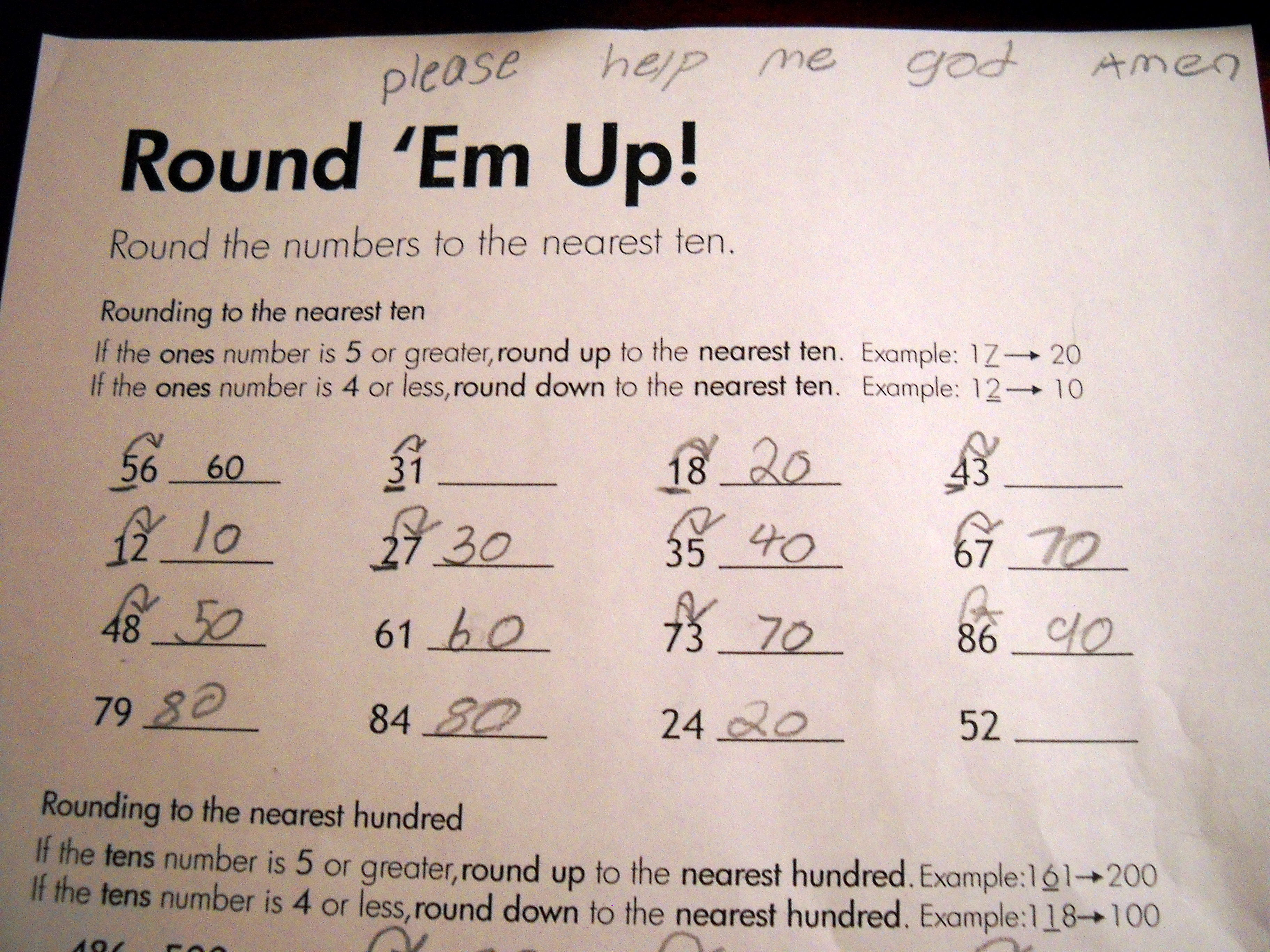
  • We’ve been learning how to round numbers…. rounding in the tens and hundreds, and – dare I say it – even in the thousands. This morning, I revisited rounding with my third graders and from the reaction, a few of them even seemed to “get” it.

    However one of my students was really struggling to round the numbers on a worksheet that I put up on our projection device. When I eventually handed off a row for students to complete independently I could practically see the gears turning as he struggled with the process of rounding a number to the nearest 10: underline the digit in the tens place, look at the digit in the ones place. 4 or less, don’t change the tens, 5 or more add another ten. We even have a cute little rhyme to help:

    Find the number, go right next door

    Four or less, just ignore

    Five or more, add one more

    After the kids went to their special this morning, I discovered my struggling student’s practice page tucked in amongst some papers on a counter. And when I looked at what he had done, I couldn’t help but laugh hysterically:

    God, I LOVE this job!

  • Over the past couple of weeks, we’ve been investigating the colonial period through our guided reading groups. With my Safety Net 1 group (yes, I have two safety net groups), the texts’ readability levels are far beyond instructional level so mainly it looks like a shared reading session.  The book we’re reading, the most basic text I could locate, is “Colonial Life”, courtesy of my Reading A-Z subscription (BTW, one of the best purchases I’ve ever made).

    Yesterday we were reading about breakfast in colonial times. The text has a nice graphic of a table set for breakfast – which included a bowl of apples.

    Me hopefully leading the students to a comparison: “Do we ever eat fruit at breakfast time?”

    Student: “No. Never.”

    This exchange happened as the students were consuming their mid-morning snack – items “leftover” from the breakfast bags which included applesauce. The look of incredulity was priceless when I pointed out that applesauce came from, well…. apples! And, according to the food services managers, that is a fruit.

    As one student observed, “Oh that’s why there’s a picture of an apple on the lid!” — the peel back foil covering.

    Still not believing me, the kids were full of questions as to how apples turn in to applesauce.  And, had I had supplies with me, I would have done just that with them.

    Somehow, I’ve got to work more experiential learning into this classroom!

  • Our strategy focus at this time in the year is making a visualization. Have you ever stopped to think about how useful this strategy really is? For my money, it seeps into just about every area of the third grade curriculum. In Word Study, we ask the kids to Look-Say-Cover-Write-Check.  In other words, look at the word you are trying to spell, close your eyes and imagine its shape and letters, write it, and check it. In mathematics, I ask the kids to imagine a story problem being played out as a movie:  If 2 children and playing tag and 4 more join them, what does that look like? How can imagining the math “situation” help students to decide which operation to use?

    And then there’s the mother of all visualizations: reading.  In an earlier post I wrote about how the vocabulary in a short Autumn poem caused my students to struggle. Well, not only the vocabulary proved to be a hurdle, but also the very process of visualizing a text and recording thoughts was difficult.  A good number of my students simply copied the words of the poem (trembling just doesn’t roll off the tip of my third graders’ tongues) by way of explaining what they “saw” as they read the poem’s text.  Another group of students started off strong (I see pumpkins lying in an empty cornfield), but then the writing took a wild turn into imaginative fantasy (black cats, ghost, and scary carved pumpkins all made an appearance).

    Today my colleagues in administration graciously came to work with my students — can you imagine a classroom so lucky to have the Principal, Assistant Principal and Literacy Specialist come in to co-teach for an hour? With our smaller groups, we broke down the text to two-line segments, stopped to talk through what pictures came to mind, and revise the students’ descriptions to be more driven from the text itself. What I was able to observe was a lesson in the power of collaborative teaching:  even while directing my own little group I could hear and see one colleague drawing out students’ understanding of vocabulary, another using realia, and another gently prodding students to close eyes and experience the scene created from the poets words. The styles of teaching were all different, yet focused on the same goal: moving a diverse group of students forward in their thinking.

    From the brief scan that I’ve done so far, the students’ writings are more on-target. They have stayed within the structure of the text and written visualizations that can be traced back to the text. When one of my three colleagues returned to the classroom on another matter, I heard several call out thank you for working with us.

    Not only the teacher, but the students recognize what a wonderful opportunity it was.  And we are moving a step closer to mastering this very valuable strategy.


  • I heard a statistic over the weekend: just short of 60 percent of registered voters will vote in this year’s hotly contended elections. That statistic, 60 percent, would be considered an overwhelmingly successful election. But consider this back-story:  the 60 percent is about half of those eligible to vote. That right — there are adults in this country that don’t even register to vote! Mindboggling, isn’t it?

    As inconvenient as getting to polls might be for some (really, couldn’t we have a 2-day weekend voting period like some European countries?), I will be standing in line this afternoon after hassling for a parking spot at my local polling place. It is my obligation and my duty to do so.  Why?

    Women, of course, were not permitted to vote until the Nineteenth Amendment in 1920. I think of this most every Election Day when I waltz in, state my address, and get my own ballot with no problem whatsoever. I marvel at the strength of women of the early 20th century who organized and demanded their rights to vote, their rights to be treated more like human beings than property. I think of my great grandmother, Minnie Palmer Flournoy, whose strength and courage to march with suffragettes makes voting all the more meaningful for me.

    Minnie Palmer Flournoy was left a widow with 2 children –  a toddler and a baby – after a train accident killed her husband  in the early 1890s. The grief of losing your husband in a place far from your family (at the time, she lived in Albany, NY far from her Missouri relatives) was compounded by the cavalier way the railroad and its lawyers sent her off without any compensation for this tragedy: I have a handwritten response from the railroad’s attorney offering no culpability on the railroad’s part, but a token “gift” of $500. Minnie eventually moved back to Missouri with her parents and worked throughout her life at jobs women were allowed to do: seamstress and rooming house keeper. From family stories she was by all accounts a strong, smart woman; a woman who raised two successful children on her own.  When women began to demand rights to vote, I imagine she was on board fairly quickly.

    The movement to gain the vote for women began with a speech by Susan B. Anthony in 1873 and ended with the passage of the Nineteenth Amendment in 1920. The years and effort of my forebears to obtain this right does not go unappreciated or unnoticed by me.

    Today, I’ll make my way to my local polling place and proudly remember those women who endured mocking, were castigated and rebuked for standing up for their convictions. And I will vote.