• It’s going to be a bumpy night.” I love this quote from “All About Eve”; and coming straight from Bette Davis’ mouth – well you can imagine the delivery.

    The more thinking is done about the implementation of the new mathematics curriculum frameworks – the Common Core – the more it becomes apparent that this is going to be a major, that is MAJOR, implementation.

    Looking at it from a third grade teacher perspective – students will come to third grade with near mastery, if not mastery, of place value AND mastery (that is spelled out) of addition and subtraction facts — all of them.  Historically, that has not been the case; students coming to third grade often have a shaky grasp of place value and most definitely we spend lots of the beginning of the year on addition & subtraction facts. Honestly, there are some children who do not leave THIRD grade having memorized/mastered these facts.  That’s a post for another day though.

    What this means to me is that, for the next year – or possibly two – we will straddle two grade levels of work. It is clear what the expectations of students leaving third grade and going to fourth are. (Click here to download the PDF or Word version); but there will also be some catching up to do for second graders coming in to third this September.  I’m sure other teachers at grade levels above and below my own grade level will feel the same.

    And to add to the pressure, by 2014 the Spring testing will have completely transitioned to the new Common Core standards. Here’s a link to DESE’s plan to transition test items.  In other words, transition quickly and get working on mastery of the new standards.

    Will we be ready – I sure hope so. Because not only will there be new standards to be responsible for, the test results will be linked to my own evaluation as a teacher.

    I have a feeling that fastening my seatbelt isn’t going to be much help here.
  • Our District has a committee is working on unpacking the Common Core for Pre-K to 8 this summer. I volunteered – begged really – to do this and, lucky for me, I am part of the committee.

    Even with all of the expertise on this committee, there are struggles as we dig through seemingly simple standards only to discover that it’s more complicated than it appears from the surface.  What will be important at one grade level may not be emphasized (notice I didn’t say it wouldn’t be important) at the next — I have to say that the way these standards are built shows much thoughtfulness into the process of becoming mathematically literate.

    Here are some of the pieces that I think are strong:

    • The standards are very specific. It is quite clear what skills and concepts each grade level will be responsible for.
    • There is a place for fluency with computation and it is spelled out explicitly.
    • Topics are explored in depth and students are expected to demonstrate understanding. Rote processes are not going to be enough; if a student is using the standard algorithm (for example), then that students needs to be able to explain how and why that algorithm works.
    It is gratifying to see this committee complete the shift begun almost 10 years ago – the shift to thinking in terms of “standards” and not what page of a text is covered.  Finally a curriculum guide that recognizes the expertise of the teacher in choosing the appropriate materials to use when teaching — which doesn’t mean nothing is provided for those who want that support; but it is freeing for those of us who have felt hindered by a particular program or product being used district-wide.
    It is going to be a massive undertaking to update guides, update assessments, and provide support for teachers who haven’t had the opportunity to look at these standards in depth.  It is an uncommon opportunity.
  • The writing is on the wall… the DESE is in the process of recommending that the teacher evaluation system overhaul include data about teacher effectiveness using the state’s MCAS test.

    I really am annoyed that no one is listening to teachers who are saying “Wait a minute…”. Not because we don’t want to be evaluated; a constructive evaluation and critique of how to do things better is always welcomed by me. But I do have some footnotes that need to be added to my students’ results.

    Like students whose parent(s) don’t care enough about their child to get the child to school. I’m not talking about students who are absent for medical reasons here. If my teaching technique is so all-fired important, why is a student with 25, 30 or (all time winner) 44 absences allowed to count toward my effectiveness.

    This spring I plotted student absenteeism/tardiness and percentile growth using the standardized reading assessment we administer (SRI) and — big surprise — the student with 44 absences not only didn’t make any gains, the student had negative growth. Well, duh. If the child isn’t in school and instead is watching daytime television, or playing video games, is this a shock?

    No one wants to talk about the elephant sitting on that chair in the corner. But we need to…. learning success depends upon a student being in attendance. Without the student participating in learning activities, how can teacher effectiveness be measured.

  • Twenty-four hours after the end of the 2010-11 school year finds me still trying to analyze why this year was so difficult. Why was it that so many students in the past group were such a challenge? Did my teaching change? Is my tolerance level low? Have I lost “it”?

    The more I think about it, there were things that I had no control over that impacted the dynamic of this classroom more than I imagined. Teaching in an urban district comes with challenges of trauma – social, familial, economic. Sometimes these are easy to surmount, but often they are not.

    When school works best, there is a partnership between student, teacher and parent. When one of those links is broken or dysfunctional, the possibility of success is lessened — this is what I believe. The value of an education is undermined when there is lack of support from home.

    Within the group that has just moved on, there were quite a few broken links in this triumvirate: children who did not have the medication that would enable them to focus (enough times that it started to seem as if the parent was purposefully withholding). Children who did not arrive at school on time, not by a few minutes, but by hours and missed valuable lessons. Children who did not arrive, period. Absenteeism of 25, 30, 40 days of school. That’s a considerable amount of time away from school when no reason was offered.

    School works best when there is a partnership. We did the best we could together, broken link or not. But I am so hoping that next year things are more cohesive, that I can convince parents – engaged or disaffected – that without their involvement, interest, and input their student cannot achieve all that they are capable.

  • which translates to “no worries”…. how often is that a part of an adult’s thought process?

    This week marks the last week of the academic year for us. It’s part of the fabric of the school year cycle – that time when I reflect on what worked and what didn’t. When I start to see those kids, even the ones who wore my patience down to nothing, through the rose-colored lens of the past. When some of those tics that drove me crazy throughout the year become endearing.

    We clean out our desks — even me this year — and, according to my new rules, throw or recycle anything that hasn’t been used in 2 years. That’s my cutoff point this academic year. I am rethinking classroom design and have ordered a set of six balance ball seats. For once, I’ve put all the stuff I like to use when setting up my class before the children arrive in one place. Now that was a growth moment — there’s a chance I’ll remember it if it’s in one place.

    The state testing is done, the report cards are done, the District assessments are complete and recorded.  I’ve completed reports for the children who will be referred for special education testing. There are just a few final things to do: I always celebrate summer birthdays with my students who have them on the last day (mostly because my own son has one) and an extra game of kickball, weather permitting.

    So for the next two days “no worries”. Until I meet my incoming group on the last day and the cycle begins again. But for now – Hakuna matata.

  • This has been one of the most challenging groups of children I have taught. Considering that this is my 23rd year as an elementary teacher, that’s quite a challenge.  Teaching in an urban district with children whose daily life is clearly outside of my own childhood experience, oftentimes means much more than academics are encompassed in a day’s teaching. I never am quite sure how the children perceive what we are doing or how we are doing it.

    At the end of the school year, our children write a letter to the incoming class, the children who will fill this class during the next academic year. It often amuses me when I find out what they recall as “important”. This year there were lots of references to our lunchtime kickball games and to our frequent viewing of Reading Rainbow, as well as the expected reference to our Valentine’s Party.

    Here, however, is my favorite letter this year — the one I will copy and look at on those days in future months when the challenge of teaching makes me feel as if I am getting nowhere fast.

    Dear New Third Grader,
    When you come to third grade it will be like an emoshinal (sic) roller coaster because when you come here Mrs. Bisson will get mad at you if you do something bad and trust me you don’t wanna (sic) go down that path. I’ve been there before and it was not so good.
    Anyway in third grade it will be very fun. I mean in third grade it is kind of a little competitive but you will get through. Even if Mrs. Bisson can be a little hard on you she lets us do fun things like play BINGO, watch movies. We even have our own journal so that is why its a good place to be.
    I also think that if you have Mrs. Bisson that you are the luckiest person walking on this earth. Oh, one more thing. Have fun in third grade.

    I will think I am the luckiest person walking on this earth to have worked with you, my friend!

  • We will have a lot of changes this coming Fall. Some are more global: a new administrator, a new superintendent, new Core Curriculum. On a more local level, my grade level has made a decision to locate the Inclusion classrooms side-by-side, so next year I will be a SPED Inclusion room again.

    And there some changes in my own teaching that I’ve been thinking about. I’ve dabbled in implementing the Daily Five over the last year. It’s something that makes sense to me. This summer, a couple of us will be going to the Daily Five workshop offered by “The Sisters” and I’m really psyched about learning more with my teaching colleagues.

    However the classroom design ideas from The Sisters that have really piqued my curiosity — along with a suggestion from  Tuesday2‘s blog — and that is what is giving me the inspiration to really look at my classroom’s traditional layout.  Is the room “mine” or is it “ours”? And if it is ours, everything – seating, access to materials, EVERYthing – needs a re-evaluation as to its purpose and usefulness in a room filled with 9 year olds.

    Just how much radical change can be made remains to be seen — the District has requirements (overhead projectors in each room has been a hot topic in the building this week). But there will be change…. this is going to be fun.

  • Boy do I ever need to redesign my classroom space.  What I have is workable, but there’s much more to be done.  What would my dream space look like? Here are some things I’m mulling over for next school year:

    1. Removing the big old TV on the gigantic (and wobbly) stand.  Yes, I do use video…. sometimes. Is it worth having this gigantic thing taking up more square footage in the classroom? I’m not sure it is. What would be a reasonable and less space-consuming alternative for those times when a picture is way more effective than words?

    2. Clearing the decks. Countertops are full, and I mean full, of “stuff”.  I know the district has a rule that each room needs an overhead projector, but I don’t use the thing since we’ve received an ELMO and projector.  But I also have too much “stuff” on the countertops — just how important are those bins with independent math activities?  Time to be brutal.

    3. Coverup. The windows let in light, but more often than not it is harsh. And several of the windows are cloudy. Sheer curtains?  Hmmmmm, would that  a more welcoming, diffused lighting?

    4. Seating. Cushions and upholstery in public spaces make me nervous. I don’t like to sit on the chairs in my doctor’s office.  Whatever we use for alternative seating needs to be welcoming, functional, space saving and movable.

    5. Student work areas. Since the furniture available seems to be just desks, that’s what we have to work with – no student tables (I had trapezoid tables at another school and I loved them!). What would the room be like without so many of them? How would that change the way we work?

    Lots to think about as this year runs out. Classroom design is a bigger deal than I’ve previously thought. It will affect the way the room is managed, it may affect the students’ concept toward the room, and it can affect their behaviors.  Hoping that over the summer I’ll get some inspiration — and some latitude — do make changes that will positively impact my students’ time in third grade next year.

  • For many, or maybe for most people, Memorial Day means picnics and the start of the summer season.

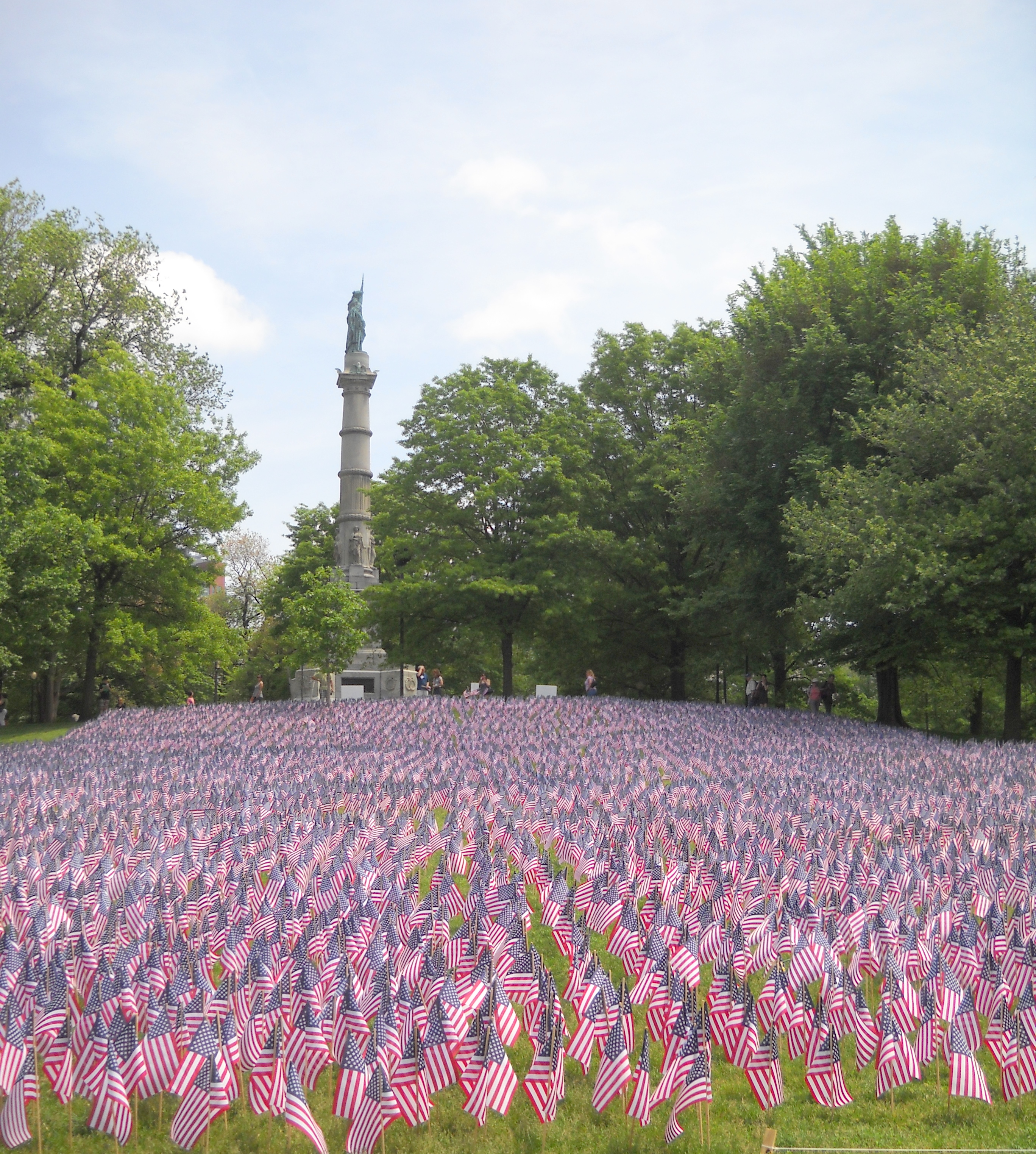
    Yesterday, with the first summer-like weekend since, well since last summer, we went in to Boston to walk around and soak up some sun. As we usually do when we don’t have a specific agenda, we drove in to the City and parked in the underground Common garage.

    Looking to to right as we emerged, I couldn’t help notice a crowd gathering at the foot of the rise that starts mid-Common. And then we saw why.

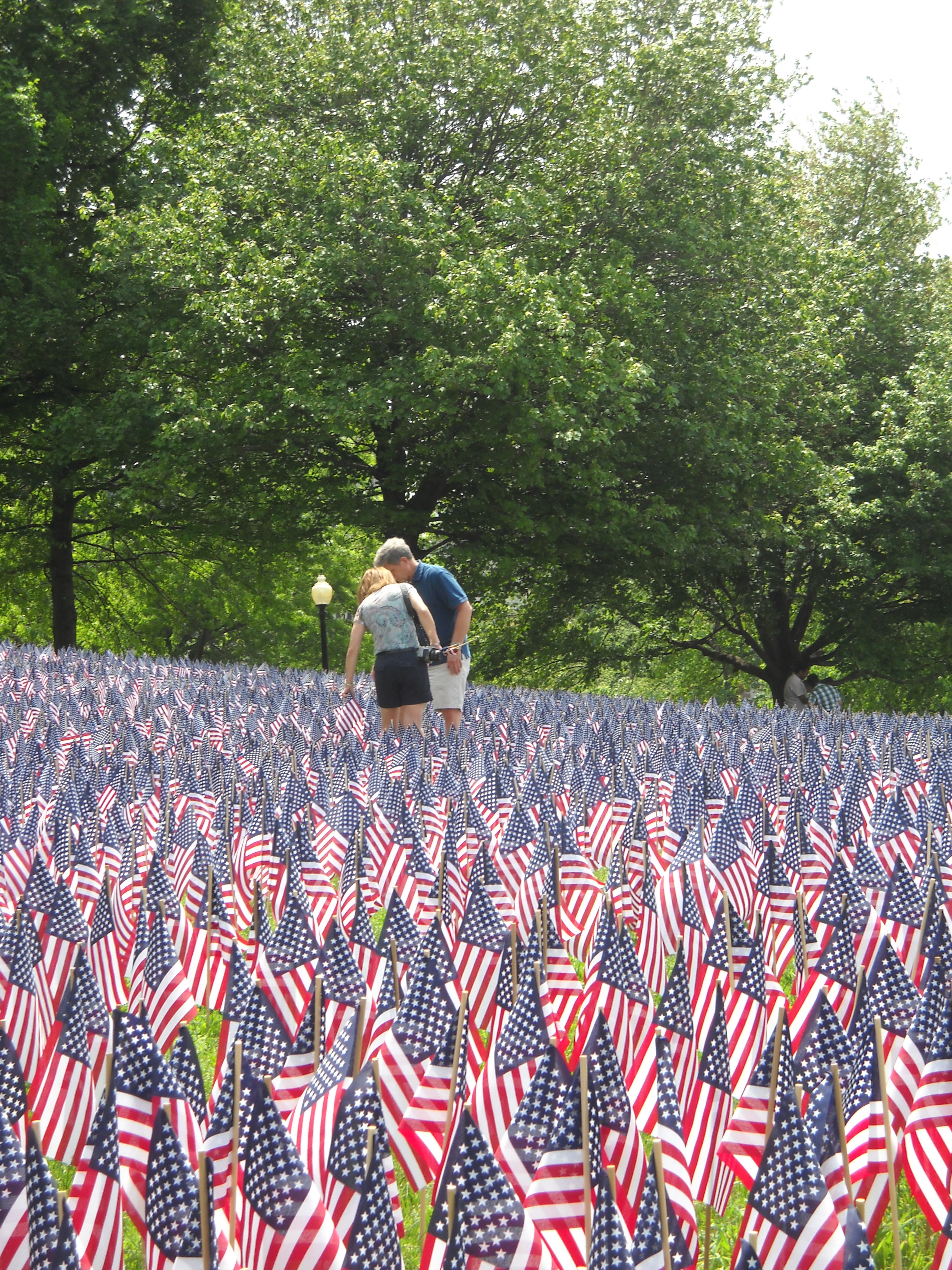
    If you have ever been to Boston Common on a weekend – a good weather weekend – it is teeming with people. Families on the carousel, splashing in the frog pond, softball and baseball leagues playing. It is not a quiet place. But on this day, in this place, hundreds of people walked to the perimeter of this memorial Flag Garden without speaking a word.

    The 20,000 flags placed on this hill are in memory of those who served and died in every war since World War I. The Massachusetts Military Heroes Fund began this project in 2010. Hopefully will continue it each year.

  • This June, with just 3 years  — or maybe 4 if the stock market takes a nose dive — left of my teaching career, I’ve started the process of streamlining.  It seems like a good idea. I certainly don’t have an delusions that all that stuff I’ve been saving “just in case” is going to be manna from heaven for my replacement. But more importantly, we are going to begin using the new Common Core Standards here in Massachusetts.  So this seems like as good a time as any to clean closets and really look at what is useful, may be useful, and should have been in the circular file years ago.

    I find it difficult to let go of those things with which I’ve found some measure of success, even when those “things” have outlived usefulness. For example, I have entire units of author studies that my old grade level team and I developed when we had to use a particular basal for Reading First. Reading First has long expired and I no longer teach second grade, why I couldn’t let go of that remains a mystery. I’m not sure it’s much use to second grade teachers I know — it is so outmoded… as it should be. Our teaching should change over time; to continue to hammer at instruction from viewpoints held long ago is to be stale and not responsive to the kids in front of us.

    So along with the frenzy of record keeping and end-of-year to-do lists, I am taking some time to reflect on what is in my classroom, to finally get rid of the things that are just taking up space, and to redesign the feel of the room.  I want it to be more welcoming and friendly and not so focused on function.  The Daily Cafe has some great information on classroom design, but there are others who have shared their passion for creating spaces that are welcoming to students.

    Lots to think about and consider over the summer. But for now, I can be found next to the recycling bin.