• I traded in my lovely Sicilian surname when I married.  Tired of being referred to as Amy Pugloski, Pugsley or some other variant for the unable-to-read, I agreed to be a Bisson. Seriously, how could that get screwed up?

    Over the years I’ve heard my name pronounced Bi-son (yeah, just like the mammal from the Plains), Bitchell, and several other fun and creative ways. For God’s sake people, it’s only 6 letters. Use the rules of phonics, you know, a vowel surrounded by consonants makes the short sound of the vowel. We’re not even trying to insist on the French pronunciation.

    Last year, I needed a new faculty identification badge. So, despite loving how I look in those deer-in-the-headlight beautifully lit school-picture day shots, I filled out the form, sat on the stool and voila. Two seconds later, I was moving on to the next thing.

    My picture ID came back with my last name spelled…. Bison. I can assure you I do know you to spell my last name. Accurately.

    Of course, school picture day companies are gone by dismissal times so there was no one to complain to. Mrs. Bison remained locked in my desk drawer for the duration. No one here by that name.

    This year, I gave it yet another shot. Again, paying close attention this time to my handwriting, I spelled my last name ever so carefully. B…i….s….s….o…n. Again, deer-in-the-headlight lighting, sit on the stool, badda bing, badda boom, “portrait”  taken.

    How excited was I that I would have my very own, picture identification card hanging from its rightful place around my neck! That is, until I noticed my name. This time, with a nod to informality, my first name appeared on the ID. My last name – no, my last name didn’t make it.  This time I was Besson.

    Good grief. And you thought I was going to write about politics 🙂


  • Many (many) years ago, I read nearly all of Norman Vincent Peale’s Positive Thinking books. I read them during a dark time: I was struggling with the career for which I had trained (which turned out not to be a match); a spiritual life that was unfulfilling. In need of an epiphany, I ended up watching Phil Donohue where I learned about positive thinking and its impact.

    Positive Thought has sustained me many times over the years. It helped me over a career bump. Eventually I found something fulfilling that I felt passionate about. It helped me through a scary illness. It helps me to stay away from the dark side, the part of me that would like to throw in the towel most days.

    As a teacher, I’ve found Positive Thinking is a profound impact on my students and their parents, whether or not they know it is applied.  When I start a conference or when I am writing report card comments, I try to begin with something positive that the student can do. Doesn’t every parent want to hear something good – I know I always did.  Simply providing a laundry list of what a student can’t or won’t do is never met with any sense of partnership between parent and school and the resulting disconnect is hard to repair.

    Our students, our families, and our selves – we all respond to positive thinking, positive talk. In our current educational climate, that is becoming more of a rarity, isn’t it?

    But positive thinking is also a necessity. It is the essence of moving forward.


  • This is a tumultuous time to be a teacher – many, many new mandates are arriving this year making for a lot of teacher discomfort as we try to make sense of things.

    My own personality is that I am an early adopter – not always a good thing I’m sure, but I do tend to try new methods and materials out fairly readily. We have been struggling with Interactive Read Alouds (IRA) and Writing About Reading (with the unfortunate code name WAR in this district – just saying).  The changeover to a more strategically envisioned IRA lesson seemed like a natural extension of the Making Meaning  program we’ve used in our district for about 10 years.

    Writing About Reading (sorry, can’t say WAR – I grew up in the 60s) also feels like what our students need. But the message we’re getting, whether intended or not, is that we need to have our students up and proficient for their grade level expectations nearly immediately.

    In the rush to get our students performing at higher levels, it is far too easy to forget that the students may not be prepared to be successful. So sometimes they are not. Even with pressure on educators, whether perceived or real, can make for a tricky mix – we want our students to do well, we want them prepared for the new and increased demands on them, and we feel like it should happen NOW.

    Last week, I needed to submit an independently produced written response so my grade level could practice applying the district rubric with consistency. So I did and the writing was AWFUL. I had been explicit with students about how to plan for the writing and then set them loose. Bad!

    What I didn’t do was about as devastating as what I did do. I didn’t gradually release the responsibility for writing to my students who had not had this writing experience before.

    So I did what most teachers do – I backed up, apologized that I hadn’t shown them or given them what they needed and started over.  We took a short text from Gouvdis and Harvey about animal adaptations, posed the essential question (“How do different animals adapt to hear in their environments?”), and went to work with a shared modeling. We talked – this is a 75% ELL classroom so we talk first – we made notes together on our planners, we shared our ideas for a topic sentence and a closing sentence, we found the (required) 3 pieces of evidence supporting the topic and then we turned our notes into sentences and paragraphs.

    The take-away from this is that asking kids to do something for which they are unprepared is wrong. I now realize that I had been asking my students to do something they didn’t yet know how to do; something we needed to work on so that gradually the responsibility could be released to them.

    Sorry kids. I promise to do a better job of teaching you from now on!

  • I have to touch the third rail: is education today more assimilation into a one-size-fits-all or is it about reaching a baseline of standards for learning? 

    I ask this because lately it seems that there is an underlying expectation that we plan or are given one lesson and asked to apply it to every student in a grade level or a district or state. Sometimes even the teacher’s dialogue with the students is scripted.

    But my teacher self – the skeptic that I sometimes am – says this makes no sense. How can a lesson applicable to one set of students work flawlessly with another? The students who make up my classroom change from year-to-year. so shouldn’t the instructional delivery also change? The ability to assess where students enter a lesson and how I deliver the instructional supports those students need – shouldn’t that be as student-driven and tailored as possible? Wouldn’t the teacher in front of those students be the best at reading the room and knowing what to do — isn’t that what you pay me to do?

    Levels or distrust, disrespect, demonization. Those trends in our popular culture seem to drive the rush to a scripted, and lock-step curriculum. Silly me, I thought a Masters in Curriculum and Instruction and a 25-year career might provide me with the tools to at least figure out how to move students from point A to point B.

    Students deserve more than a scripted curriculum, one that is often developed by profiteers lurking on the edges of education ready to swoop in and make a profit by manufacturing a crisis in education that often is not real.

    Resistance may be futile – for now. But as long as I’m allowed to teach, I will covertly or overtly continue to resist those one-size, scripted curricula.

  • A colleague of mine once referred to No Child Left Behind as No Teacher Left Standing.  We laughed – later we cried – and now, speaking just for myself here, we are just plain depressed.

    It matters not how diligent an educator is about keeping up with research and data, the stream of new initiatives is never ending.  My professional interest in developing curriculum notwithstanding, absorbing the Common Core standards in BOTH English Language Arts and Mathematics, locating resources for teaching – resources that are high quality and (with a nod to my own personal finances, free) are very seldom available, all takes time.

    Instructional planning takes thought and consideration. This often means inventing something from the ground up, something tailored to help meet the needs of very diverse learners. I don’t mind that part as much as I mind getting the curriculum guides a weekend before I actually need to teach the unit.

    I work with some terrifically talented grade level colleagues who willingly share – thank goodness!  We often meet on our own time and collaborate. If one of us finds something, we share with the others.  How lucky I am to work in such an environment.

    Because what is happening in education now is putting such stress on teachers, that frustrations and emotions are nearly always at the surface.  And that feeling that we are all “in the weeds” just will not go away.


  • It is a reward unlike any monetary bonus or plaque. I can’t speak for other educators, but I live for the moment when there is that small, fleeting glimmer that there has been a connection between students and teacher.

    At this time in the school year, I am still sorting out student learning styles and personalities. Still trying to figure out how to engage some students or get out of the way of others.

    I noticed one of my more quiet second language learners, one who hardly engages in eye contact, trying to avoid any engagement with me for several days. As part of interactive read-aloud, we had been working on verbal stems for acceptable (and polite! Politician take note!) discourse – “I agree with ____ because…..”, “I disagree with ____ because….”, “In addition to what ____ said, I think….”). This activity may sound stilted to you, but for my students who don’t really speak in sentences – second language or not – it is a critical building block for oral language, socially acceptable expression of opinions, and written language.

    So yesterday, as we “discussed” the plot of Kevin Henkes Julius, Baby of the WorldI put my new friend on the spot. At first she did what many second language learners do – she shook her head no, she averted her eyes, and she locked her lips down. Those of you who know me, will know that wasn’t going to fly.

    So gently, I fed her the stem…. and after 2 or 3 cajoling nudges, out came the most wonderful contribution to our discussion! And with that, a small glimmer of a smile previously hidden from me. The moment was so brief that I wasn’t sure I had caught it. But for this one student, it seemed to convey, a new confidence and a connection to not only me, but to the safety of our classroom group.

    And that is exactly why I love teaching!

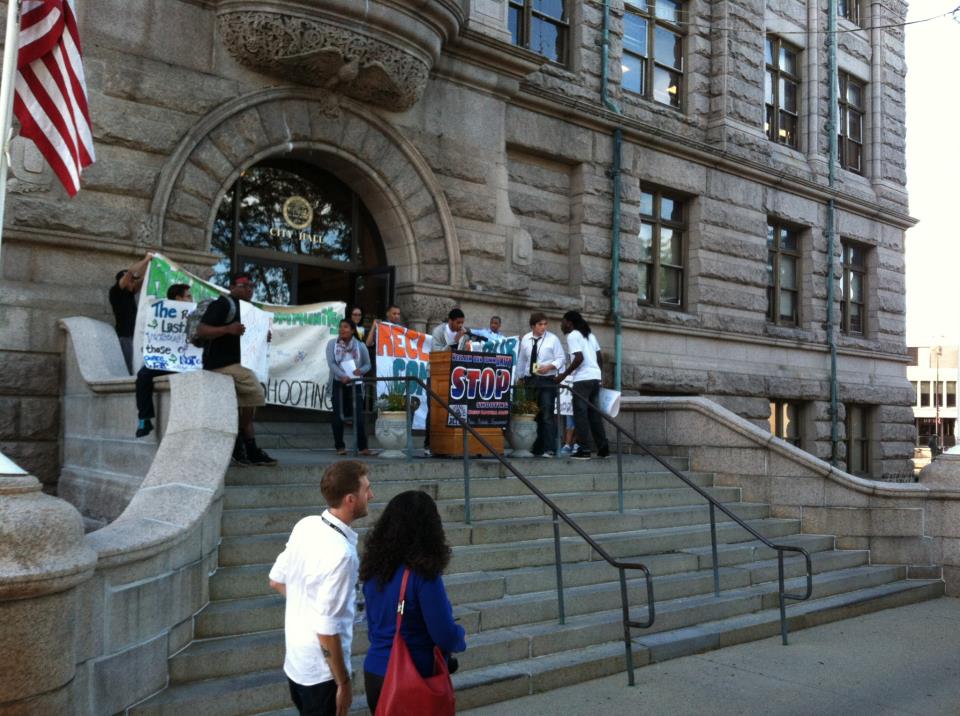
  • It was at the end of our school day yesterday when one of my students matter-of-factly asked if I had heard about “the shooting”. Knowing about the violent incident this past weekend on a street near my elementary school, I waited for her to continue. Which she did. As if it weren’t something out of the ordinary, this 8-year-old described how her mother brought my students and her sibling to an upstairs bedroom where they would be safe from further gunfire. And this revelation led another student to share that he lived on the next street and also  heard gunshots.

    Can I just be on the record that no 8-year-old should have to deal with this?

    A few years ago, one of my students was nearly hit when a stray bullet went through the front window of her family’s apartment on the same street. When I asked what she did next, she told me she just got on the floor. Simple as that as if a bullet going through the front window was not that unusual.

    So yesterday, when I heard about a walk, a community response event sponsored by several city neighborhood groups and UTEC (United Teen Equality Center), I felt the need to walk in support of my students, many of whom are exposed to violence and trauma in ways that are normally quite easy to shut out.

    As the walkers traveled from City Hall in silence, I realized how easy it is to detach from the violence my own students deal with. This simple act, made it real – as one speaker said, tonight we would not be driving by, we would stop and reflect on the recent city violence.

    I don’t have many answers for my students; they live in an environment that I, a product of white, middle-class upbringing, can hardly begin to imagine.

    Eight-year-old or eighty-eight years old, violence is never an answer. Walking with those whose lives are highly impacted by such events made turning away impossible.

  • If you listen to the pundits, the coming presidential election is boiled down to a single question: Am I better off today than I was 4 years ago?

    I think it’s more complicated than a “yes” or “no”.

    Certainly my family’s monetary worth is not better, however, I do not blame presidential policy for this. The damages were done long before the 2008 election.

    Speaking of my own income, compensation has not increased much over the last several years. After 4 years of Mitt Romney gutting Massachusetts education funding (through state aid, etc.), there were and are draconian cuts to local school budgets. At one point in the last contract negotiations, a school committee negotiating member proposed a NEGATIVE raise. Several years lapsed with either a 0% raise or without a new contract, effectively a 0% raise as teachers worked at salary levels negotiated 1, 2 or more years earlier.

    But that’s only the obvious. As school budgets were cut and personnel essential to supporting students disappeared, every line item was slashed. That includes supplies – supplies that teachers need to implement the very curriculum that we are held accountable for. Does this sound like Catch 22? The materials had to be procured somehow; guess where the funding came from? If you said out of my personal money, you would be on target.

    In the last year, I’ve seen some improvement to school funding. There is a price to be paid for that – some of that policy I disagree with – but some positions have been restored. And for this change, I can say I am better off. Not restored to what things should be as there is much work to be done – but the fiscal improvements toward funding education are a step in the right direction.

    My opinion is that the state of our country’s fiscal health was well-hidden by the previous administration.  The recovery process is only in its beginnings; the US economy – tied as it is to world economy and coming from a state of near collapse 4 years ago – is going to need a long recovery.

    A simple yes or no answer to “Am I better off” really isn’t that helpful.

  • The first days of a school year always challenge me. Often, I feel like I’m not, you know, getting anywhere. Last week (northeastern Massachusetts schools often begin before Labor Day unlike many districts inside of Route 123), was no different. As my students came into the classroom I came to the panicked realization that they weren’t even aware of the expectations for arrival routines!

    What to teach that first day when there are so many critical and essential things to be taught when there are so many essentials? As an enthusiastic Daily Five fan, applying the 10 Steps to Independence to basics seems natural — we’ve applied it to walking in the hallway, to getting started on the day and closing off  a good day’s work, even to fire drill practice.

    We’ve got a long way to go before the day moves seamlessly. But we are well on the way to student independence, to building an environment in which I can trust students to make good choices about their learning – an in which my  students can trust me to guide them when needed.

  • The start of school is looming and I am spending some time thinking about how I’d like to change-up some of our learning activities. With all the attention on the Common Core in our District, and with the commitment to Launch-Explore-Summary lesson structures, I am once again tweaking Daily Five for math.

    The basics of the philosophy and research behind the Daily Five, whether it is in math or literacy, always are there.  Clearly stated and modeled expectations (10 Steps to Independence), choice, brain research-based lesson structures (thank you Michael Grinder!).  Now, however, we are fitting this into our Launch-Explore-Summary lesson structure.

    My newest iteration of the Daily Five for math is the Daily Explore Plus Four.  Using Launch-Explore-Summary, the target lesson follows our District curriculum modules in mathematics.  A focus lesson, approximately 10 minutes long, introduces the day’s math exploration.  Students can then begin to work on that exploration while I monitor who is able to persevere through the problem or activity and which students needs some additional support.

    After about 20 minutes of independent work, we will re-gather as a group.  For this focus lesson, there may be an opportunity to share solutions (or partial solutions), talk about what was uncovered in the Explore, or continue with another 10 minute whole group learning activity.

    Before dismissing students to work on other math activities, just as we do in the Daily Five for literacy, students will indicate what activities they plan to participate in during remaining independent times. Here is where most students will participate in the ‘plus four’ activities (Strategy Games, Drills and Fact Practice, Technology, Problem Solving).

    During the second independent time (another 30-40 minutes), while students work on their chosen independent activity, I will be able to meet with a small group or meet individually with students who struggle with a mathematical concept.  For teachers who are already deep in to the Daily Five in Literacy, think individual conferences with a mathematics focus.

    At the end of the math period, we will once again, re-gather as a whole group to summarize what our math goal was – and process whether or not we feel like it was accomplished – and 3 or 4 days of the week I plan to implement a 5-10 minute “Math Talk” based on Sherri Parrish’s Number Talks book.  On the fifth day, I’ll use the time to check on math fact fluency (a requirement for 3rd graders in the Common Core standards).

    This is a flipped version of what we’ve traditionally done in math class.  In the past, the planned lesson based on the pacing criteria took about 60 minutes and the intervention/small group instructional block was 30 minutes.  With the knowledge that some students will choose to keep “exploring” during the second independent session, the model has flipped so that launch and explore are accomplished within the first 30 minutes of math.

    Why do I think this is a good move? Well, for starters, I know I will get a better use of time by meeting with smaller, focused groups – the same way I see improved focus during individualized reading conferences.  Secondly, by strategically choosing strategy games that align with the standards currently being taught, students will have additional opportunity to practice those skills in a fun way. Analyzing test data will allow me to target and  support additional skill and strategy practice where students need it in the ‘plus four’ as well. The flexibility is endless.

    The start of a new school can be exhilarating and frightening all at the same time. I am definitely looking forward to a change-up of our math time; one that I think will be more beneficial to my students.