• When you ask kids about their favorite subject in school, one of the most popular answers (after lunch) are “recess” and “gym”. Why is that?

    chute2

    Kids seem to inherently know they need some physical exercise. They know they feel better when they get to move around. Brain and body breaks aside, kids need to exercise.

    So why is it that in the current educational culture, recess and gym are given the short straw? This school year, my students were allotted 10 minutes (including travel time) recess time and 50 minutes of gym instruction.  I’m sure they run (!) right home and go outdoors to play after school – not.

    From my perspective, childhood obesity is not just some sad story on the evening news. It is real. And we need to start by allowing students more time to get out there and move.

  • About six weeks ago, I found an article in the Washington Post that caught my attention: School Lunch Can Be A Teachable Moment.

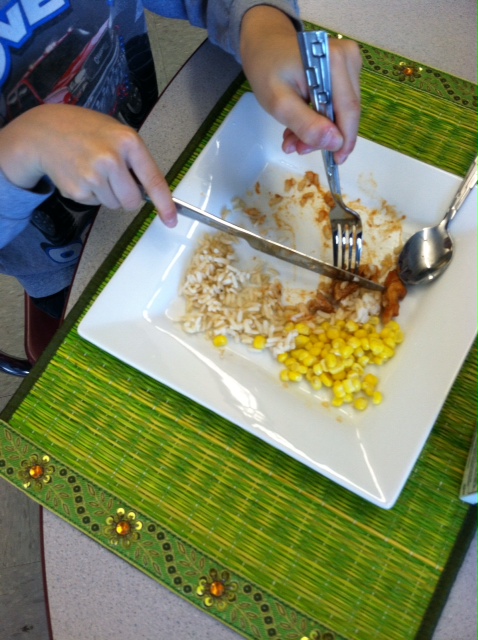
    lunchphoto1Does the institutional nature of school lunch periods make a difference to kids? The idea that using place settings to create a more civilized lunch period sent me straight to Home Goods (our local source of discounted home furnishings).

    Our school days are short of time; devoting time for students and teachers to eat together as the author of the Post article advocates just doesn’t seem to be possible. But there was something I could do. My idea? To use one lunch period each week to each with a small group of students.

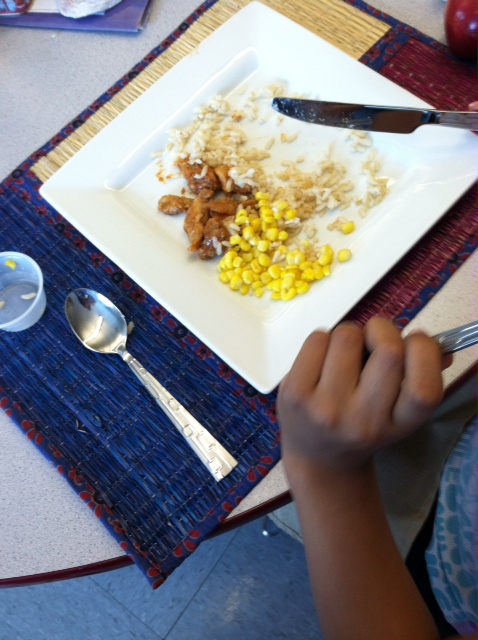
    The environmentally-unfriendly styrofoam trays, and plastic baggie filled with a spork and paper napkin were replaced with actual silverware, plates,lunchphoto2 napkins and place mats. Each week we pick a day for a group of 4 students to eat upstairs – fancy lunch.

    It has been such a fun experience for all of us I think. First of all, the calmness of eating in a classroom was not lost on any of the students. Each group has commented on the quietness of eating together, of having quiet conversations.

    Many of my students don’t eat at a table with the family for dinner or supper. They shared that they often eat in front of a television, in a living room, using finger foods. We practiced setting a table with silverware, we learn to utensils, we learn to cut food into bite-sized portions.

    We are learning to enjoy a meal together.

  • Recently I happened upon a video of Steve Jobs giving the 2005 Commencement address at Stanford University.  Having sat through a number of such addresses – and well aware of how rare is the speech that is remembered 30 minutes afterwards – I was curious what, beside the celebrity of the speech-maker, might be the substance that made this video worth watching.

    If you have 15 minutes, the video is posted here, but there is also a transcript link here.

    The take-away? Three of life’s most powerful pieces of advice – trust your own instincts; don’t settle, pursue your dreams; live your life as if today was to be your last.

    In the current education environment under which I work, it is difficult and near impossible to follow this advice. My instincts tell me that trying to squish a load of (ahem) stuff into the heads of young learners isn’t working. It is making for miserable kids who don’t excel in the learning mode that is required to perform “successfully” (quotes on purpose). I wonder what the percentage of students who just plain give up might be.

    I worry a lot about the future of education. Imagine a time when a student being able to pursue the study of something like calligraphy either in high school or college, just because. There is far too much pressure on students and on their training to be successful after graduation(s). Had Steve Jobs not taken the path through college that he did, Apple’s dedication to elegance of design in all things Apple, from fonts to hardware, may not have happened.

    I am at a turning point in my career – I don’t have many years left to do this thing that I love so well. “Don’t settle, pursue your dreams….” and “live each day as if it were your last.” Is what is happening in classrooms today the way I want my students to remember their early education? 

    When the answer is no, there is work to be done.

    Your time is limited, so don’t waste it living someone else’s life. Don’t be trapped by dogma — which is living with the results of other people’s thinking. Don’t let the noise of others’ opinions drown out your own inner voice. And most important, have the courage to follow your heart and intuition. They somehow already know what you truly want to become. Everything else is secondary.

    Stay hungry. Stay foolish.

  • I am an avid reader of the Choice Literacy website. I love reading what the leaders in literacy have to say and particularly value those who not only share their pedagogy and thinking, but also work in classrooms with real students.  Franki Sibberson is one of those contributors on Choice Literacy; her writings always make me consider changes that can be made to the way I think about and deliver lessons to my students.

    This is Franki’s post from this morning.  When I read it, it became clear to me that while the pull-outs for Tier 3 interventions give my struggling readers support the way instruction at K-2 does, my on- and above-grade readers need greater independence. And – surprise, surprise – every student needs the opportunity to read independently.  That’s something I’ve said all along: Readers can’t grow to be better readers if they never get the opportunity to try out or practice reading on their own. Oddly, I feel validated now – and more determined to make this happen in my classroom.

    As an experienced teacher, what Franki shares about learning – and letting go – with intermediate readers really resounded with me.  We struggle at our school with  providing just-right support to the readers who should be able to soar as readers with greater sophistication and skill alongside those who need greater support.  Reading Franki’s article in Choice Literacy this morning made me see things in a new light: in my new 3rd- and soon-to-be 4th-grade classroom, I have two very different groups of readers. The level instruction must be different and will look different.

    This appears to fit with what our District reading guidelines.  As a district, we are moving toward book clubs and conferring in Grades 3 and 4. It is a model that I’ve dabbled in with my third graders – and now it will become more frequent. Our struggling readers receive Tier 3 supports through a pull-out program for 30 minutes a day – that will be their “guided reading”.  Thinking of these two models side-by-side helps me to understand how to differentiate the literacy block for all readers.

    Teacher has had an aha moment.

  • Yesterday, we – my class and I – wrapped up our standardized state testing for 2013.  What a long, strange, trip it has been.

    Starting last March with our Reading MCAS test, my students have been demonstrating their knowledge of third grade skills.  That’s right, last March, when we were 7 months into our academic year (minus the week of snow days), my students had to demonstrate their end of year proficiency in Reading.  I may not have been the best math student on the planet, but I know that 7 months does not equal an entire school year.

    Yesterday, students completed their Mathematics tests. They worked so hard it is easy to forget that they are not taking the SAT or PSAT; they are 8- and 9-year olds performing on tests that take unbelievable amounts of stamina even if you are older.

    Kids are kids. While one child finishes a 45-minute test in 20 minutes, another will take twice or three times that time. One student completed the test twice – she literally went back to each question, reworked the answer and then wrote a sentence or two explanation for why her math was correct.  Two and one-half hours later, she finished this 45-minute test. After months of telling kids to “check, check, and double-check” your answers, I certainly was not going to discourage her effort!

    We had the usual events out of our control: no glasses…. sick…. Hopefully the impact of those variables won’t be too great; however, my experience with MCAS – and now that it plays a part in my own teacher evaluation this becomes more important – is that it can have an impact and I do need to document just in case. Sad but true, MCAS is not just about student achievement.

    So yesterday we put a period at the end of “MCAS 2013”, and today we return to our regular classroom routines. I can’t put a quantifier on it, but the classroom mood sure seems a lot lighter.


  • This week my principal approached me with an intriguing question – would you be willing to loop to fourth grade with your students?

    I needed a little time to think about that, but not for the reasons you might assume. My hesitation had nothing to do with a repeat year with my students, some of whom have been quite a challenge this year.

    You see, I’ve been in my classroom space for the past 6 years; the thought of moving (again) was just depressing. Imagine the amount of treasure I’ve saved in those closets “just in case”. Secondly, not all of our classrooms have been equipped with the projection and MOBI technology that we have been using this year. Would my “new” space – because I would be trading classrooms with a colleague from Grade 4 — have this technology installed?

    In the end, of course I said yes. The fourth grade teacher with whom I will share this adventure is similarly excited and we’ve already begun to meet to toss around ideas for making transitioning easy for both of us.

    I look at my students differently already. I know I get an opportunity to start a school year with them at an advantage: they already know me (and my limits) and I know them too.

    So while I needed a moment to consider this idea, I am excited to start planning and preparing for another year with the same students. And I am looking for advice from teachers who have done this. Do you loop?

  • Their uncle called them “losers”.

    What can make a difference in the life of a youth whose behaviors are at once destructive to humanity and self-destructive?

    We hope and wait for answers to the “why” of the Marathon tragedy; those answers may never materialize. Why was there such a disconnect to the rest of humankind? Why would creating bombs and firing guns be an answer?

    Last year, Adrien worked to photograph a wonderful organization working with Lowell area youth. The group, UTEC, (United Teen Equality Center) has the mission to “ignite and nurture the ambition of Lowell’s most disconnected young people to trade violence and poverty for social and economic success”.  

    Listen to the stories these young people tell of how they were once disenfranchised and the difference UTEC has made in their lives. The following short video and the story of the project are the results of Adrien’s association with UTEC last summer.

    At this time when we are wondering what triggered the Tsarneav brothers to disconnect from humanity, it makes me pause and wonder if there was a moment that might have changed their course as well.  This is, of course, a mammoth leap of speculation.

    We may never know that answer to why the Tsarneav brothers did what they did, why their uncle called them “losers”. But we can be thankful for the UTECs of the world who help the disenfranchised become successful members of the world in which they live.

  • It has been a hellish week, this vacation week that so many of us in Massachusetts looked forward to. Today we are about and around in sunny, but unseasonably cool spring weather. The grass has finally decided to green up, daffodils feel safe poking up from the damp earth. Most of our routines have returned normally – things seem the same, but they are forever changed.

    In New England we continue to feel pain. Words fail most of us. So we hug, we cry, we read – and some of us write, or at least try to do so.

    Yes, the suspects – or at least the ones who seem directly connected by evidence – of this heinous atrocity seem to be either dead or locked up. But I defy any human not to think of the four victims of Marathon Monday’s bombing without an indelible sadness of 4 lives that were cut short too soon. Or the lives of those people who, simply by going outdoors on a fine April morning, now have the climb of a lifetime ahead of them. Will we ever feel safe again in a crowd?

    Yesterday, a priest at St. Irene’s Church in Carlisle gave one of the most powerful homilies about evil and good that I have ever heard. At the end of his talk he read this Facebook posting from Cam Siciliano, which I quote here:

    I don’t want to know his name. I don’t want to see his face. I don’t want to know his life’s history, his back-story, who his family is, where he went to school, or what he liked to do in his spare time. I don’t want to know what “cause”, if any, he was fighting for. I don’t want to know why he did it, or may have done it, or what possessed him to carry out his actions. I don’t want to know. Because that’s what he really wants. I’ll be damned if I’m going to give him what he wants.

    Put him on trial, but don’t cover it. Tell me when you decide to jail him for three lifetimes – because that number matters. That’s the number of lives he has to now pay for. That’s all I want to know about him. Nothing else.

    Instead, tell me about the first responders who ran towards the fray, within seconds, fearless. Tell me about the ones wearing the yellow volunteer jacket, or the neon police vest, or even the ones in the regular everyday t-shirt who became a helper. Tell me the story about the first responder who held gauze over a wound until they made it to the hospital. Tell me the story about the volunteer who held the hand of the injured spectator until they got into the ambulance. In six months, tell me the story of those who lost a limb, who beat the odds, pulled through countless surgeries, and are learning to walk again. Tell me the story about the love, the compassion, and the never-ending support of thousands, millions, of people who support the victims here. Tell me their stories. Tell me everything you can, because they are the ones that matter. Tell me of the good that they have done, are doing, and will continue to do, regardless of… No, not regardless of, in spite of. In spite of that someone who would do them harm. Because that’s what freedom in this country means. It means coming together in the hardest of times, even in the face of unfathomable adversity, to make life better for all those around us.

    Tell me the good stories. That’s all I want to hear.

    I know that at some point I need to learn about the two alleged perpetrators of this atrocity. If there is something that can be gleaned from their self-destructive path that will help the disenfranchised students that I often-times see, I will need to reflect on that. Maybe there is some connection that can be made, maybe not.

    But for now, I too, need to hear about the good, the kind, the compassionate humans who rose above the evil that we have just experienced this past week. Don’t we all?

  • I know that I have only one voice. But I have one, and I am determined to use it.

    On the four month anniversary of Sandy Hook, we are reminded that nothing has been done to prevent yet another shooting of this nature.  Listen to the family members of the victims in this tragedy. They live the aftermath of our society’s inability to do something. 60 minutes 4-7-2013

    Today, family members of the victims of this tragedy will be in Washington, DC. I implore our representatives in Congress to listen – do not rush by arrogantly and claim you are “all set” as one insensitive Connecticut representative does in the video.  Listen, listen to these people who will live with the aftermath of this tragedy for the rest of their days.

    We cannot afford to be complacent, afraid of controversy, or stubbornly one-sided in these discussions. This is a complicated issues — along with gun control, we can no longer ignore those who face mental challenges, and yet, through stigma and misconception, are outcast from receiving meaningful help and assistance. We cannot allow, as the NRA has suggested, our schools to become armed bastions.

    Something needs to change here. It’s not just Sandy Hook – violence impacts families and communities every day. Read, or at the very least, look at the graphic of mass shootings found this article from Mother Jones.

    My own students sometimes come to class – third grade – with stories of guns going off in their neighborhood. They know the difference between a car backfiring and the sound of a gun. Is this the kind of childhood we want for our children?

    Please contact your own congressional representatives.  I have.


  • I’m afraid we didn’t get very far in “diving deeper” into today’s poetry selection. Mostly, today was a lesson in multiple meanings of words. By that, I mean, a word that meant one thing in the mid- to late-1800s (when this poem was written) and the colloquially accepted meanings that kids hear today.

    First of all, there was quite a bit of twitter about the fact that the poet of our first selection – Emily Dickenson – has a name that makes immature minds go into hysterics. Because, you know, her name has DICK in it. At that point, I knew this selection would be trouble. I just didn’t know how much trouble I was in for.

    Here’s the text of the poem:

    AUTUMN
    Emily Dickinson

    The morns are meeker than they were,
    The nuts are getting brown;
    The berry’s cheek is plumper,
    The rose is out of town.

    The maple wears a gayer scarf,
    The field a scarlet gown.
    Lest I should be old-fashioned,
    I’ll put a trinket on.

    I anticipated “gayer” would cause a reaction, so I spent some time explaining that “gay” had another meaning when the poet was writing.

    Of course the little congregation of 9-year old boys at the back corner of the rug thought “nuts are getting brown” was hysterical. They couldn’t contain their delight — definitely wanted to share their unique perspective with all sitting within earshot.

    Maybe now that we have worked out all the vocabulary minefields, we can study this poem as the curriculum developers intended. Or not.