 For 30 years, I was a teacher in both private and public elementary schools. I certainly was not a perfect teacher, and I made more than my share of missteps, especially in interactions with students.
Experience can be an exacting teacher, however. One of the most important and useful lessons I learned was that for empathetic practitioners, there is no such thing as “zero tolerance”. Despite one’s insistence that a rule be followed without exceptions, the reality is simply the opposite. In a world of right-or-wrong, black-or-white, there is always a gray space.
Take a school’s zero tolerance for wearing caps in school as an example. On the surface, such a policy seems simple enough particularly for those of us who were brought up in the generation of “men do not wear caps inside.” I share with you an anecdote from my time as an elementary teacher.
One morning, a student of mine walked into my third grade classroom just on the cusp of the tardy bell. His head was down, he hadn’t gone to his locker, he made zero eye contact with anyone and… he had his baseball cap firmly on his head. This student was a leader, well-liked and respected by his peers and, even at his most challenging, liked by his teachers. When I asked him to take off his cap, as was the rule, he simply looked down and shook his head defiantly.
As I was about to escalate this conversation, I was saved from being a jerk by the school’s social worker who had cajoled the whole cap story from this child. For some reason, this student’s father had taken to giving the child an at-home hair cut, leaving tufts of his hair randomly interspersed between patches of skin. My student was mortified that his friends would see his new haircut and, as kids often do, taunt him mercilessly. So in a nod to the gray area, the zero-tolerance of caps in school was abandoned and the cap stayed on.
I tell this story because there is an important take-away for every “zero tolerance” situation, including the one currently unfolding in our government. The consequence of this government’s action however is far less benign than becoming an over-zealous enforcer of school rules.
Zero tolerance should never become an absolute; there are far too many extenuating circumstances that can and should guide it. It is a lesson our government could and should apply as well.
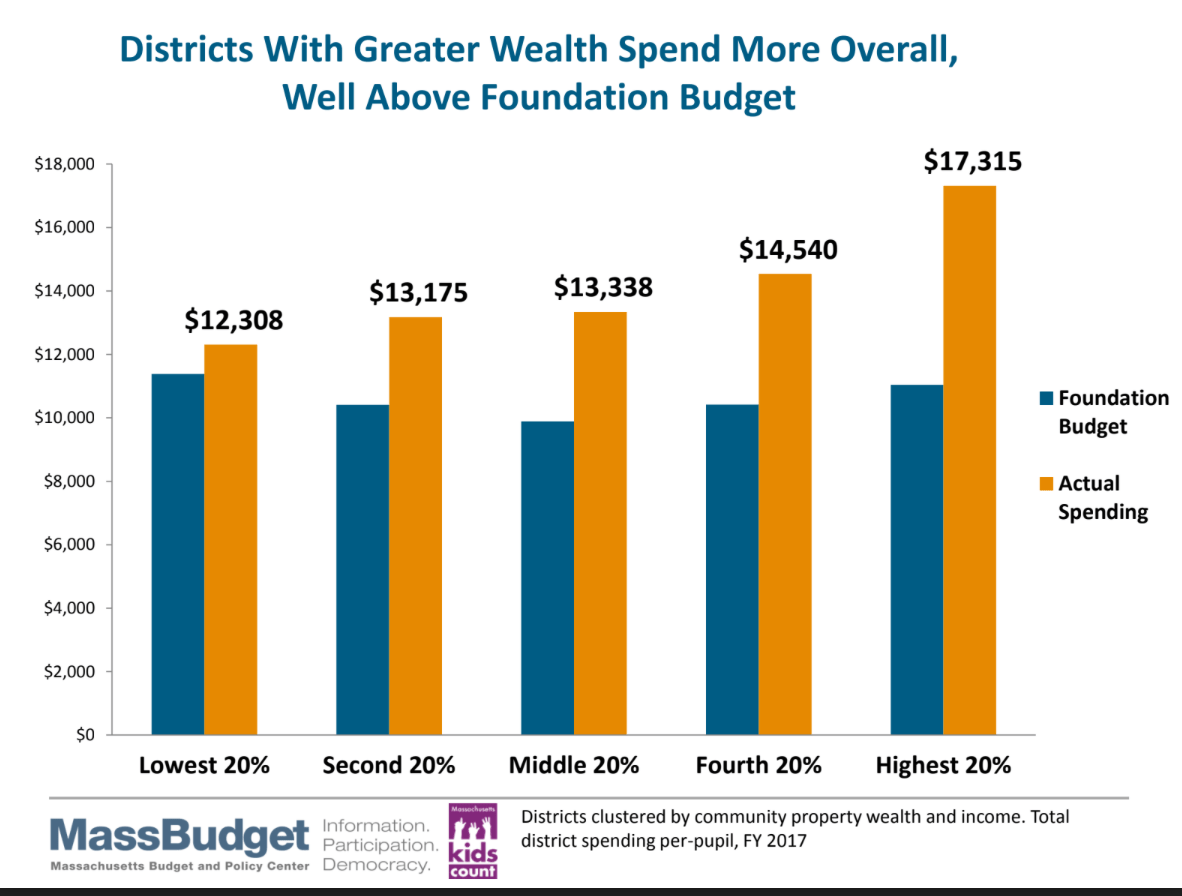
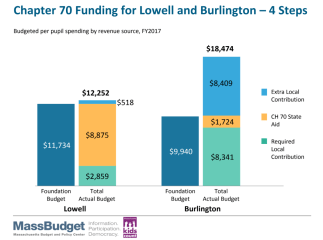 example: in neighboring Burlington, MA, the per pupil cost calculated $9,940. In Lowell, that base number is set at $11,734. Based on the economics of each community, the Commonwealth determined that Burlington’s state aid be set at $1,724 leaving the remainder, $8,341, for the Town of Burlington to provide. Recognizing that Lowell’s community economics are different from Burlington, the numbers look quite different: state aid is $8,875 and the City’s required contribution is $2,859. In an effort the keep this “simple”, which it is not, I’m ignoring the whole cash vs. “in kind services” debate.
 Senator Charles Shumer and Representative Nancy Pelosi have published their collective ideas supporting public education. Their 5-point proposal can be found in
  t’s budget time once again in Lowell and if you thought last year’s budget was a squeaker, wait until you see this year’s edition.
 I was in Boston this past weekend to be an ally for the student organizers of March for Our Lives, Boston.
 responses to active shooters several times a year. The protocols and program acronyms, such as the
 I am abundantly aware of the ridiculous response to keeping students safe from an intruder carrying an assault weapon into a school building. The response in such situations might mean a lock down. It might mean running. It might mean creating a barricade by piling furniture at the egresses. If the shooter enters the classroom, we teach students to run around, scream, or throw items such as staplers and books in an attempt to distract the intruder.
 he students know that safety from an intruder armed with an assault weapon is not just an issue for schools. It can happen in nightclubs. It can happen in outdoor concerts. It can happen in churches. An assault rifle can p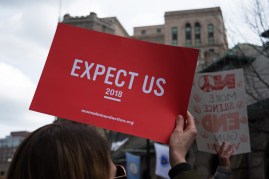
 In case you weren’t paying attention, it is budget season here in Lowell, Massachusetts. The Superintendent’s proposed budget is based on funds coming from Chapter 70 (state aide) and funds allocated by the City of Lowell. There are lots of moving parts to this process, including budget hearings which are generally open to the public and to public participation. The result is a financial roadmap for the coming fiscal year.





 Did you happen upon KQED’s interview with San Francisco educator, Michael Essien, principal of MLK Middle School? If not,
  Some years ago, I enrolled in an Italian language class at Boston Language Institute. The class met for 3 hours – no break – several times each week. The instructor only spoke my “new” language, Italian, for the entirety of the three hours. We had some written materials, some listening resources, but mainly we were expected to immerse ourselves in Italian. If this sounds like what happens in a classroom, I would agree.
 After An Educator's Journey