• As almost everyone with a stake in public education knows, Massachusetts funding of Public School education is in dire need of updating. Since 1993 when Education Reform and the Foundation Budget calculations were developed, there has been little done by the Commonwealth of Massachusetts to update the funding formulae and account for changes in costs over the past 26 years.

    Last July, after the Massachusetts Senate unanimously passed legislation to update the Foundation Budget formulae, the attention turned to the Massachusetts House of Representatives. Sadly, the Foundation Budget Reform legislation was unsuccessful in the House and the entire effort fell short.

    A broad coalition of advocates for not only K-12 public education funding reforms, but also Massachusetts public higher education reform worked together throughout the Fall of 2018. In early January 2019 when the new Legislature was seated, the coalition presented two critical Acts designed to provide funds for all students across Massachusetts public education systems. The two acts, the Promise Act and the Cherish Act, endeavor to bring critical funding support to K-12 public education and public higher education respectively.

    As part of the state-wide and local coalitions working together, Lowell Education Justice Alliance or LEJA, has been hard at work in the Merrimack Valley to bring attention to the critical effort to update funding of our public schools. Along with LEJA, there is broad support from Massachusetts Education Justice Alliance (MEJA), Massachusetts American Federation of Teachers or AFT-MA, Massachusetts Teachers Association (MTA), SEIU, and teachers’ union locals in the Lowell area, including UTL495. By establishing this broad coalition and working with students, parents, and the community at large, we intend to bring attention to the needs that our schools are experiencing and work to fund our public schools adequately for the next school year.

    On Monday, March 11, 2019, the groups sponsored a well-attended Legislative Forum which included Senator Ed Kennedy and a representative from Senator Barry Finegold’s office, and Representatives Rady Mom, Tami Gouveia, Tom Golden, Marc Lombardo, and a representatives from David Nangle’s office. Parents, students, educators, school administrators, and community members spoke about how underfunding schools has made a personal impact. We were fortunate to speak to several of the participants before and after their testimony, and we have compiled some of their ideas in our podcast, Episode 35.

    It is clear that while many in the Massachusetts Legislature do understand the impact of under-funding schools and why that must change, not everyone does. We hope you, our listeners will consider joining this effort to convince local Legislators that our students cannot wait. We need to fix the Foundation Budget Formula now and Fund Our Future.

    You can listen to Lowell Legislative Forum participants talk about why the Promise and Cherish Acts are important on this podcast from Episode 35, UTL StraightTalk.

    FOR MORE INFORMATION

    Lowell is, according the Massachusetts Budget and Policy Center, underfunded by $42 Million each year. You can read more about Lowell’s underfunding by downloading this flyer.

    BUT, Lowell is not alone in underfunded Foundation Budget funding. Get the Facts about Funding Our Future by linking to AFT-MA Fund Our Future website OR use this interactive map from MTA to select a city or town in MA and discover how much that municipality is underfunded.

    Confused about how the Foundation Budget works. We were too – take a look at this short video featuring Colin Jones from Massachusetts Budget & Policy Center. Mass Budget & Policy Center also maintains an excellent website of resources if you are looking for more information.

    Lowell Education Justice Alliance (LEJA) meets regularly in Lowell to advocate for students and public education locally. You can keep up with their efforts by joining the group on Facebook OR emailing lowelleducationjusticealliance@gmail.com for more details. All who are interested in Lowell Public education, whether a students, parent, educator or community member are welcome to attend meetings.

    LEJA is affiliated with Massachusetts Education Justice Alliance or MEJA. You can visit the MEJA website for more information by clicking here.

    If you are moved to contact your State Legislator to add your own voice and to raise your concerns about the Foundation Budget, you can find contact information for every member of the Massachusetts Senate or House by using Find My Legislator.

    United Teachers Of Lowell 495 is participating in several statewide events for Fund Our Future. Please be sure to check our email blast, Five for Friday for dates and times. We welcome all members to make suggestions for future events.

    PHENOM, of Public Higher Education Network of Massachusetts, has a lot of information about the higher education funding bill, the Cherish Act.

    If you were unable to attend the Forum, you can see a video recording of the presentations on Massachusetts Education Justice Alliance’s Facebook page.


  • Photo by Pixabay on Pexels.com

    Last week, the Lowell School Committee and anyone who was listening to the School Committee’s meeting heard the LPS McKinney-Vento report. The report enumerates homeless students in the Lowell Public Schools as defined by McKinney-Vento act:

    The McKinney-Vento act defines homeless students as students who lack a fixed, regular and adequate nighttime residence due to economic hardship, loss of housing or a similar reason.

    – March 1, 2019 Report to Lowell School Committee

    As of March 1, that number in Lowell was 982 – and actually climbed a bit from there due to students displaced by two fires in the City. The reported number of homeless children, however, represents 5 percent of Lowell Public Schools’ students.

    This is a heart-breaking situation, and it is one that I, a former teacher, was aware of when I was a teacher. Nearly every year in which I taught, I had one – and sometimes more – students who were identified as homeless. They lived in shelters, they lived temporarily with a neighbor or relatives, and yes, some of them were living in a vehicle until their situation was discovered by Social Workers.

    This brings me to the point of writing this entry: in our public schools, we rely on Social Workers, Counselors, and Health professionals to help us not only to identify which students and families are in trauma, but to help mitigate the circumstances in which they find themselves. In our public schools, with 5 percent of a given student population in crisis due to housing uncertainty, that is a massive responsibility for which there are some, but not many solutions.

    Lowell’s McKinney-Vento report sparked a lot of conversations, as well as people asking “what can we do”? I don’t know the answer to that, but I do know our school social workers, with caseloads stretched beyond reasonableness, are a key response to students and families living the trauma of becoming homeless.

    With burgeoning caseloads, our schools need more professional, trained school counselors, social workers, and wrap-around services to support the homeless in our midst. That, of course, takes a monetary investment.

    You may have heard me state that the outdated Foundation Budget calculations, now over 25 years old, are shortchanging Lowell Public Schools by $42 million each year. That is not just a guess on my part, but an estimate based on real numbers that come from Mass. Budget & Policy Center. School funding is a crisis for which the solution – fully funding schools by updating ridiculously outdated funding forumulae – should be a priority.

    Our community’s children cannot wait.

  • Photo by Tommy Lopez on Pexels.com

    This morning I spotted an article in the NYTimes, A Beginner’s Guide to Getting Into Podcasts. Podcasts are au courant these days and it seems as if everyone is starting one. Hey, maybe that explains why my partner-in-podcasting, Mickie Dumont and I have one.

    Around the time that the Janus Decision was handed down by the Supreme Court, we started to think about an efficient way to get a lot of information out to people. The Janus case had some intricacies – historic and legal – that we wanted our UTL members to know about, but we felt we needed a new way to communicate that would allow members to multi-task.

    From our first informational podcast, we have grown to include some introductions to amazing people working on members’ behalf at the Local and AFT-MA levels. And one of the most amazing and gratifying opportunities has come from talking to our UTL495 members, allowing them to share the phenomenal work they do each and every day.

    We just posted one of those member spotlight segments this morning: a podcast interview with STEM Academy Newcomer Teacher and WGBH Educator Ambassador, Mariana Athayde. We invite you to listen to Mariana, who is joined by Lowell Technology Integration Specialist, Kara Wilkins, and WGBH Senior Manager Training and Educator Engagement, about the Educator Ambassador program and to learn about some of the outstanding resources available to every educator through WGBH/PBS LearningMedia.

    We have 28 weekly podcast episodes posted on our podcast website, www.utl495-straighttalk.com. We invite you to browse the episodes we’ve posted on the website, listen, feedback and – if you like what you hear – subscribe to the podcast on ApplePodcasts.

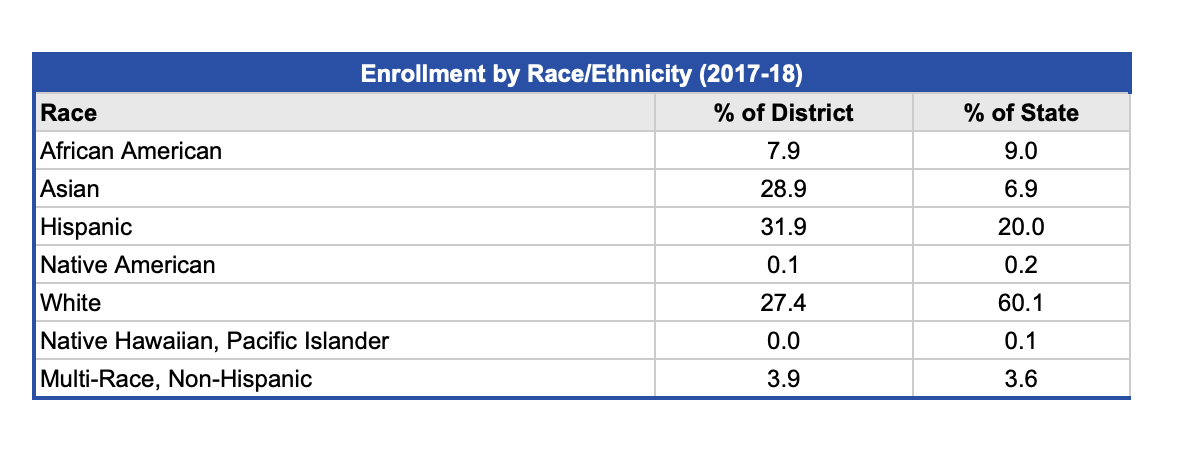
  • The Lowell Public Schools has a racially and ethnically diverse student population. This chart generated by Massachusetts Department of Elementary and Secondary Education (DESE) gives some insight into that.

    Data from http://profiles.doe.mass.edu/profiles/student.aspx?orgcode=01600000&orgtypecode=5&

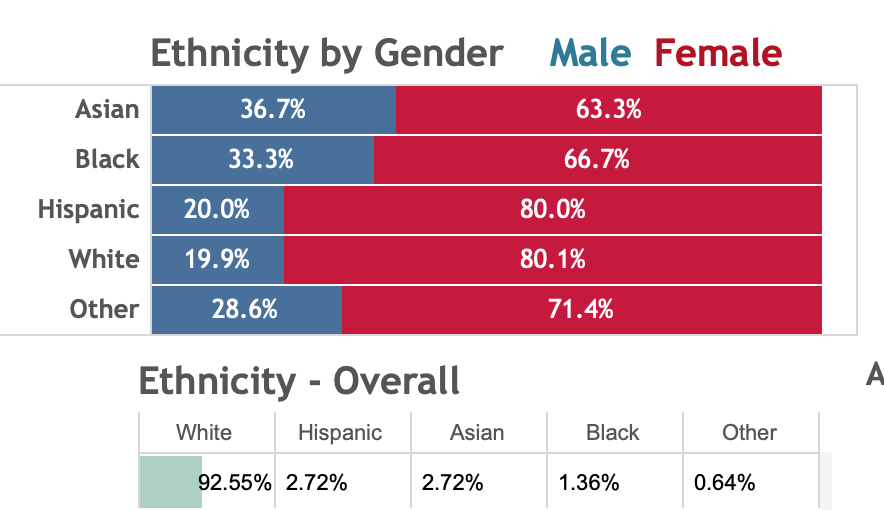
    The teaching workforce, however, looks like this:

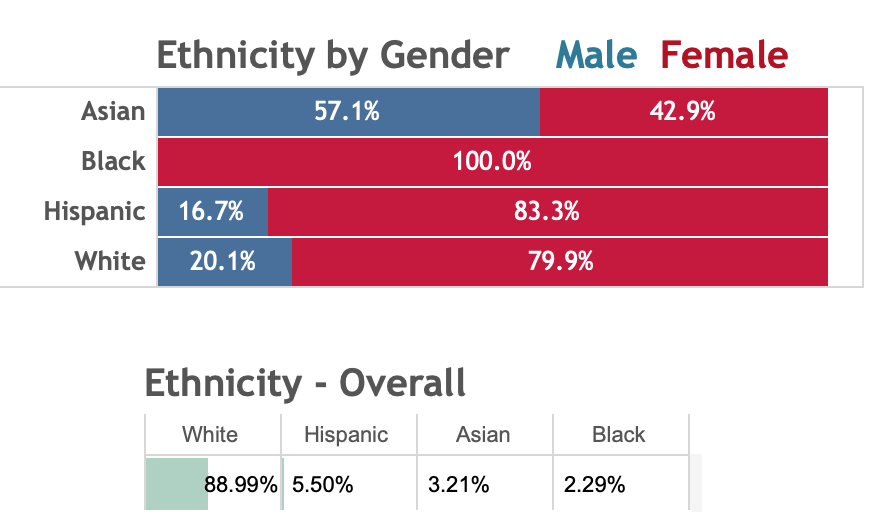
    While the school building administrators (Principals and LSAA) looks like this:

    With all the research – Google to find more – on diversification of the workforce and the positive impact on students, clearly Lowell needs to step up.

    Lowell also needs to put far more serious import and effort into Human Resources and Recruiting. Recently, both the Interim director of Human Resources AND the Assistant HR Director left their positions. The School Department’s CFO is apparently attempting to take on many of the HR Director’s responsibilities.

    In my opinion, that is definitely NOT OKAY. In order to recruit and retain diverse, qualified candidates for positions within the Lowell Public Schools, this department needs a full-time and, dare I say, professionally trained HR Director. If Lowell Public Schools is serious about diversifying the workforce to be more of a reflection of the students in our schools, throwing off the tasks of HR onto the responsibilities of the finance officer, who already has a pretty full plate, is ridiculous.

    However, along with giving the Human Resources Department the resources – human (oh the irony) and fiscal – to begin to diversify the school work force, there needs to be other considerations that will call for a long-term remedy. Can Lowell can “grow their own” diverse education workforce? Read more about how one district in Oregon is doing just that.

    Some years ago, Lowell had a program for Paraprofessionals that would enable those interested to pursue certification as educators, although at the time, I believe the certification was limited to Special Education. Would Lowell be willing to invest whatever monetary expense might be needed to help our Paraprofessionals transition to licensure as educators?

    We also need to do a little soul-searching on how attractive a career in education may appear to students in secondary schools. Are there internships that could be explored for High School age students? Can Lowell partner with MCC and UML to make a degree in education affordable and accessible for LHS students who commit to working in District?

    The conversations have started, and that is encouraging. But to achieve the vision of having a diverse education workforce reflective of our students here in Lowell, there will need to be some other commitments made. Let’s put our money where our mouths are.

  • white and grey voting day sign
    Photo by Element5 Digital on Pexels.com

    Don’t sit tomorrow’s election out. Go vote.

    Think your vote “doesn’t matter”. I disagree. Recently in the MA3 Congressional District Primary, less than 150 (recounted) votes was the difference between the eventual winner, Lori Trahan and second place, Dan Koh. Yeah, those 150 votes mattered. Quite a bit as it turned out. Your vote might just be a deciding factor; go vote.

    Yes, I agree with you that the electoral college is an abomination but we are in the mid-terms and the electoral college won’t be a factor this time. Maybe who you vote for will be able to help change the presidential election process; however, so go vote.

    Good ol’ boy/girl network making you think it’s pointless. Vote anyway. It will only be pointless if you don’t vote your heart and mind. If the candidate for office is unopposed and you write in a name, that also sends a message. As I learned in Latin class, illegitimi non carborundum. You can look that one up and then go vote.

    Does an Election Day on a November Tuesday seem inconvenient?  (The answer to why we vote on the first Tuesday in November is here.) Your vote could change that; after all many states allow early voting now.  Absentee ballots can still be petitioned for and submitted prior to noon today (see MA Secretary of State Absentee Voting or call your City/Town elections office). And although the Early Voting window is closed for this election, you can and should still go vote.

    Hard to get to the polls? Need a ride? Contact candidate campaign offices. Oftentimes there are volunteers who can help with that. And by-the-way, the rumors about free Lyft and Uber rides are not exactly true. Here’s the straight talk dispelling rumor and misunderstanding from Snopes. Get a ride and go vote.

    In Massachusetts, the polls must be open from 7 am until 8 pm; some places are allowed to open at 5:45 am, so check with your city or town election office. If you are in line at 8 pm, you must be allowed to vote. DO NOT GET OUT OF LINE (that is also true for most other states). The Massachusetts Secretary of State’s Office has a detailed list of when (and why) you might be asked for identification and also about requesting a “provisional ballot”. Check here. Know the voting regulations and go vote.

    Listen, we all need to make time for this civic obligation. There are some important issues that are being decided and even more coming in the future. You may or may not be cancelling out my vote; go vote anyway.

  • depth of field photography of p l a y wooden letter decors on top of beige wooden surface
    Photo by Skitterphoto on Pexels.com

    Sometimes I wonder if we’ve lost our collective minds when it comes to early childhood education.  This morning, I found this well-written article, from January 2016’s Atlantic: “The New Preschool is Crushing Kids“.  Thoughtfully written by author Erika Christakas, the idea that our education system has shifted from a “protected” childhood to a “prepared” one resonated. Ask educators and you will hear that what used to be taught in second grade, is now a requirement for first grade. First grade expectations are have moved down to kindergarten. And preschool? Yes, preschool is filled with academic skills.  It’s the trickle down theory of education.

    According to Christakas though, all of this new “rigor” may not translate into academic success.

    New research sounds a particularly disquieting note. A major evaluation of Tennessee’s publicly funded preschool system, published in September, found that although children who had attended preschool initially exhibited more “school readiness” skills when they entered kindergarten than did their non-preschool-attending peers, by the time they were in first grade their attitudes toward school were deteriorating. And by second grade they performed worse on tests measuring literacy, language, and math skills.

    Could it be that by forcing young children to perform academic skills at such an early age is killing their curiosity and love for learning?

    Our schools seem to focus on the “cognitive potential” learners, even those of a very young age. When test scores are published and reported, we hear about gaps in achievement between advantaged and disadvantaged learners.

    In my experience, such gaps are a function of a child who needs more time to experience the world, to learn the language used in school, to converse, to listen, and to experiment. It troubles me that in place of deepening and enriching the experiences of young children, young learners are subjected to more seat/paper/desk work. In an impatient rush to boost test scores and school ratings, there has been a misguided effort to push academic skills and concepts earlier and earlier at the expense of learning that is developmentally appropriate.

    I was taught that just because you can, doesn’t mean you should. I believe our edu-crats need to take heed of this adage. More is definitely less for our youngest learners.

  • two multicolored slinky toys
    Photo by rawpixel.com on Pexels.com

    Our first grandchild arrived in August, and as many grandparents come to understand, things have changed since we raised our own children. Babies don’t sleep with crib bumpers, or on their tummies. Children don’t wear winter coats in car seats. I most definitely have zero applicable knowledge when it comes to infants. Times have changed, research has changed, thinking has changed.

    My wheelhouse, though, is education. I wonder – often as it turns out – if my own thinking as a teacher is outdated. I was reminded of this when a colleague shared the school district’s current Early Childhood (PreK) progress report with me – which was over 10 pages long. These 3- and 4-year-olds have been “in school” barely 5 weeks and already their teachers are tasked with assessing their progress.

    Progress in what, exactly? When one is 3- or 4-years old, shouldn’t the ultimate goal be to learn to love learning? To get along with others and take turns? Socialize?  A 10-page checklist of skills – by category – seems ridiculous for a little one who has only been on this planet for less than 5 trips around the sun.

    It did make me curious: what exactly is being asked of young children, so I did some browsing through Boston Public School’s Early Childhood page. Check out the “robust questions” intended to spark conversation with 3- or 4-year olds in Centers found in the vocabulary section of this document,  “What is the inspiration for your work?” “What is your plan for structure?”

    Looking at the assessments recommended for this age group, there are a number of screening and assessment tools recommended and required.  Some would be useful as a child’s language development progresses; one that seems “optional” but noted in use in some school PreK programs is Fountas & Pinnell benchmark testing. That’s right, some schools endeavor to find a 3-year-olds “independent” reading level. No, they are not kidding. Shouldn’t we be reading to children this young and not expecting them to read to us?

    Here’s my question as a new grandparent and a retired educator:

    When do young children get to just be young children?

    Is there such a driving need to prove children are “learning” at such young ages that reasonable expectations, developmental appropriateness and an emphasis on developing social skills and love of learning been replaced by assessment, evaluation, and checklists?

    My hope is that the pendulum swings back to more child-friendly early childhood education before my granddaughter reaches school-age.


  • Screenshot 2018-06-08 07.05.05About two weeks ago, the Massachusetts Legislature failed once again to update school funding formulae known as the “Foundation”.  In my opinion, this is not only a huge disappointment, it is a disservice to students, families, and public schools in 351 cities and towns across Massachusetts.

    Here in Lowell, the erosion of school services and supports can be traced in the budget cuts that have been necessary over the last nearly 20 years. In the late 1990s, when an elementary class size reached 25, it was common practice to assign a paraprofessional to that classroom, which allowed for more focused and individualized attention to students. In 2015, my retirement year, my grade level of 100 students and 4 classroom teachers shared 1 paraprofessional.

    In the 1990s and early 2000s, elementary school staff included not only a library aide, but a certified Library Media Specialist. The library was a space where students not only learned research skills, but were exposed to wonderfully diverse literature and media curated by the Library Media staff. By the mid-2000s, all but one Library Media specialist was cut from the Lowell Public Schools and school libraries were maintained by Library Media aides. This year, 2018-19, the school budget has cut all library staff in Grades Kindergarten through Grade 8 essentially closing the libraries to any students below Grade 9.

    These are but two examples of service cuts in Lowell. There have been many others. Teachers in Lowell spend inordinate amounts of personal money (in my own case, I spent on average of $1,000 each year and some years much more) to supply classrooms. Social workers, Speech and Language therapists, OT, PT, Special Education…. all carry larger-than-reasonable caseloads.

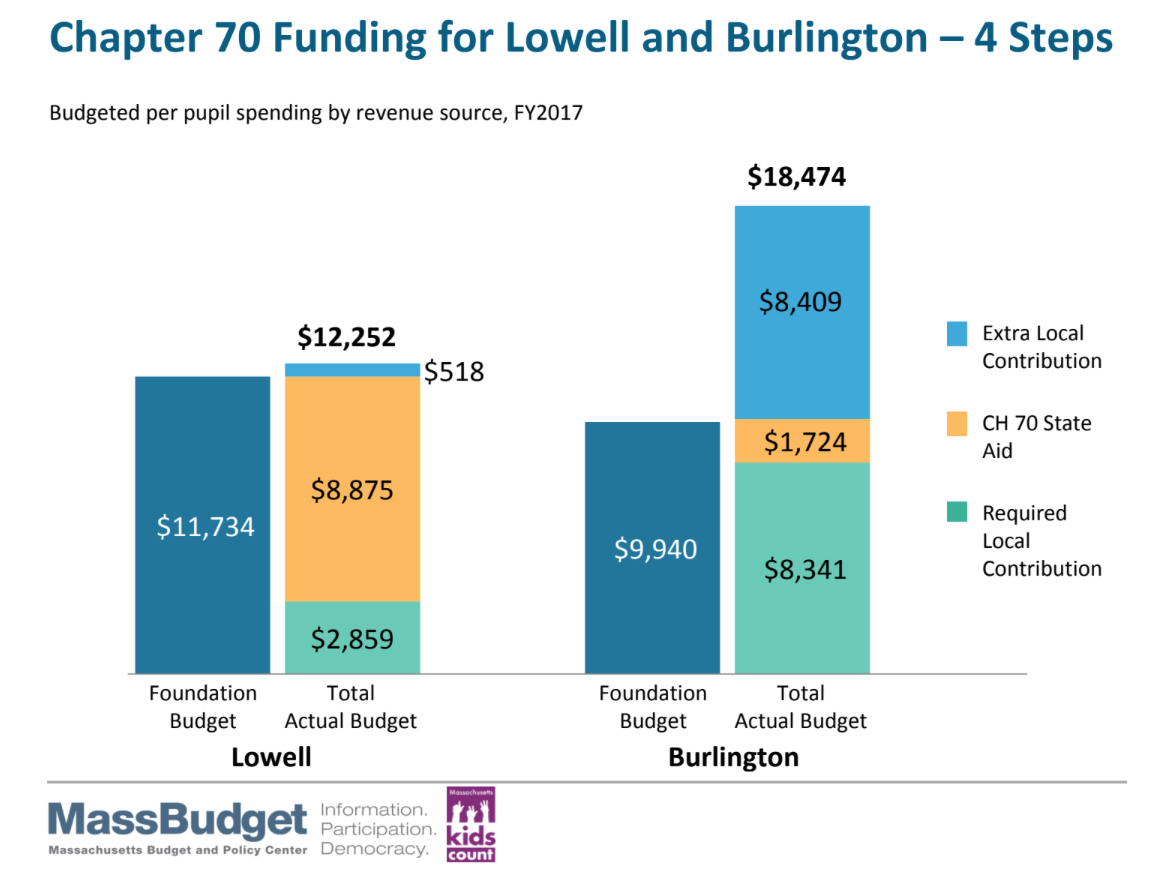
    Have municipalities like Burlington or Wellesley cut K-8 library staff and access to school libraries? Of course not. Wealthier communities make up the shortfalls in Foundation funding from their property tax base and a community that is able to afford to allocate more funds toward schools. Does that seem equitable to anyone? (read WBUR’s commentary Inaction on School Funding Will Keep Opportunity Gaps in Place.)

    What does our Commonwealth say about our schools and the Commonwealth’s responsibility to fund education? We only need to look at the Commonwealth’s Constitution and this paragraph:

    “Wisdom, and knowledge, as well as virtue, diffused generally among the body of the people, being necessary for the preservation of their rights and liberties; and as these depend on spreading the opportunities and advantages of education in the various parts of the country, and among the different orders of the people, it shall be the duty of legislatures and magistrates, in all future periods of this commonwealth, to cherish the interests of literature and the sciences, and all seminaries of them, especially the university at Cambridge [and] public schools and grammar schools in the towns….” Mass. Const. Pt. 2, C. 5, § 2.

    As of this writing, the Legislature has failed our schools and our children. They have failed in their duties to “cherish” education and they have failed to provide the funding that would allow ALL public schools across Massachusetts to provide equitable educational opportunities.

    We must tell our narratives as parents, students, educators, and community members. We must let our legislators know in no uncertain terms, that to continue to underfund the Foundation Budget Review Commission’s recommendations is unacceptable. We need to cherish our schools here in Massachusetts and fix the funding so that every child has access to equitable educational opportunities.

  • We are about a week beyond the Foundation Budget Review Commission (FBRC) disappointment. Last evening, as I listened in to a conference call sponsored by Mass Education Justice Alliance (MEJA), this question was posed:

    What we are missing because of underfunded schools?

    When I left active teaching in 2015, I know that underfunding was impacting the public school in which I worked in many ways. Paraprofessional staff had been severely reduced as had ELL support teachers, Reading Specialists, and Science specialists. Library Media Specialists and Instructional Technology Specialists were eliminated. GoFundMe and Donors Choose were the new “normal” for obtaining necessary school classroom supplies. Teacher out-of-pocket expenses climbed (at the time I was spending nearly $1,200 per year on books and paper goods), new curriculum often meant more personal expenditures on trade books and resources for the classroom.

    But, as I write this, I know my experiences are three years post-retirement. So I ask you, if you are a Massachusetts Public School teacher, how has underfunding impacted you?

  • pexels-photo-220320.jpegLowell appears to have established a personnel practice that is not, in my opinion, a winning strategy for attracting, and more importantly, keeping the best administrators to serve a large and complex school system.  

    The last two School Superintendents in Lowell had tenures lasting 3 years. When these former administrators first were appointed, the spirit of collaboration and cooperation was positive. And then, as often happens, the honeymoon period disintegrated. Time passed, the acrimony continues and before you can say “help wanted”, a new hiring committee formed. 

    Oh Lowell, this is why we can’t have nice things.

    The School Committee agenda published on the City’s website hints at what could turn out to be an extension of this practice, this time directed toward the current superintendent, Dr. Khelfaoui. This is disturbing for several reasons:  the loss of continuity in LPS District leadership and the manner in which what appears to me to be a personnel issue, is being conducted.

    Right now, the Lowell Public Schools budget/financial situation is dire. The lack of funding is so critical that K-8 school libraries will no longer have a library aide to oversee them. Effectively, that will end the library access for elementary and middle school students. There have been several cuts, equally acute, at the High School level. Lack of funding is no longer a belt-tightening exercise, it is now affecting students and school services directly. 

    Anyone paying attention knows that the amount of Chapter 70 funding allocated to Lowell’s charter schools has increased by $2 million to a total assessment of $19 million. Top that off with a state budget that chronically, and I’d say intentionally, underfunds its obligations to both ELL and low-income students (see Foundation Budget) and a charter school reimbursement that never actually receives funding from the State.  Consequently the swirling vortex of school funding has turned into a tsunami. This is not necessarily the fault of Lowell’s Superintendent of Schools.

    The CFO for the District has left Lowell for another Massachusetts school position. Currently the CFO position is vacant at a time when critical end-of-year reporting is in process. Three candidates for the interim CFO position withdrew before being interviewed. Does this indicate that Lowell’s reputation for being a tough gig is limiting the number of candidates willing to work here? 

    Lowell, your reputation precedes you.

    And that reputation as a “tough gig” brings me to conducting and discussing personnel and evaluative issues. No doubt about it, one of the School Committee’s main responsibilities is overseeing the school superintendent. It is the body that evaluates the superintendent. [Note the last evaluation, overall “Proficient”, was completed and reported at the School Committee meeting on Dec. 20, 2017. Notes for that meeting are found here in Agenda Item 6. under “Unfinished Business].

    The three agenda items for the July 18, 2018 meeting (link above in Paragraph 4) which, in short, call for a document to terminate the superintendent’s employment, an immediate move to put the superintendent on administrative leave, and the appointment of a replacement from the Superintendent’s Central Office “team” telegraph that the School Committee has issues with the Superintendent’s performance since that 2017 evaluation. Shouldn’t this be a discussion held in person, either in a face-to-face meeting OR in executive session?  Putting such items out in an open meeting seems vindictive and petty, and not at all benefitting to Lowell’s schools or families. It most likely means any resemblance to a Central Office “team” has now evaporated.

    This is an embarrassment to our schools and our community. It does not serve Lowell’s interests now, nor will it serve in the future when a new leader for our schools needs to be selected.