• In the last week I’ve administered three district-mandated tests to my third grade students.  Everyone is collecting data!  There have been 2 benchmarks – one each in reading and math — and a newly mandated math unit test.  We’ve administered our individualized reading assessments from Fountas/Pinnell. Having completed the MCAS barely 2 weeks earlier, my students are burnt out with testing.  In fact, going out on a limb here, they are burnt out on school.  It’s over. As far as the kids are concerned, third grade is visible only in the rear view mirror.

    I like data, but I have so many issues with the testing being distributed by administrators who don’t know test writing.  Number one at the top is the quality of the district made math tests.  It seems that every time we administer them, there is at least one major flaw in the question.  Sometimes one of the multiple choice possibilities is on the next page, sometimes the question posed has more than one correct answer.  Listen up people!  Test and measurement is not for amateurs.

    This time of year is pretty tense with all the wrapping up and testing.  This year is particularly intense as budgets are being set (or not) and money is disappearing.  The LPSD is facing a 9 million dollar shortfall.  Obviously that means cuts in staffing, cuts in program funding, larger class sizes…. and makes for a very sad ending to the year.  Our future is hazy at the very least.

    Ten days…. and then what?

  • Yesterday, I made my annual pilgrimage to the Scholastic Warehouse Sale. Armed with a listing of my newly reorganized Leveled Library inventory, I forced myself away from the picture books and materials more suitable to second grade independent readers in order to focus on increasing nonfiction texts.  20 year old buying habits are not easy to break.

    Although the sale was not as big of a bargain as I’ve experienced previously (economics?), I still walked away with some nice reads for my third graders — lots of N, O, and P texts — in the nonfiction genres. Sometimes there is a lot of flotsam in the materials Scholastic puts out, and the warehouse sale does involve quite a bit of sifting through, but that being said, getting books at 25 to 50% off list certainly is a big deal when adding to a class library with personal funds.

    And I bought myself a book or two for read-alouds.  If you’ve never read Bats At The Beach by Brian Lies, I highly recommend it.  I first discovered this book on NPR’s Weekend Edition with Scot Simon.  Scot was reading this book with Daniel Pinkwater (who doesn’t love Guys In Space?) — it was so engaging that I bought it right off.  And it has been a well-loved read aloud by my students ever since.  Well, on this trip to the warehouse I discovered Brian Lies newest edition, Bats at the Library. Equally enjoyable — and we premiered this book during our read aloud this afternoon!

    This morning, we spent more time on the library’s organization.  Under the impression that the students were putting books back in their proper bins, I was shocked to find that over 20 had carelessly been thrown in any available bin.  Regie Routman speaks to us about the gradual release of responsibility — in this instance, I must have not be gradual enough.  So the minilesson I had planned during Literacy Studio turned in to a shared practice of how to put books away.  Will this be the last time? I doubt it.

  • Tonight, my colleague Colleen Turco and I shared our new and improved third grade mathematics curriculum with our peers as part of our course final. The more I work on curriculum — and I’ve been at it since 1987 — the more I realize that nothing is every really “finished”. Curriculum is a fluid as the students who populate our classrooms from year to year. Can we ever consider something done? I doubt it.

    This project was started nearly a year ago when Colleen and I realized that following the Investigations in Number, Data and Space curriculum strictly left us little time to develop number sense or conversation about mathematics. We also came to the realization that the timing of the units left our students with little time to learn the math facts, multiplication and division, expected in computation. With these things in mind, we spent the summer pulling apart the curriculum and reordering units in a way that seems to make sense for our student population.

    Additionally, Colleen, who is our school’s Math Resource Teacher and who knows the big picture like no one else can, made sure we had addressed all the third grade standards in the Massachusetts framework. Working together, we’ve pulled in lessons and resources from many different places (Math Solutions – THANK YOU!) which we felt supported the philosophy of mathematics teaching, yet improved upon, supported, or revisited the curriculum framework.

    Now that we’ve developed this document, or plan if you will, and implemented it on a pilot basis in my classroom, Colleen and I are ready to roll it out to the rest of my grade level team — and adjust it. Already I have a list of things that need tweaking.

    Our first attempt at making sense out of the mathematics curriculum feels pretty good; although I do have an eye on the standardized testing which I hope will show some improvement over prior years.

    We hope any readers of this blog — if you are out there — will offer up suggestions for materials or lessons that will enhance our work in progress.

  • This is the time of year when you really need to have “chops” as a teacher. Once the weather becomes fairly reasonable here in New England and the spring sports begin, my students seem to think they are done for the year. Unfortunately, the academic year has six more weeks to go.
    Each week has a new set of challenges: starting next week, our challenge is the MCAS Math tests. I get that given the educational climate we live in, testing is here to stay. What I don’t get is why my students need to be tested on the entire third grade curriculum when there’s about one-sixth of the year left (or in the case of the English Language MCAS about one-quarter). What is the point of testing students’ accomplishments when the total curriculum hasn’t been offered. That seems to set the kids — and the schools — up for failure. Or is that the point in the first place?
    This is also the time of year when what we fondly refer to as culminating activities seem to take on a life of their own. If it isn’t a field trip, there’s a special event (art fairs, family nights, awards….). The rush to the finish line can be quite chaotic. The students are getting tired of us – time to cut the umbilical cord. End-of-year data collections, placements for next year, retentions – maybe?, special education re-evals, testing, documenting, record-keeping…. oh my!
    So to my colleagues, who are testing, writing, evaluating, recommending, and trying to hold down the fort for the next six weeks – cheers!

    And happy Teacher Appreciation Week!

  • Having finally completed leveling, documenting, and labeling the classroom library, this week finds me in between projects.  What would life be like without a project?  I don’t know because it’s never been tested!

    The students are on their way now using their reading bag bookmarks as a guideline for finding just right books in the library.  It will be interesting to see what happens in the next few weeks as the book exchanges are more independent.

    One of the Looms
    One of the Looms

    One of our activities this week was a trip to the Tsongas Industrial History Center in the Boott Mills.  We are so fortunate to have this terrific resource in our community!  The docents and Park Rangers are both knowlegeable and entertaining and students learn much about the Industrial Revolution as well as the history of Lowell. The Boott Mill is also open to the public as park of the Lowell National Historic Parks.

    This trip was as outstanding as the others I’ve been on with my

    The Weave Room at the Boott Mill
    The Weave Room at the Boott Mill

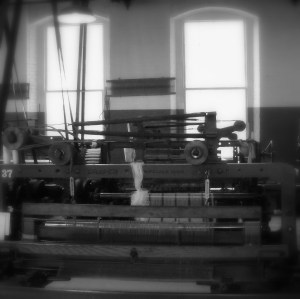
    Third Graders.  The program we participated in – Change in the Making – enabled students to learn about how this area of Massachusetts changed from farmlands to factories over a period of about 100 years.  The black and white photograph is an image of one of the looms outside of the weave room.  Only a few looms inside the room were running on the day we visited, but the clatter was nearly unbearable.   Imagine having to work in such an environment for 10 to 12 hours each day.

    One of the most (un)popular parts of the tour was the climb to the fifth floor activity rooms using the spiraling staircase that the Mill Girls would use.  As our guide pointed out, the Mill Girls made several trips up and down the stairs throughout the day.

    Lots more fun going down than walking up!
    Lots more fun going down than walking up!

    In addition to the climbing, students used a cotton gin to remove seeds from the cotton — and also attempted to invent a tool that would do the same.  They observed the living conditions at the Boarding Houses, and learned how Mill workers were recruited to leave farm and family to come to Lowell.

    It is always amazing how much the students learn on this trip.  It’s a perfect blend of information sharing and hands-on learning and generally ends up being the event students write about when they reflect on the school year.

    No matter if you travel to Lowell with students in tow or on your own, visiting the Mills and learning about the history of Lowell is highly recommended.

    Boott Mill stair tread
    Boott Mill stair tread
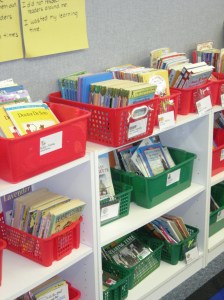
  • The calendar may be telling me that we “only” have 36 school days left, but this week we celebrated a new year — at least a new year as far as our classroom library is concerned.  newbaskets The book baskets have been labeled and, when needed there are level reminders on the baskets.

    On Monday, we talked as a class about the labels and what that meant as far as replacing books or looking for new texts to enjoy.  The students listened and asked questions and took their role as initiators of the new library very seriously.  During each guided reading group this week, students have been returning all the books that had previously come from the library.  Many of these books were either unlabeled — and therefore not in the database as of yet — or an inappropriate level for the student.

    Another part of the process is to get kids picking books at their independent level. First, I created a large wall poster listing all of the levels (color coded). Then, using the last Fountas Pinnell benchmark as a guide, each child got a new book selection bookmark with a colored dot indicating the level of books that should be “just right”.  Students were instructed to pick 3 books from the library using the colored dot as a guide.  They can pick one level up or one level down from the dot.  I dislike putting a number limit on the books being checked out of the library and some time I hope to remove this from the groundrules.  However, for whatever reason, I have quite a few students who hoard books — 10 or more at a time — and I’d like the books to be in circulation for everyone.

    Using the guidelines for selecting books from the library proved to be a challenge for the students and an eye-opener for me .  I thought the obvious benefit was going to be in the newly organized library. Little did I realize how much my students needed structure in selecting just-right books!  My students, many of whom are under confident about their reading, gravitated to books that were well below what they should be reading in order to grow as a reader.  For example, students who should be reading N chapter books (Yellow 4), were begging to reading Yellow 1 or Yellow 2 picture books.  Left to their own, they were selecting materials that would not challenge them to become better readers.  The new guidelines definitely appears to be a benefit of the new leveled library — one that I hadn’t even anticipated.  We are now having conversations about why reading at your level is a good goal and when reading a very easy book might be okay.

    So as this project is winding down I can see there have been some real benefit from the work involved.  In addition to organizing the materials, and knowing first-hand what is available in the library, knowing how many of each genre and level will help me to make sensible choices when I purchase new books for the classroom.  The library has been consolidated so that the organization is more transparent and kid-friendly — holy cow, they even are putting the books away in the right bins! And it is becoming less easy to slide by picking books that are too far below the students’ reading levels to challenge them.

    Happy new library, Room 207!  Now let’s get reading.

  • Every year we scour our standardized test scores wondering what we can do so that our students look as good on paper as they appear when we are assessing them day-to-day.  I hate that standardized testing, in this case MCAS, is considered the measure for success.  I think of some of my colleagues who took the National Teacher’s Exam — does that test still exist — a grueling all-day summative paper assessment by which prospective teachers were judged to be worthy or unworthy of hiring.  People I admired performed poorly on this test — the single measure used to judge employability.  In the same way, I dislike the high-stakes tests that judge our students and judge our teaching effectiveness. Should one measure be the end-all of whether or not students are learning?

    Off of the soapbox now, the topic I’m considering is what magical intersection of ideas and conditions will help my students acquire mathematics?  And that’s what this section of the blog is about.

    Once upon a time – at least 15 years ago — I was a participant in a summer course designed by Math Solutions and developed by Marilyn Burns.  Marilyn Burns is not only a master mathematician, but she is a master teacher — and unlike other experts/consultants in education, she puts her money where her mouth is: she actually teaches the lessons using the methods she advocates by volunteering in public schools in her area of California.  Right there she had my respect — no theoretical ivory tower.

    One of the presenters said something sage that has stayed with me all these years.  When we are shifting the teaching of mathematics, or any topic for that matter, to a more constructive, meaning-based model, it can take up to 5 years for our students to “get it”.  The presenter, whose name has escaped me, told how her school in Texas had adopted using replacement units for basal math texts — unit based on deepening students’ comprehension of mathematics. And while the test scores (remember them?) were disappointing at first, after several years, there was a delightful, vindicative jump showing that students had not only acquired math concepts, but were now flexible in applying them.

    Isn’t that what we h0pe for? The current frenzy of testing and accountability of teachers for what students can and cannot show in a single-shot standardized high-stakes test, doesn’t allow us much time for developing a program in a methodical way.  Lesson #1:  Things take time.

    The second lesson was an idea planted in my brain by a brilliant and gifted mathematician, Andrew Chen of Edutron.  I had the privilege of being a student in one of Andrew’s Intensive Immersion Institutes, a mathematics class to strengthen/clarify/stretch mathematical thinking for teachers.  Andrew’s words, that our students are just as bright as their suburban and high-achieving counterparts, were like a breath of fresh air.  Generally urban teachers are told either outright or through insinuation, that they can’t be as good as counterparts in less troubled teaching environments — or the students’ test scores would be higher (how insidious is that!).  Here was an MIT mathematician telling us that our students (and teachers) can achieve much, but sometimes other things (socio-economic ills for example), get in the way.  Lesson #2: Don’t give up on students or yourself.

    Both of these ideas have been in the back of my mind as I’ve been working with our Math Resource Teacher and Coach to tweak the third grade teaching resources this year.  As we develop materials that work for our kids, we’ll use this space to document some of the things we’ve learned about teaching mathematics in an urban school system.
  • This week is April School Vacation Week here in Massachusetts — we celebrate Paul Revere’s ride, the Battle of Lexington and Concord, the Marathon, and a Red Sox Home Day Game all on one day. We also have a school vacation.

    Why is it that whenever I am on school vacation, I spend about 20% of my time in school catching up? Well, I suppose that’s a discussion for another time.

    Today, I used my “20% day” to work on two projects — one is a joint math curriculum project with our Lincoln School Math Resource and Coach, Colleen Turco and the other is the seemingly never-ending classroom library project. Guess which one ate up most of my day — yup, the library project!

    I have about 20-25 more biography books left to level and add to the database. Of that 20-25 I am considering adding all but 5 or 6 to the crates of books I am discarding from the library. Not because I dislike the subject of the biography (although some seem a bit uninteresting to me — I know, I know, withhold my own judgements), but because in a perfect world, the biographies and historical fiction and nonfiction books would be a bit more supportive of our Massachusetts History and Social Studies Curriculum. Something to think about before we return to work on Monday, isn’t it?

    I’ve also been pretty aggressively recycling the books at the upper end of the leveled library — S, T, U and beyond. Unless the book seems to be a “classic”, or an extraordinary read, it is just going to gather dust. Lucky for those books, they will find a new home I hope as we have some newer teachers in the upper classrooms who probably will appreciate having these levels added to their own classroom library.

    This project has been an incredible amount of work, but the books that remain in the library have purpose, are in good condition, and once the children have been taught to do so, should be easily returned to their proper homes.

    Next write, there will be pictures! Promise!

  • TLabeled and sortedhis week I spent most of a “day off” in school sorting through the books that had been labeled and logged and organizing them into color coded baskets – red for fiction, green for nonfiction, blue for poetry and yellow for special collections.  Using both the small nesting baskets from Really Good Stuff and the stackable medium bins has been a good thing.  And the shelves are beginning to look like something other than the mishmash that had been.  At this point, I have finished the most tedious leveling – those 500+ books that had not been leveled at all – and I am sorting through the baskets in of previously leveld books.  Will need to weed out used and otherwise unattractive books.

    I hate the feel of books that have been sitting on the shelf – in the warm sun and near the blowers for the heating system in the classroom.  They feel dusty, the paper pages feel rough and uncomfortable and often the covers are worn or brittle.  These are the books that I’ve been recycling rather aggressively.  Those that belong to the school and were purchased with school funds (Title I, building budget, etc.) are shared with colleagues who need to bulk up their own classroom library or with the Lincoln Lenders.  The later is a collection of books for our students to swap – something that happens about once each month.  Bring a book to trade and get one in return.  It works quite well and more and more children are able to have a book of their own.

    A side-activity to the classroom library sorting is that I have been classifying my own teacher collection of trade Author collectionbooks – you know, the books that drive a minilesson or those that are used to jump start a writing lesson.  By freeing up all those cardboard magazine files, I’ve been able to sort my “special” collection by writing topic (narratives, letter writing) and by mini lesson.  I’ve also organized the author collections that have accumulated over the last ten years of my teaching.

    The room is starting to feel organized — and I feel as if I’ve got a handle on what books are available to my students.  It is tedious and hard work, but I believe it will be worth it in the end.  If there is an end!

  • That’s the question under consideration this week. According to some of the readings out there on the topic, the recommendation is 20 books per student in the library.  For a typical classroom that’s somewhere between 500 and 600 books.  Since I’ve already hit the 500 mark on the database using just books I’ve brought into the classroom — the unleveled books from my former genre library — I’m starting to question how many books are “enough”.

    Admittedly, too much of what is left in the class library is from the picture book genre.  And I have lots of lower leveled books brought over from when I taught a lower grade so clearly there needs to be a weeding out. That’s the tough part I think.  Never one to throw out something that might prove useful in the future, it is difficult to decide what books stay and what books go.

    Also, the space issue is becoming critical.  The classroom seems jammed with “stuff” these days — where did all this come from?

    It is time to take a more critical look at what book levels are in the library and to be ensure that genres are represented. And then possibly the weeding out can begin – again.