Apparently, along with this week’s advice for potty-training a child, we now need expert advice in helping kiddos to cope with our own – and the child’s – fears after a mass shooting. Our country has experienced so many of these gut-wrenching mass shootings that advice is needed?
Allow me to rant a bit here. There are actual solutions to the number of violent terroristic acts involving mass shootings. Licensing and strict registration of guns for example. Or amunition. Yet legislation always seems to be dead on arrival in the hallowed halls of the US Congress. So what happens? Experts offer advice about everything except to address the elephant in the room.
As an educator, I was trained to respond to an active shooting situation during our yearly active shooting drills. Specifically, that meant instructing my 8-, 9-, and 10-year old students how to defend themselves should a shooter enter our school building and/or classroom. We planned to stack classroom furniture in front of our door, throw whatever was handy (like a stapler), hide silently against wall so as to not be visible to anyone looking from the hallway into our classroom interior, and/or run like hell to a “meeting place.” My paraprofessional and I scoped out a closet that I and a mobility-disabled student could attempt to hide in since a sprint out of the building was not possible. We removed the closet bar and brainstormed ways to make that closet a viable hiding place.
So I ask: Have we become insane? The solution to mass shootings is to stop them. This week over 30 families have a huge hole in their hearts where a loved one once lived. Many other families are coping with serious injury that will take weeks to physically heal and a lifetime of therapy to cope and recover, if that is even possible.
Are we to believe that the solution to mass shootings is to learn to live with that fear?
WBUR’s Max Larkin’s piece on the way Massachusetts has changed counting children living in poverty, How Massachusetts Lost Count of Its Poor Students, was published yesterday. While Massachusetts educators are paying attention, this is a topic that deserves much broader discussion as the unintended consequences are substantial.
In 2015, the Commonwealth began recalculating the number of students living in poverty based upon a new metric which included enrollment in programs like SNAP. Using this new way of counting and classifying the needs of students meant the use a new label, “economically disadvantaged”, replacing the term “low income”. However, more than a change in labeling data collection resulted.
In Lowell prior to the new measures, the average (and I stress the use of the word AVERAGE) poverty rate district-wide was in the 75.1% (2013-14 DESE Select Population data). In the particular school in which I taught, that rate was closer to 85% (84.9%). Using the new means of measurement, in 2014-15, Lowell’s District calculation of students in poverty, now referenced as “economically disadvantaged” was reduced to 49%. So according to the new measure, over the summer break about one-third of Lowell Public School’s students disappeared from the count of children who lived in poverty.
Why does this matter? When we look at student growth and achievement, there are factors within the school and classroom over which educators have control but there are also factors which influence student growth over which educators have little to no control. One of those factors is the impact of living in poverty. This is a huge reason school districts make every attempt to provide students who are low income or economically disadvantaged with additional services. Such services range from wrap-around services for health and housing security to additional educational opportunities like books for home enjoyment and field trips.
As an educator, it did not make sense to me that over the summer break one-third of our students were suddenly no longer in need of such extra supports. Certainly no one could imagine that over the summer months about a third of Lowell’s students for whom poverty was a factor had suddenly become financially stable.
Poverty levels are often a consideration for needs-based grants. Here’s an example: In Lowell, the United Teachers of Lowell applied for participation in the FirstBook Books on Wheels free book distribution program in 2015. To qualify, the District needs-based percentage had to be 70%. Under the new calculation using CEP, Lowell’s 49.1% economically disadvantaged calculation would have disqualified our students and their families from the benefits this wonderful program: books to add to a home library. Luckily our Title I office had actual data which did allow us to qualify for the program.
Which makes me wonder: what other needs-based programs are our children living in poverty missing because a district or school no longer qualifies based upon economically disadvantaged data collected by Massachusetts Department of Elementary and Secondary Education? Are our children who are living in poverty missing the additional services needed to help them be as successful as their more affluent peers based upon a falsely “improved” low income number?
When the Commonwealth falsely represents students living in poverty based on a flawed new metric, the consequences have a significant and real impact on our most vulnerable students.
One thing I’ve learned as a parent and as an educator: children mirror our own behavior. That makes sense, doesn’t it? Has anyone had their own child pick up some naughty language which was repeated at a most inopportune moment?
Besides being excellent observers, children look to adults – those who are their caregivers and those encountered through media as “celebrity” – for models of acceptable behaviors and interactions.
This, of course, causes me to wonder about the effect the racist and hyper-charged hate-filled “soundbites” that are blasting into our lives on a daily, and oftentimes hourly basis. What impact is this having on our children?
When adults use disparaging taunts and insulting nicknames to refer to others around them, particularly those with whom there is a disagreement, children intuit that this is an okay way to react and respond. When an adult feels compelled to tell someone to “go back where you came from” or targets people of color, the message is again condoning what I believe and know are unacceptably racist behaviors.
It won’t take much for this to spill over into diverse classrooms. School staff – all of us really – will need to be ready to counteract and replace the unacceptable with inclusiveness and kindness. While that is going to be challenging when each day brings a new low in personal interactions from some corners, it is important, essential work.
Because they’ve got to be carefully taught can run both ways.
I was once called an education technology pioneer, probably because there wasn’t anything I wouldn’t try at least once if it seemed like it might be a good fit for my students. Drawing on my experience in the private sector, and as an Instructional Technology Specialist in public schools, I embraced the idea that technology was a tool and there was a core of programming that should be in every student’s technology toolbox.
Briefly, the article tells of less-affluent communities who are embracing a Pre-School curriculum developed by Waterford. You can learn more about the mission of this non-profit here and read more about their partnerships.
While “preschool for all” should be must be a priority for US education, replacing a face-to-face preschool with screen time and 15 minutes of technology programming bothers me. I agree, every child should have access to preschool. As an early grade educator, I recognize that the fact that many communities that cannot and do not offer a quality preschool program puts some young children at a disadvantage which is difficult to overcome.
For some communities, offering universal preschool education through public schools is a matter of economics. There just isn’t adequate public funding for the public schools to offer preschool programs to every family wanting to send a child to preschool. Community budgets are strapped, and there are as many reasons for short funds as there are preschoolers, so community leaders do as the mayor in Fowler, California has done: offer a freebie program for online preschool access.
While I understand that this may seem like a good idea on the surface, it is not. In an effort to ensure every child can read by Grade 3, academics are being foisted onto 4 year olds. That is wrong.
The question is: Just what should a preschool program look like? Should a preschool be 15 minutes of drill and kill on a computer? Who is deciding which computer-aided skills are taught? I ask this because I was stunned to discover the Waterford program teaching silent letters as a phonics skills appropriate for preschoolers. When I actively taught Grade 2, “i+gh” for example was a second grade skill, not a preschool/pre-reading skill.
Preschool, in my opinion, should be heavily weighted toward teaching children to get along with each other, to share and take turns, and to learn appropriate group social behaviors. Preschoolers should also be allowed to learn by experiences; those experiences are important to everything that comes later in learning. Preschool children need to form a strong, compassionate, relationship with the adults teaching them. A positive preschool experience sets the stage for lifelong learning attitudes. These are the things a 15-minute daily online preschool program can never provide.
Our education leaders, in fact all of us, need to step up efforts to make an affordable universal preschool experience available to all who would like one, and stop relying on questionable “free” software to fill in the gap.
For the first time since 1974, I no longer hold a teaching license. I decided not to renew my licenses (I have three), and that is something I am discovering to be a source of some apprehension. I retired several years ago from active teaching, however, my identity for most of my life has been, and I imagine will continue to be, synonymous with education.
I’ve wanted to be a teacher since the second grade – which oddly was my favorite grade level to teach – and despite a few detours, that is what I’ve done with most of my working career. But like most things, it is time to officially bring that to a close; my time has passed and it is time to officially let some things go.
Throughout my years of teaching I experienced, as you might expect, good days and bad days, but, as with most who enter the field of education, I wouldn’t have traded for another career. Working with children and families and learning from colleagues has been a rare privilege.
I was fortunate to re-enter education when teaching was, I think, at its best. I think it is difficult to describe that to people. There was a level of collegiality between administrators and teachers based upon mutual respect and trust. And it was that mutual respect and trust that made the hard work of education exceptionally rewarding. We worked hard, the children worked hard, we all learned. And still we had fun.
My principals were exacting and their expectations were high, yet I never felt that I couldn’t try new ideas for reaching students. I trusted my administrators and colleagues, but more importantly, they trusted me.
As I move into this next phase of my life’s story, I do know that I am not leaving education far behind. I have a granddaughter who will be entering school in the next few years, and thus, my interest in education is changing focus a bit.
The paper proclaiming my legitimacy as an educator may have expired, but there is still much to think about and speak up for. And that is what I will continue to do.
Budget season is going full tilt in Lowell and the outlook is definitely not very palatable.
The School Department is running on fumes: no K-8 libraries this past academic year, proposed cuts to fine arts positions, proposals to cut services for students in guidance, behavioral supports, Special Education. Who knows where it will end?
Well, here’s where I get off:
I think a question should not be just about what services and positions will need to be cut. I think the big questions is this: Why isn’t the Commonwealth of Massachusetts adequately funding schools so our children receive all of the services they need to succeed?
By all, I mean: why are schools going without libraries, or technology, or nurses, or social workers, or paraprofessionals, or class sizes that enable an educator to address the needs of the students in front of them in a consistent, thoughtful, reflective way? Why are these and other services that enable our English Language Learners, our Special Education students and our students living in trauma and poverty to be better supported on the chopping block?
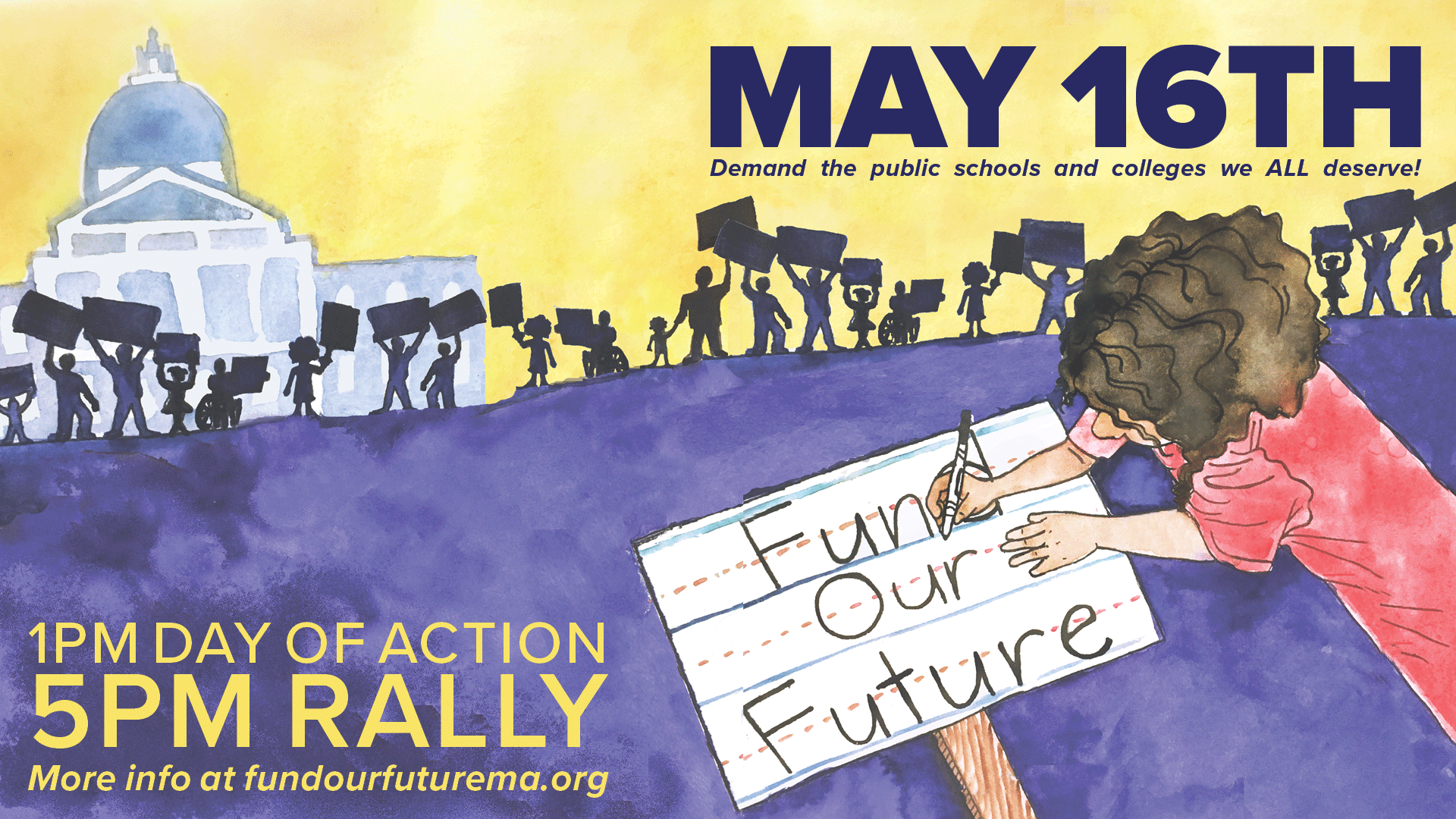
Today, across Massachusetts, educators, parents, students, community members are gathering in both Boston and Springfield to SHOW our Legislators that we are not willing to accept the flimsy excuses that have left public school funding scratching for scraps for the last 25-plus years. We are showing up to let you all know IN PERSON that it is beyond time to fix the Foundation Formulas and that our Commonwealth needs to fund our schools so that all of our youngest citizens get an equitable and adequately funded public education.
So even though I could be doing about a million other things today, I will show up, not only for the Rally at 5, but also to engage any Legislator who will agree to speak with me about the importance of funding our future through supporting the Promise Act and the Cherish Act. This is for all the students I’ve taught, the ELLs, the SpED students, the children living in poverty – and for my baby granddaughter, who just might be able to attend a fully and adequately funded school when she enters Kindergarten five years from now if the Promise Act is passed this year.
And that is why I’ll be attending today’s Rally to Fund Our Future on the Common. Will you?
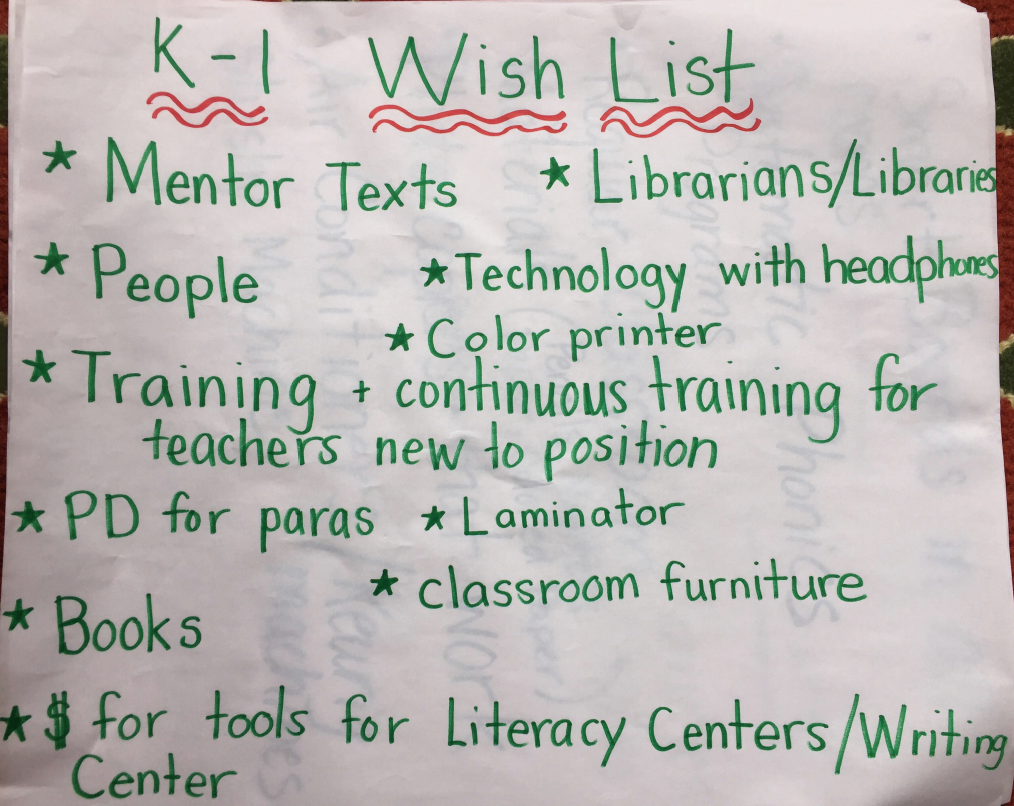
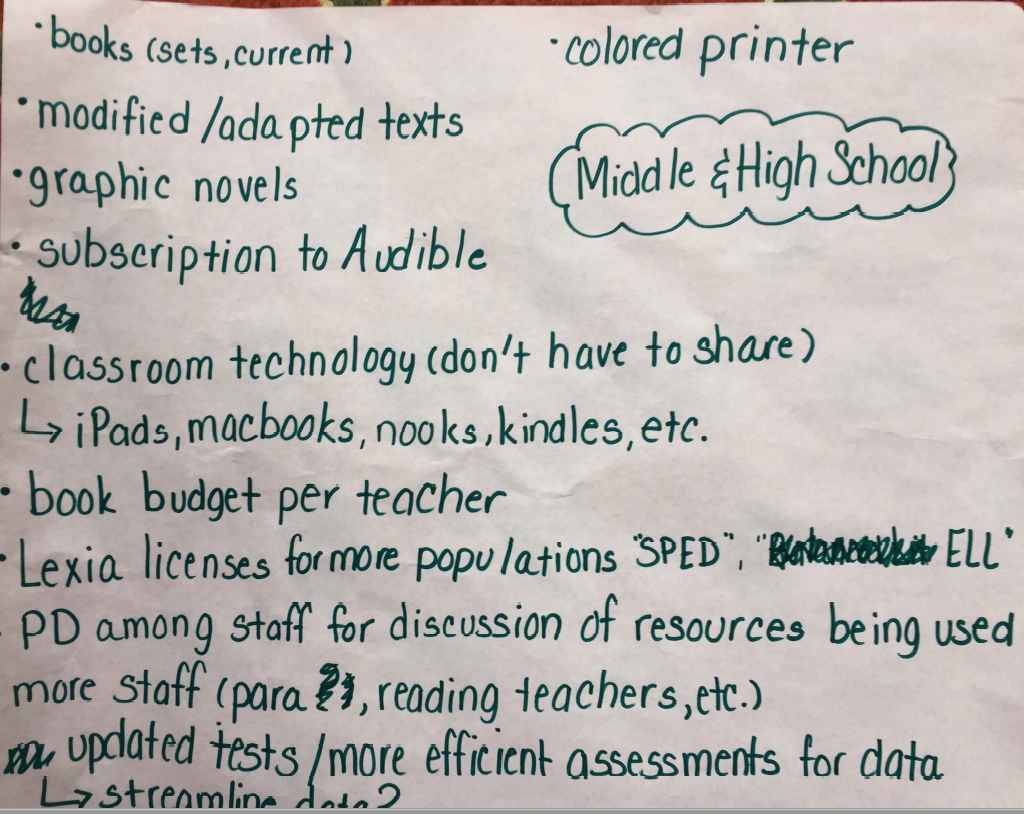
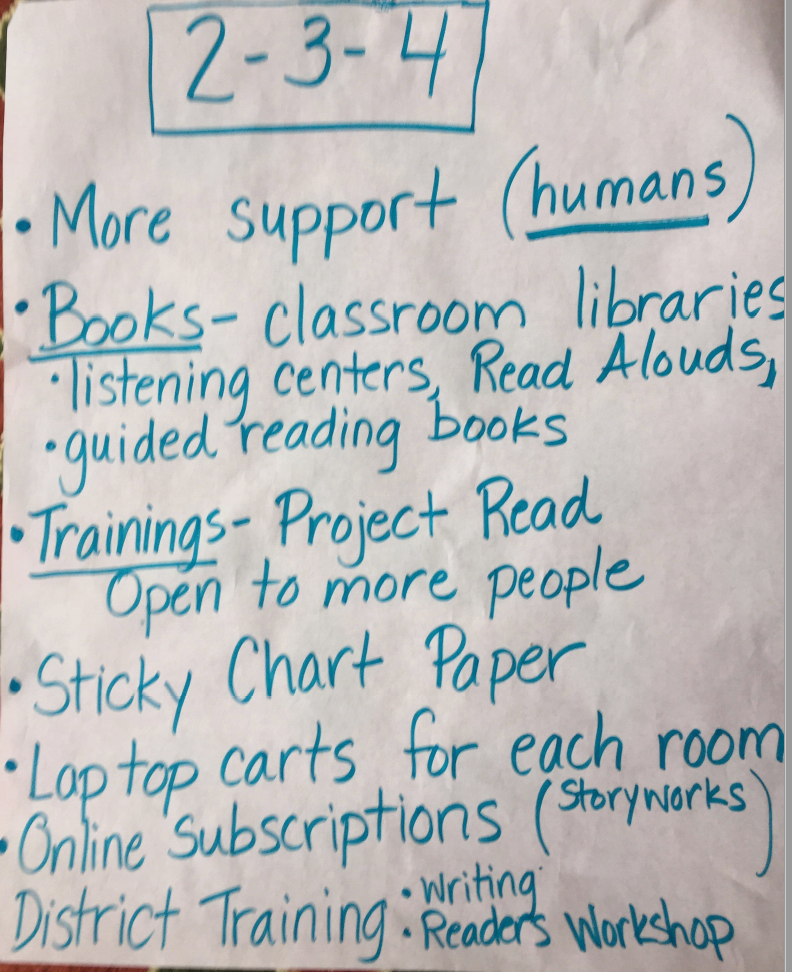
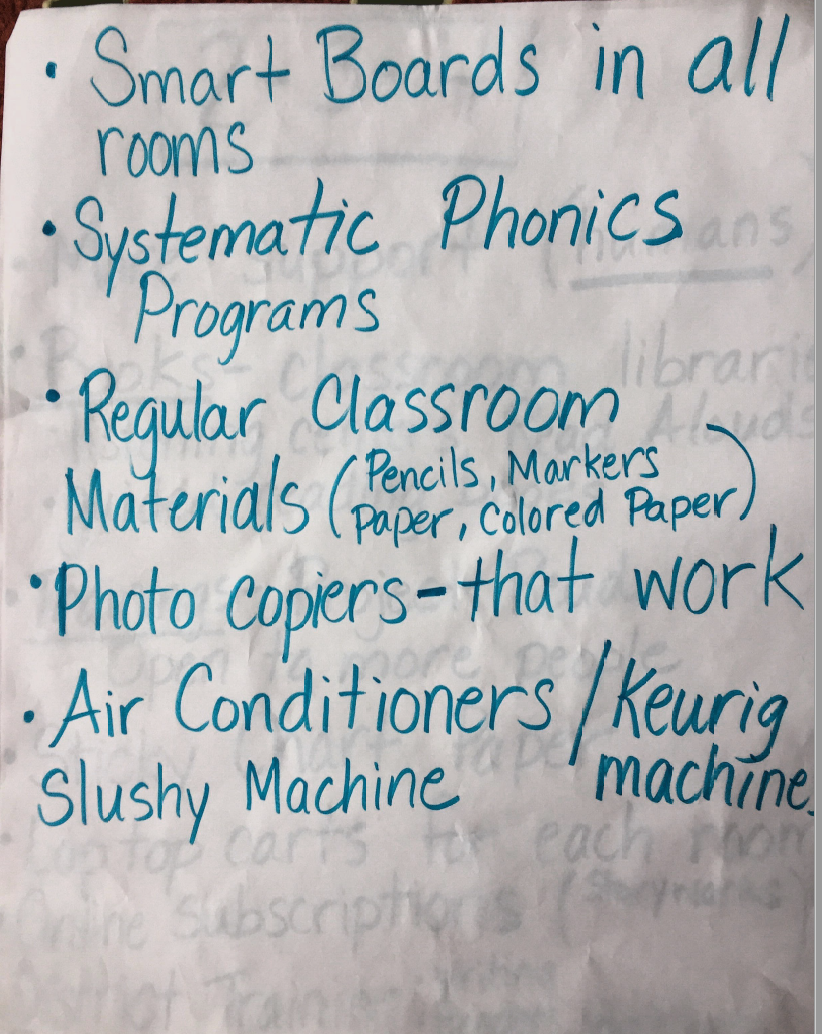
Every time I lead a Balanced Literacy course, I ask the participants to create a list of what is needed in the classroom IF funding were no problem. This Spring Semester group came up with these ideas. (yup, a couple tongue-in-cheek, but mostly serious).
Unfortunately, most of these are out-of-reach as our school budget reflects a 25-year under-funded and outdated Foundation Formula.
Our students deserve better. Get to Thursday’s Rally to #FundOurFuture on the Boston Common and send a clear message to those Legislators (and yes, there are some uncommitted in #Lowell who don’t see this as a problem) that it is time to throw on those big boy/girl pants and support the revenues that will enable our public schools to function on more than fumes.
There are events starting at 1 pm for anyone able to get to the Statehouse for them; the Big Rally begins at 5 pm on the Common. If you’re coming from Lowell – look for the Lowell sign so we can stand together.
Look at the faces on the students who are about as engaged as any child can be. These are fifth graders and they are not only having the time of their life, they are making a memory never to be forgotten. What would their school experience be if there were no music opportunities in their young lives?
The former music educator in me can certainly appreciate the skill and organization that propels this group of musicians. But I would argue that the connection made to an art like music is just as important.
As a high school freshman, when my Dad’s career took him to New England. it was music that made the culture shock of moving from the comfortable Midwestern community in which I had grown up more bearable. There were friendships that were made in the music room; it was a place where I had something in common with my otherwise foreign New England peers. It was the only place I felt less of a freak or outsider.
What if that safe place that my high school’s music program provided had not been available to me? Because I was different, I already felt a lot of teenaged alienation, and yet, the experience of practicing with other students in our orchestra and chorus helped me to belong. And by belonging, I had a pathway in as a student; it made me into an engaged learner which is something that has stayed with me throughout my life.
One of the impacts bothering me about the test-driven curriculum that we see today is that the arts are in increased danger of losing funding during tough budget times. The disciplines of music and art are often looked upon a frills. I would disagree.
While not every student will choose a career as an artist or musician, our schools should be places where students can experience and appreciate the arts in a personal way. Sometimes, as it was for me, that encounter with the arts may become the difference between a dismal and exceptional educational experience.
As the budget season gets underway in our public schools, Gateway communities in Massachusetts are faced decisions about which programs to keep and which will be cut. When municipal school budgets like we see in Gateway cities do not adequately provide for educational expenses, the temptation will always be to jettison the arts. That I believe is not only short-sighted, it is wrong.
The solution, however, is within our grasp. With 25-year-old Foundation Budget formulas driving which programs are funded and which are not, the answer lies with the Legislature’s capacity for adopting the Promise Act and for making progress toward fully and adequately funding all of our public schools.
So on May 16, I’ll be on the Boston Common rallying with my colleagues to demand our Legislature does the right thing for our students. Somewhere in that crowd might be a young person for whom the arts is a safe way to engage in learning, just as it was for me. I not only won’t give up on you. I cannot give up.
When I first met my mother-in-law, I was totally fascinated by the organization she used to allocate family finances, the system we fondly refer to as the “envelop system”. My mother-in-law would take an amount of money each week, break it down into smaller portions, and put each portion in its own coin-sized manila envelop which was kept handy throughout the week.
For example, if she budgeted $100 for food shopping throughout the week, five $20-bills would be put into the grocery envelop. When the money was gone, she either shifted cash from another envelop to buy something or went without until next payday.
In my mind, this is an apt analogy for what is happening in the Foundation Budget nightmare currently in place in our Commonwealth. The Commonwealth assigns a set dollar amount of aid for each community based on particular spending allocations, the chunk of money arrives at the municipality and when it doesn’t fully cover one spending category, the schools shift the funding from one category to another that has been shorted.
However, one of the biggest issues with the Commonwealth’s envelop system is that the money going into each envelop is the same amount as was used in 1993, over 25 years ago. Imagine trying to run your own household using the same amounts of cash as you comfortably spent in 1993.
Lowell Superintendents’ Forum, 4/22/2019
In Lowell, we heard last Monday about a shortfall of nearly 500 classroom teachers each year. Big underfunded and under-calculated items in the Foundation Budget are surely contributing factors to this. If a district such as Lowell has huge differences between the Commonwealth’s foundation budget determinations for school spending and the amount spent is more than what has been put aside, there are two choices.
Applying the “envelop system” demands a municipality either a) add money from the municipal coffers to make up that difference or b) shift funding from one category to another.
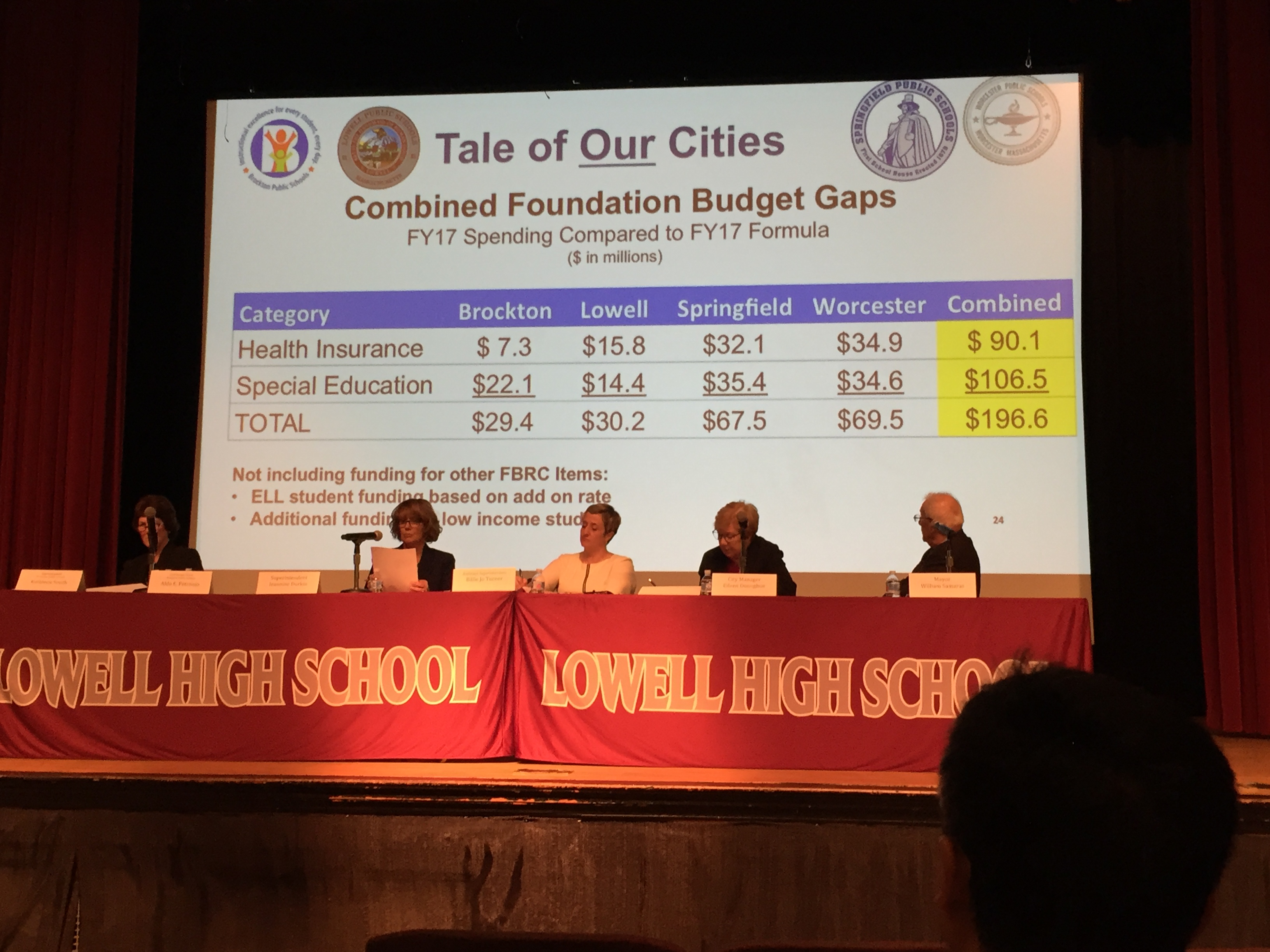
Of course these differences between state funding and actual spending are quite common – not to mention quite large – when the basis for the Foundation Budget calculations have not be updated in about 25 years. If state funding is based in the 1990s but actual expenses reflect the reality of 2019, it follows logically that there will be a huge conflict between state funding and reality. The differences are exacerbated when a municipality, like Lowell, Brockton, Springfield or Worcester, cannot contribute beyond what has been calculated in the Foundation Budget numbers, something a more affluent city of town might be able to do. It follows, then that some difficult educational budgeting choices must be made.
A gateway city, like Lowell, has nearly zero percent chance of not feeling some excruciating budget pain which brings us up to the shortfall of 500 classroom teachers. It is indeed painful to Lowell and to our children.
Four major areas – think of them as “envelopes” – need Foundation Budget reform: English Language Learners, Special Education (not including the Circuit Breaker), Health Insurance and Low Income. All of these funding categories are based on amounts that were set in 1993 which means that when one looks at what the Commonwealth funds and what the expense reality in 2019 is, there are huge variances.
Lowell Superintendents’ Forum, 4/22/2019
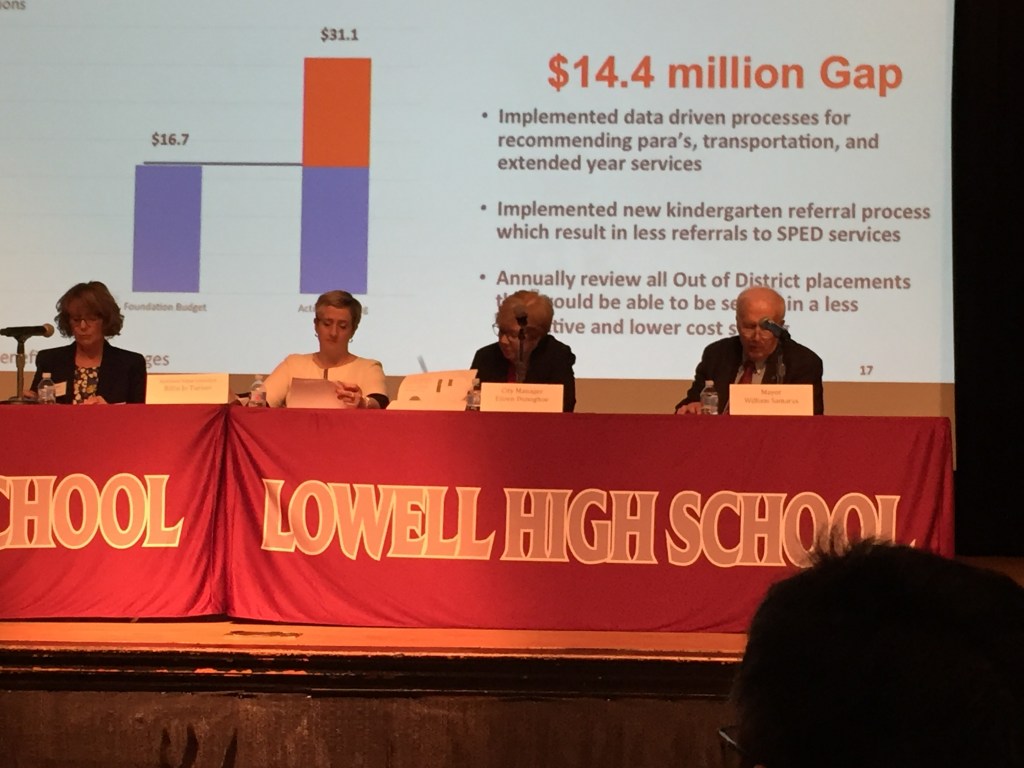
Let’s consider the budget “envelops” for a couple of these categories. The Foundation Budget calculates Special Education spending at $16.7 million, but the actual cost of Special Education in Lowell is $31.1 million. That’s a difference of $14.4 million which has to come out of one of the other budget envelopes. Health Insurance as budgeted through the Foundation Budget calculations is figured at $17.3 million, but the actual insurance costs, even after switching to a cost-effective plan like the GIC, is $33.1 million. Surely no one in Massachusetts is expecting to pay the same insurance costs as they did in 1993, so is it any wonder that the Foundation Fund amount is so out of whack?
As a taxpayer, a voter, and as a former educator, I am shocked when local politicians claim there’s no money to correct this. I think it is more likely there is no courage because that is what it will take to face the reality of underfunding schools. Revenues to fund schools, as well as transportation and infrastructure, in our Commonwealth are essential.
The envelop is empty and there is no time to waste.
There is so much to digest from last evening’s Funding Forum. So I’m just going to start with one aspect of Massachusetts school funding – the poverty level calculations.
When I retired in 2015, the Low Income Level in Lowell, was re-tooled as “Economically Disadvantaged”. In 2015, the number of students considered economically disadvantaged in Lowell was reported to be 49.0%. One would think the world would be knocking at Lowell’s door to find out how magically 25% of the public school student population was no longer economically disadvantaged. But, the world is not.
There was no magic solution. The same children I taught who needed supports because they came to us from low income families and socio-economically disadvantaged environments, simply moved up a grade level and experienced those same socio-economic traumas. This time, the supports were fewer. The change in counting these children was caused by the Commonwealth’s redefinition of how low income status should be determined. Starting in 2015, the determining factors became participation in SNAP, DCF foster care, transitional assistance for families, and Medicaid (MassHealth).
How does this impact school funding? To begin with, the Foundation Budget allocations contain a calculation to support low income students. The low income multiplier is applied to a community’s low income population to assist with supports these children may require in order to be on an equitable playing field with children who do not experience poverty. So when the Commonwealth changed the definition of poverty so that fewer students were considered economically disadvantaged, the amount of funding available for support also decreased.
This is some pretty fancy footwork with data and statistics isn’t it? Correcting the calculations for low income support was one of the issues directly addressed by the Foundation Budget Review Commission 3 years ago. It is also one of the many reasons why the Foundation Budget must be overhauled this year.
Our children who need support, whether that means additional academic support or extra-curricular opportunities before/after school, or essential wrap-around services such as programs that address health needs and food insecurities, cannot wait. Changing the definition doesn’t solve the problem. It just makes things more difficult.




 Budget season is going full tilt in Lowell and the outlook is definitely not very palatable.


 After An Educator's Journey