• I broke down today and started to work on a room arrangement.  I am planning on 24 kids – already have 23 on the roster – and have a contingency for a 25th.

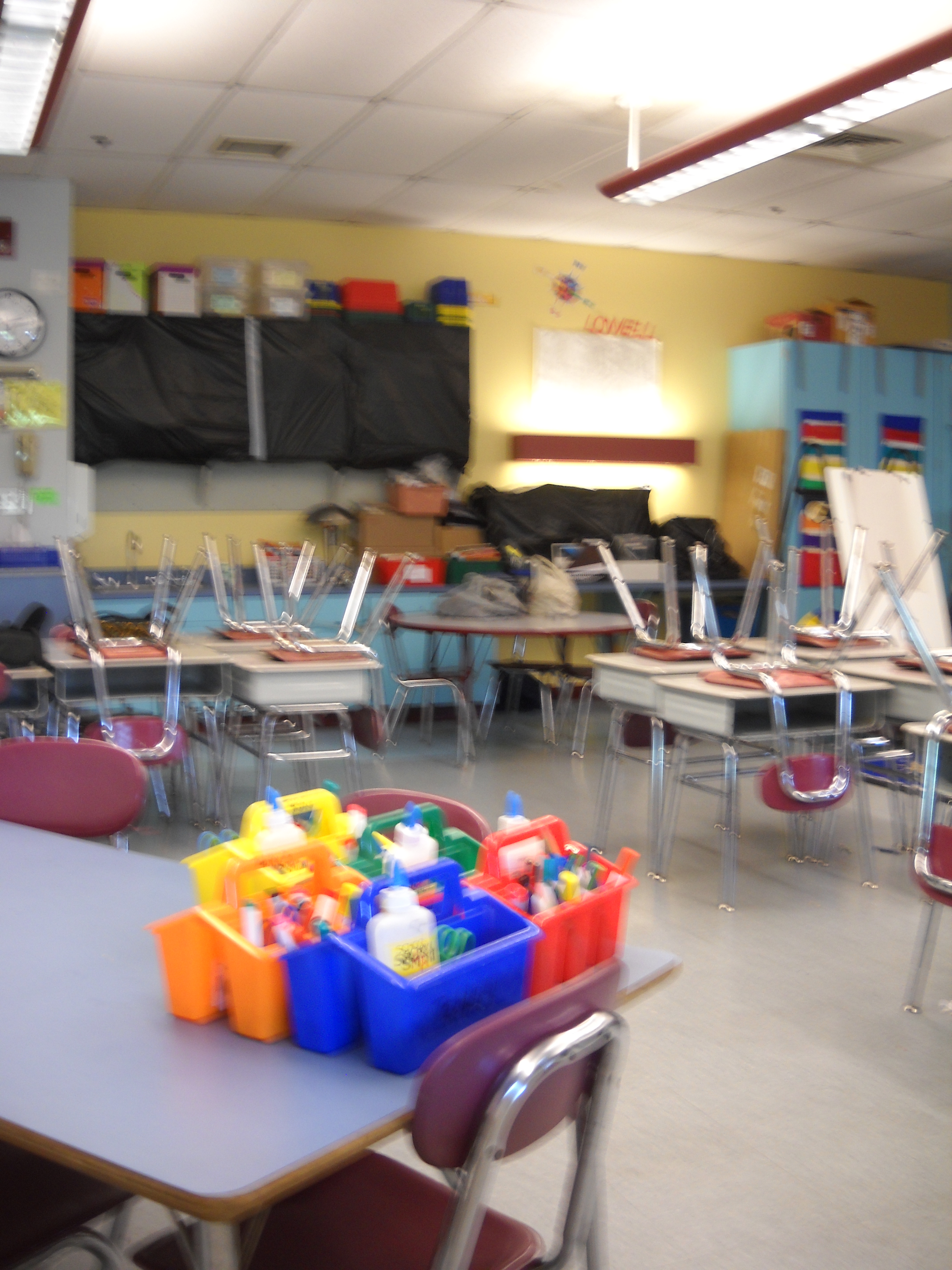
    Here are some “before” shots from last June:
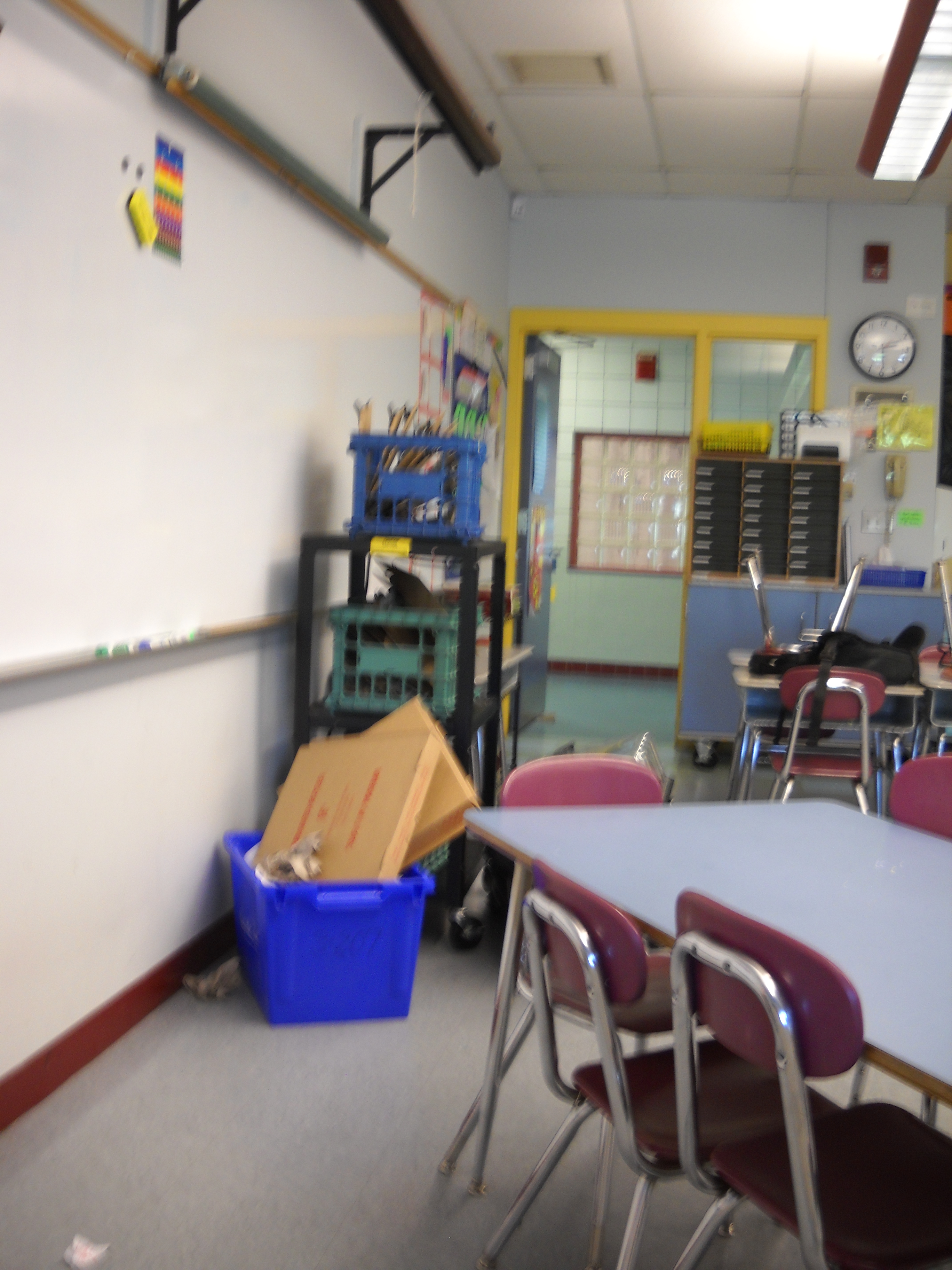
     
    Mail station and conferencing area
    View to back of classroom

    Step one was to move shovemy desk out of the way. I have a large, desk with an
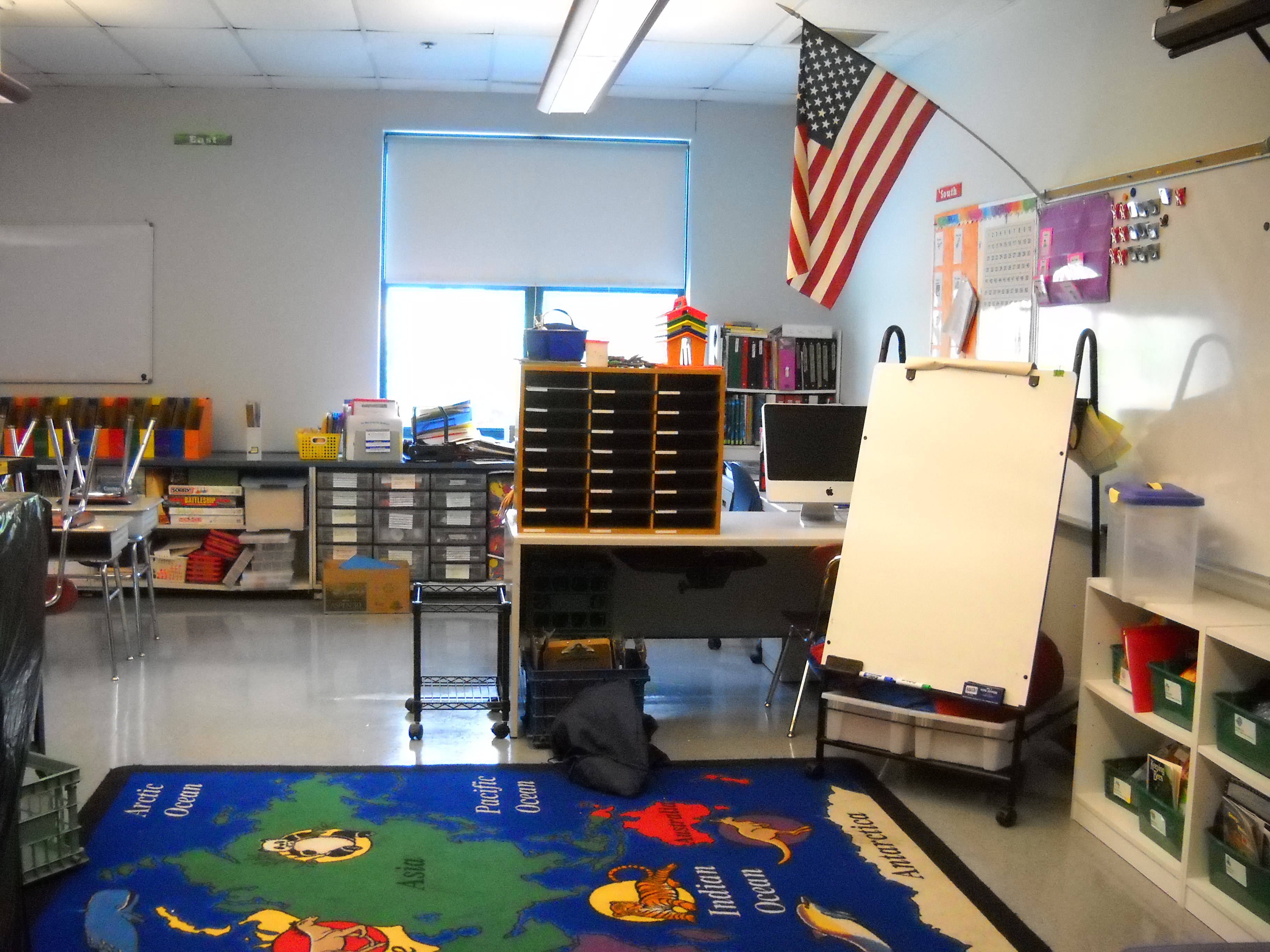
    New front layout

    equally large return; thankfully it is not attached! I have rotated the return around so that that kids have access to the knee hole. On top of this space I’ve put a 24-slot letter sorter we use for “mailboxes” and the shiny new iMac that actually runs the web-based programs our district subscribes to. I’m kind of happy with this arrangement already. The mailboxes are inside the classroom space now and not at the doorway causing a logjam. They are lower so the kids should be able to access them. And the computer is now easily accessed by students.

    I have an old(er) Dell laptop that I have replaced with a personal netbook. I will

    Back of the room

    hopefully gain permission from the computer network gatekeepers to access the internet from within our school’s firewall – which will allow me to do what I need to do assessment and data-wise, unplug the laptop and bring it home to continue my school tasks.  We’ll see how long it takes to get all of that permitted.

    I’ve also flipped where the classroom library was located to the front of the room. My classroom is at a junction point for 2
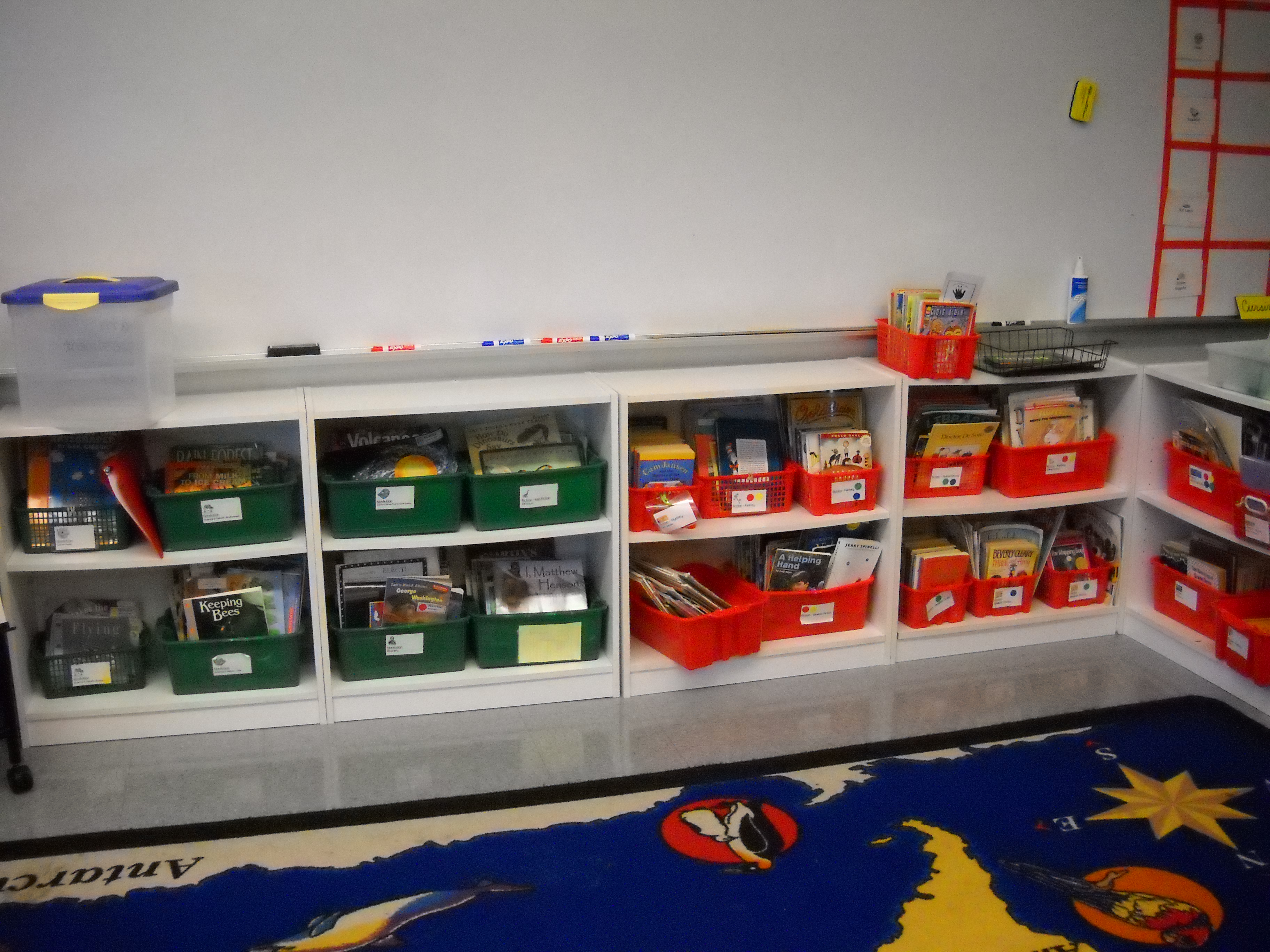
    New library location

    hallways – it is often noisy – which means it is distracting to put the reading conferencing space and/or student tables in that vicinity. I placed the shelves to create a kind of barrier which I hope will insulate us a bit from the hallway noise.  This is also where the gathering space is for whole group lessons.

    Finally, I’ve decided to group my students in 6’s – not because that’s such an ideal number for cooperative learning, but because there will be less real estate involved with the desks when we get down to 4 groupings.

    Now to work on the tossing; after sending out an all-school message, I got a taker for the table I wanted to get rid of. Next up is to get the TV cart moved in to storage and clear off the countertops. Once that is accomplished, I can bring in my plants and lamps — and some other homey touches. I’ve even located some fire retardant valances on the web. Things are starting to come together.

    Yardsale anyone?

  • How does that saying go? If you’re not green and growing, you’re rip and rotten. One of the key components of the Daily Five – teaching learners to be independent – is not only appealing, but imperative. After some false starts last year (based on my reading of both the D5 and Cafe books), I attended a Daily Five workshop. And the whole thing is becoming less muddled.

    Typically, my students don’t do well with a million and one different teaching models thrown at them. We already have a Launch-Explore-Summary model in place for our mathematics instruction. There is a great need for small group/individualized math conferencing and intervention, particularly this year when we transition from the Massachusetts 2004/2009 Frameworks to the Massachusetts version of the Common Core Curriculum. There will be gaps, that is certain.

    To address both the transition to a new curriculum and my students’ need for consistency, I have decided to make a go at implementing a Daily Five model during mathematics instruction. What are the five areas going to be? Well, here’s what my current thinking is:

    • Exploration activities based on the launched mini lesson (a “must” do)
    • Strategy Activities. Through the use of games and other constructive activities, students will address computational and conceptual gaps.
    • Problem Solving. All of my students, but particularly second language learners need practice in the structure of problem solving situations. This will be a weekly assignment with time built into our schedule for students to discuss how they solved the problem (rigor! perseverance!)
    • Basic Fact Games/Practice
    • Technology Tool (a chance to use the accompanying programs for our math program OR the interventions found in the Galileo program).
    I’ll need a minimum of 85 minutes; 90-100 would be better. That means getting back to class and started on our mathematics work right after recess. Hopefully the stamina-building and direct instruction in expectations for independence will give us greater success. On paper it looks do-able, in reality – I am hoping so.
    Planning out the block comes next.  Suggestions welcome.
  • What is my purpose in life?

    I was asked that question recently and my white glare honest answer is, I’m still working to uncover that answer. My purpose has been defined differently at every stage of my life.

    At different times, my purpose has been defined by different roles: daughter, sister, wife, mother.  Each role carries a separate purpose.  Supporter, caregiver, even pain in the ass. For my family, my purpose is often to be historian; my deep obsession with family history leads me to honor and respect those who came before. It connects me with the history of our country and our world. It causes me to pause, to wonder at the hardships endured so that I could be here in this place at this time.

    Professionally, my purpose also has evolved over time and again has been dependent upon my role. I’ve taught every grade level from Pre-K through 12th grade.

    Currently, my purpose is intertwined with my role as a third grade teacher in an urban school. For me, my purpose in the classroom carries the responsibility of opening minds to possibilities, to embrace discovery of something new, to discovering that as a learner, you are far more capable than anyone had imagined. To love learning and creating and finding your way – not without false starts and missteps, and not without learning from those missteps.Not without having some fun either. To take pride in what has been accomplished; to ignore those who say “you can’t” . To know that smart is what you are when you work hard… not what you were born with.

    My purpose in life, my mission, is to guide learners to these ends. Surely there is no test for this, no measure. The pursuit of such overtakes my life, not just 10 months of the year, but all twelve. It is critical. It is important.

    It is my passion.

  • I’ve been spending a bit of time thinking about what the physical atmosphere and arrangement of the classroom projects.  I am a packrat. There, I’ve said it. I saved egg cartons – must have had to toss about 50 of them when we moved 16 years ago – knowing in my teacher brain that I “might need these some day.” Well, someday never came.

    As much as I would like to make the classroom into a homey place, I worry about the wisdom of bringing upholstered furnishings into a space and risk bedbugs or other interesting things. Fire inspectors tell us that only 50 percent of our wall surfaces (or is it 20?) can be covered – and nothing within X feet of a door. Sprucing up foggy plexiglass windows with a window valance is out of the question.

    Even so, there are things I can take control of. I have a concern that a cluttered classroom translates into a chaotic message for students who are easily distracted. I understand that there have been rules created to ensure teachers have equitable access to equipment -our Union book spells out some of this. But an overhead and extra cart in the room – I don’t use this any longer as we recently obtained projection equipment – just takes up space.

    Here are some of the things I am considering:

    • Clear the countertops as much as possible. Use the surfaces for displaying special literature or projects.
    • Using the “return” on my desk for the students’ mailbox center and for the newer computer. Where will all that “stuff” on the return go? I am rehabbing a 4-drawer file cabinet which I’d like to use to get stuff of the surface areas.
    • Get rid of the rectangular reading table. I have a round reading table that can be used for conferences or listening or what-have-you. I want to conference right at the student’s desk or read in small groups in a rug area.
    • Put the television in storage. The cart it sits on must take up 6 square feet.
    • Throw, recycle, sell – get rid of any personal teaching material that doesn’t support the current framework or hasn’t been used in more than 2 years.

    This year I will be sharing my space with at least one – possibly two – SpEd/ health paraprofessionals and some medical equipment for one of my new students. It is not only a nicety that the room becomes less cluttered, it is imperative. There may be decisions to be made about where adults put personal “stuff” and how much can or cannot be in the room. That will most likely not be met with enthusiasm.

    Time to roll up sleeves and get cracking.

  • August 9, is the anniversary of my Dad’s death. If he were still with us today, he would have been 93.

    My Dad fought a long, hard and brave fight against COPD and emphysema. He had been a smoker – first cigarettes, then cigars and pipes. I once heard him express regret over smoking, but the 1930s and 40s were a different time.  It never came up, but I would bet money that he would have been sorely upset if any of us had taken up smoking.

    He didn’t talk much about his childhood. His own mother died when he was nine so he didn’t talk much about his own childhood. But once in a while – especially when my aunt, his older sister visited, family stories would creep out. He (and she) signed their own report cards. His family went on a camping trip in the early 1920s to Gettysburg, where his grandfather had fought, and to Washington, DC. He sat in one of the chairs in the White House.

    He loved chocolate – and I think may have genetically passed that on to all four of us. He could fix just about anything; that’s something he did not pass on. He couldn’t spell, but he could burp “oh baby”.  An excellent driver, I don’t believe he ever had an accident; all the dings in his cars in the late 1960s – those were from me.

    When my Dad died in 2004, one of my friends told me that there won’t be a day that passes when you won’t miss him.  She was right. Especially today.

  • Underneath all of the coverage of the debt crisis was another important event that really needs some attention: the Save Our Schools rally in Washington DC over the weekend. Stakeholders in public education got to listen to and rally around some educational heavy-hitters – Diane Ravitch, Jonathan Kozol and others whose writings and voices I admire. They have the fortitude to call public education – or what passes for it – on the carpet and not worry about jumping in to the fray.

    One speechmaker that surprised me – not because I didn’t think he was thoughtful enough for it – was Matt Damon. That’s right. Matt Damon the actor, writer and pride of Boston (Cambridge really, but we won’t worry about ZIP codes here).

    How proud his mom, Lesley College educator, Nancy Carlson-Paige must have felt to hear Matt talk so poignantly about the impact teachers made on his life. Teachers who did not have to worry about whether or not the single-shot, high stakes test scores that we live with now would measure whether or not they were effective educators of children. They provided students with opportunities to express themselves creatively, to learn about the world, and to learn to love learning. Can we say the same happens now?

    Maybe it was the turning of the calendar to August when thoughts turn to preparing for the upcoming school year, but I personally really needed to hear these words:

    So the next time you’re feeling down, or exhausted, or unappreciated, or at the end of your rope; the next time you turn on the TV and see yourself called “overpaid;” the next time you encounter some simple-minded, punitive policy that’s been driven into your life by some corporate reformer who has literally never taught anyone anything. … Please know that there are millions of us behind you. You have an army of regular people standing right behind you, and our appreciation for what you do is so deeply felt. We love you, we thank you and we will always have your back.

    So if you live with, know, appreciate or support a public educator or someone working in public education, speak up. We need to know that once in a while, we get it right.

    To read Matt Damon’s speech in its entirety, here’s a link.

  • The Massachusetts Common Core Curriculum implementation starts this coming school year.  As a District Team, we’ve looked at how the standards are expressed with increased attention to Focus, Coherence, Clarity and Rigor.  In Lowell, we began our look at the new standards by defining exactly what these four terms mean. One idea that has stuck with me as we work on preparing materials for our colleagues is that  the standards are not “intended to be new names for old ways of doing business. They are a call to take the next step….”

    Where this becomes apparent is in looking at clarity as applied to the Common Core. I’ve been taking these standards apart since early June now, and each time it amazes me at how clearly each grade levels’ responsibilities for student learning is spelled out.

    As a Third Grade example, our former Frameworks (2000, 2004) 3.N.10 asks students to “Add and subtract (up to four-digit numbers) and multiply (up to t2o-digit numbers by a one-digit number) accurately and efficiently”.  This standard corresponds to the Common Core 3.NBT.2, “Fluently add and subtract within 1,000 using strategies and algorithms based on place value, properties of operations, and/or the relationship between addition and subtraction.”

    For me the new standard is truly packed with specifics. Fluently add should mean that no matter what the strategy, students can perform the operation without hesitation.

    Using strategies and algorithms based on place value does not mean the standard algorithm — in fact the standard algorithm does not become specified until later grade levels (Grades 4 & 5).  What this standards tells us – clearly – is that all students need to be able to perform addition and subtraction within the thousands place using relationships – such as friendly number strategies – or using a process reliant on place value (decomposing and then adding partial sums for instance).

    While we may have students who are ready to record these problems using a standard algorithm, unless the student thoroughly understands and can explain the use of the standard algorithm – thereby demonstrating that the student is ready to use a standard algorithm – the student should use some other process for computation. Blindly applying a process without the knowledge of the what and why is no longer accepted.

    To me, this is refreshing – a recognition that understanding and comprehending a mathematical topic with depth, and rigor is of importance.  The wording itself of the standard is clear and direct.

    As we explore the Common Core, we discover that there is much more clarity about the level, or depth of thinking, to which we need to bring our students. And that is a good thing.

  • One of the most powerful and admirable things about Gail and Joan – the Sisters – is how they openly share their teaching life.  They don’t preach that they have all the answers, and anyone who has spent more than a nanosecond in a classroom knows that absolutely no one can have all the answers. Teaching is organic; it changes from day to day and sometimes from minute to minute. It changes from year to year as well as the culture of the classroom is fluid and dependent on the humans that make up the class.

    According to The Sisters, one of their most frequent troubleshooting queries is about children who don’t seem to develop the stamina required during independent work periods.  Fake reading, avoidance tactics (bathroom visits, taking FOREVER in the bathroom), whatever you call these behaviors, the kids aren’t reading and are often sucking away valuable teaching and learning time.

    Joan and Gail call these kids “barometer” kids — depending on which way they are going directly impacts the entire atmosphere in the classroom.Last year I think I had quite a few kids who could make or break the learning in the day. Some of this distraction was a cry for attention and some was something deeper. Whatever the cause – attention or organic — the impact on all of us in the room was immense.  Here’s a link to what they have to say about one of their students who had difficulty building stamina.

    The Daily Five structure demands that children learn to own some of the responsibility for their own learning — and that includes building the stamina it will take so that I, the teacher, will not always need to be the ring-master.

    It will take a bit of trust for me to let go, to trust that my students are capable of learning how to do just that — to be trusted to make good learning choices without me getting in the middle of things.

    We will all be learning new things this school year.

  • Today, I had the privilege of attending The Sisters Daily Five presentation here in Massachusetts – and if you get the chance, it is well worth your time…. and money. Some of the most intriguing parts of the presentation involved the research on brain function.

    When I try to apply a something new and exciting to my own teaching, the temptation is to just rip of the bandage and dig in. Maybe that’s not the best way to do it though.  Having lived in older home for most of my adult life, I know that when I first move in, I want to spend all my capital on the things that are seen, the obvious things like a new coat of paint or new furnishings. Fixing structural pieces (the chimney, the roof) aren’t going to be as obvious.

    No one walks into your (new) home and says “Wow, that’s quite a nice chimney job. Love the new cap!” But these kinds of fixes are the structure and although there’s more of a wow factor in repainting or re-papering, the structure must be dealt with first. So how does this thinking  relate to the Daily Five?

    According to the Sisters, Kenneth Wesson’s work on neuro brain function, informs the structure they advocate for Literacy: a small focused hit of instruction with the whole group followed by a period of 10-15 (primary grade) or 20 (intermediates) of independent work. Wesson further states that the amount of time allotted to the whole group lesson is directly proportional to the average age of the students in the class. Joan – one of the sisters – taped her class to prove this was wrong when she first heard it and ended up becoming a believer. She shares this video clip during the Daily Five presentation.

    Think on that for a moment. At the beginning of the school year my students are 7 or 8 and by the end they are 8 or 9.  My third graders only sustain focus on what is being taught for an average of 8 minutes! And if I have a “young” class — teachers know what I mean by this — the time is even less.

    The impact on teaching is that time spent on the actual lesson must be focused and succinct. Thank goodness I am not forced to use a basal; if I had to do all the ramping up to the actual point of the lesson, my kids would either learn little or we would both be frustrated by constant re-teaching.

    But what I do need to attend to next year is boring right down to the essential learning more quickly. It may mean timing my mini lessons until I get the feel for just how long 8 minutes is.

    It is a model we’ve used both in Reader’s Workshop and in Mathematics (Launch-Explore-Summary), but the model stopped short of explaining why it is so important to have a short burst of focused whole group instruction. As I start to plan for the coming school year, the one structural piece I am determined to attend to is this one. Those mini-lesson times, whether in literacy or mathematics, need to correlate to the amount of time my students can function.

    And maybe then we’ll be able to move on to dressing things up.

  • Every day there appears a new idea for making teachers accountable for student achievement. Yesterday I noticed a pip of an idea in a twitter post: Phys. Ed. teachers should be evaluated based on their students’ fitness level.  This preposterous idea, that the fitness level of a student who has maybe 40 minutes contact time with the physical education teacher, should be the basis for that teacher’s effectiveness is exactly what discourages me. Isn’t there an “outside” influence on such success? Of course there is — the home, the importance a parent places on physical activity  follow-through, not to mention nutrition choices!

    And then I began thinking about how our own state testing is going to impact how I am perceived. Here are three things that you won’t see from picking apart my students’ MCAS scores:

    Being in class matters: The students who did not regularly attend school had the worst SRI growth — I’m waiting to see what the MCAS data officially looks like, but I won’t be surprised if these same students’ results are not very good.  Their growth from beginning to end of year using the Fountas & Pinnell benchmark (although that’s somewhat subjective) also reflected limited growth. It would appear that something must be taking place in class that would cause students who do come to school to learn. Hmmm, wonder what that could be?

    Supportive families matter: Even when students come from some pretty unbelievable socio-economic circumstances (homelessness, poverty, violence), the end-of-year results of students where the parent was a collaborator were positive. What does that say? Could it be that learning in a vacuum without home involvement is rare?

    Timing is everything: One of my biggest — notice I said “one of” — is the timing of the state English Language Arts exams.  It happens in March which is, let me count, 7 months into the school year. Please explain how 7 months of learning makes a complete year (10 months). It follows on the heels of ELL testing, the MEPA in Massachusetts. the poor 8- and 9-year old kiddos who have to do all of this get exhausted.

    If I’m accountable for learning for an entire third grade year, shouldn’t I get the whole year? This year was a special challenge; students coming from one of the classrooms had a long-term substitute for much of second grade. The regular classroom teacher is a strong, conscientious teacher but the substitute was definitely not up to the task. For these students I spent a LOT of time trying to bridge gaps from second grade. I really could have used more than 7 months for this work.

    Isn’t this what bothers educators about state testing tied to evaluations? It is the unknown, random, living-breathing fabric of teaching. We work with humans. Stuff happens. Outside influences impact the final “product”.  There is more to growth (an lack thereof) than testing.