• A few weeks ago, the District trained all 3rd and 4th grade teachers on a new science program that is being initiated here in Lowell. The logistics of revising an already tight schedule to include a new program with some pretty hefty time requirements has been nightmarish to say the least. It hasn’t helped much that the administrator who successfully advocated for this program is no longer part of the Central Office administration.  It also has been received less-than-enthusiastically because of timing: adding in a new program when we have major curriculum overhauls in English Language Arts and Mathematics (Common Core!) while we straddle the former frameworks makes everyone cranky.

    However, yesterday my students were involved in a soil experiment that has made all the angst over getting this off the ground feel worth it.
    Looking for the unexpected

    As typically happens when implementing a new program, you read it once, read it again, and still miss something. At least I had remembered to gather leaf matter from my backyard for the student observation. But as it was 6:30 and I was on my way to school, I just picked up what I could from the side of my driveway. To me, it just looked like a bunch of dead red maple leaves – nothing too interesting to observe and record.

    Well, were we all in for a surprise.  Table by table, each group discovered not only leaves (and a few sticks), but BUGS! Spiders, beetles, bug casings — the whole gamut. And were the kids ever excited! “This is the best day of my whole life,” one of my less-academically inclined students yelled.  I think I would agree.

    I never know just how valuable, exciting, and wonderful a lesson is until it gets rolled out in front of the students. All that hand wringing? Worth it.

  • The weather has been unseasonably warm for the last several days. Yesterday was no exception. Even though yesterday was the City of Lights Parade and Holiday Stroll here in Lowell, no one seemed to mind that temperatures were in the 60s — people were dressed in flipflops and shorts while waiting for their moment with Santa.

    When asked, Adrien shoots for Cultural Organization of Lowell, the organizer of this and other wonderful events in the City.  Yesterday while he was on assignment, I walked around too, making a record of the Mill City on an unusual late-November afternoon:

    Boarding House Park, Lowell MA
    Boarding Houses, Lowell MA
    Boott Mill Trolley Tracks, Lowell MA
    Gatehouse Reflection, Lowell MA
  • I am in agreement that we need to give students real responsibility for their environment in school. Kids need to be responsible for picking up after themselves, for noticing when papers are on the floor, for taking care of their commonly shared spaces. I get that.

    However, I read something in several news sources that made me cringe. Here’s a link to  a proposal from republican presidential hopeful Newt Gingrich. In short, Newt wants students to replace union janitors/custodians in school and get paid for doing so.

    Now if you want to earn a popularity contest with the conservative wing just mention “union” and come up with a replacement (or don’t come up with one). Also use the buzzword “bootstrap”, which apparently Gingrich did:

    Currently child-labor laws and unions keep poor students from bootstrapping their way into middle class, Mr. Gingrich said.

    Let’s cut to the chase here: no amount of  money paid to a child (as opposed to negotiated pay earned by adults) to keep the school clean is going to result in a move up the economic ladder. And, P.S.,  those child labor laws are there for a reason.  Mr. Gingrich may wish to revisit a history book – or even Wikipedia.

    Correct me if I have misunderstood, isn’t a child’s “job” in school to learn? At least that is what I have always told my own child and the students I have taught for over 25 years.

    When there is blood or vomit involved, no one should have to call an underage child to clean up. Universal precautions with fluids are serious.

    Students should pick up after themselves – yes – just like they should help out at home. They shouldn’t expect to be paid for taking care of their own spaces; they should learn to be responsible because it is the right thing to do.

    A student’s job in school is to learn.

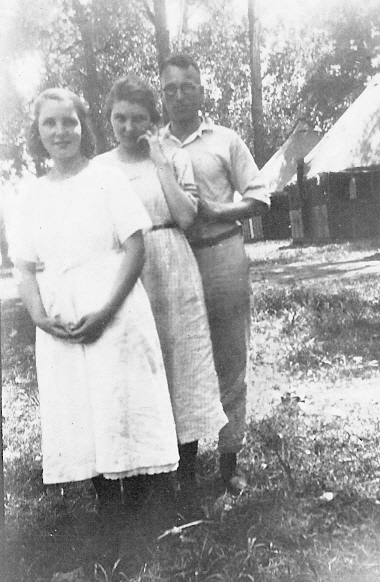
  • Palmer Flournoy with Edna Wyant Flournoy & Helen Wyant, 1920

    Today marks my materal grandfather’s birthday. His name was Palmer Chester Flournoy and he was born in 1889 in Albany, New York. When he was still a baby, his father, a railroad conductor, was killed in a tragic railway accident. My great-grandmother moved her family – my grandfather and his older sister, back to Stanbery, Missouri to live  with my great-grandmother’s family – the Palmers.

    My Grandfather only attended school until he was in about 8th grade; after that he went to work. He was well-spoken and a fabulous story-teller. And from family stories, we know he was a trickster and strong-willed. And intelligent – he was respected as honest and fair.

    One of the things I most remember him telling me was that I could “catch more flies with honey than with vinegar.” He always spoke respectfully – how I wish I could remember that more often. Once when his butter pecan ice cream came without pecans, he respectfully wrote to the corporate headquarters and in a short time not only  received a replacement half-gallon of butter pecan, but also received a second half-gallon. I try to remember that when write a letter of complaint. My grandfather was an amazing expert in respectfully expressing that something was amiss.

    The most important lesson my grandfather taught me was to live in dignity, even when life is throwing you curve balls. Macular degeneration and cataracts took my grandfather’s sight. Even though low-vision robbed him of reading, or driving I don’t think I ever heard him complain. He had an outgoing nature, and if he couldn’t figure out which coins to use when paying for something, he simply asked the clerk to help pick out the coins. When I was in my twenties, he rode buses or walked everywhere in Daytona Beach; whenever one of us came to visit in Daytona, he could be counted on to meet us at the airport. And to see us off. Life may have robbed him of vision, but it took nothing else from his great enjoyment of life.

    I think a lot about my Grandfather’s great capacity for enjoying life despite what hardships are encountered. And hope that as I grow older, I will always remember lessons learned from a real gentleman – in all senses of the word.

  • When you have pretty strong convictions about something, they are not always understood or shared by others.

    For me, one of my thoughts is that creating an environment of order and welcome is of high importance to my students’ frames of mind. With many of my students coming from existences that are not always orderly, I have felt that the ambiance created in the classroom can go a long way toward settling students, toward allowing students to focus and learn.

    My colleagues and I are reading Charles Appelstein‘s No Such Thing As a Bad Kid, as part of a teachers’ book club this fall.  I was struck by the importance of cleanliness, warmth, and color in a classroom toward creating a safe environment for my students. Appelstein specifically calls out attending to classroom design – as do the Sisters. It is something I have been dabbling in for the last 4 months and now, armed with both Appelstein’s and Gail and Joan’s thinking, I may be ready to do something drastic.

    I hate clutter. There seems to be no end of it in an inclusion classroom, so the first thing I need to address is the collection of materials that do not appear to have a use. Countertops get covered with materials – surely there has got to be a neater way to store what materials are needed for a day or week. This is tricky when you are sharing your space with other adults – I don’t want to be bossy about it, but some of the materials I see tucked away has no real purpose in the everyday learning of my students.

    The next step will be to somehow find a way to create a more welcoming space – adding curtains/valances (whatever the fire code allows), changing that God-awful turquoise to something more calming, putting away or weeding out materials that aren’t in use, creating spaces that are welcoming for children to read, write and think.

    So really, I am not a nudge, but I am convinced that the changes I can make — and the clearing of clutter — will impact the learning environment in this classroom. And they must be done.

  • Recently, Northern Nevada Writing Projects WritingFix website featured the book Show Don’t Tell by Josephne Nobisso. It caught my eye as this is exactly what I ask my Third Grade Authors to do: use your words to SHOW what happens in your writing. In fact, Googling those words, this seems to be a pretty universal thought for teachers of writers.

    As my students have worked through the past weeks to create a Small Moment Narrative – our featured writing product for November – one strategy I’ve introduced/reviewed is that by adding conversation to writing, an authors shows what is happening in the story.  Oh how my Third Graders love to use quotation marks! Sometimes those marks appear in the darndest placed 🙂

    In preparing for conferencing, I try to read each students narrative ahead of time. It gives me an opportunity to consider the most important next step we need to take in a student’s writing. And sometimes it is just plain fun to pre-read their ideas and thoughts.

    Before I packed up some of the students’ writing for my “homework” yesterday, one of my ELLs approached me with a warning: “I’ve written some Spanish” she told me in a whisper.  I assured her that wouldn’t be a huge problem – armed with false cognates and an online translator, I was pretty sure I could problem solve the gist of her writing.

    But what she had done was not just add randomly placed Spanish words in her narrative. She had written conversations in Spanish! Why? Because that is her home language and that was the language her mother speaks with her. So when Mom spoke in her Small Moment, the conversation was authentic.

    Absolutely brilliant – don’t you think?!


  • This summer was partially spent in aligning Common Core Mathematics curriculum (Massachusetts-style) with the district’s universally available materials and laying out a scope and sequence that makes sense vertically and horizontally. As anyone who has looked at the Common Core in depth can attest, it’s an on-going process full of starts and stops.

    A particular challenge to 3rd and 4th grade teachers in this transition year – this year our students will be MCAS-tested on 2004 Curriculum Frameworks – is, while we work to transition there is a great  need to keep a close watch on those standards that have been moved from our grade level. Particularly the standards for which our students will be accountable but were not previously taught to mastery.

    To my thinking, this is where using the Daily Five in Mathematics makes perfect sense. I can still launch my core lesson – the Common Core-based lesson, have my students work for a period of time on the activity (notice I’m not saying worksheet!), reconvene for a summary discussion and refocus students on continued work using one of four categories: Strategy Games, Facts-Clocks-Money, Problem Solving, or Math Tools.

    Yes, I know that the Sisters don’t use this terminology.  These are the terms that I use because of the mind-blowing task of straddling two curricula while transitioning to full Common Core implementation.

    As a third grade teacher, I know the bulk of my mathematics intervention – the dance to catch kids up on things that are now receiving more emphasis – will be on number sense and operations (CCM: NBT, OA) . Prior to this year, there was no explicitly spelled out requirement that students master addition and subtraction to 18s in second grade.  We’ve got some wood-shedding to do here.

    To keep things sane, and to allow me to meet several small groups, I have a few strategy games that I call “landmarks”. In our current multiplication unit, those games include array cards, Marilyn Burn’s Circle and Star game, as well as Close to 100 (or 1000) and Collection Card games (Investigations in Number Data and Space) we used to introduce 3-digit addition/subtraction. The teaching challenge is to pick out universal games where “rules” stay the same, but the ante is pushed to make it challenging for all students no matter what their level of mastery.

    As most students use the four choices to continue to build mathematical concepts and skills, I can meet with small groups of students needing intervention support  in place value, or understanding of addition/subtraction or some other yet undiscovered area of need.

    How can I do that? Because my students are Independent Learners, I know that when I attend to the small group, the rest of the class is engaged in some meaningful practice and learning. The same Daily Five expectations for Literacy – get started right away, do math the whole time, work quietly, work on stamina – are applied to independent explorations in mathematics.

    For me, the Daily Five principles applied to the mathematics class make this differentiation possible. My implementation certainly is not perfect, but knowing my students are getting what they need without the teacher being pulled away by monitoring what is going on in other areas of the classroom makes the work ahead possible. And definitely more enjoyable.

  • In case you didn’t hear all the hype we had a bit of a weather event here in the Northeast. When one of my colleagues relayed that the weather prediction for Saturday was 6+ inches of snow, well, naturally I went into high “French Toast Alert” mode. Even bought a special loaf of cinnamon bread just for the occasion.

    When Saturday broke and we still had no precipitation falling, I rushed to my neighboring town for additional provisions. Beer, milk, eggs, ground coffee, toilet paper. You know… the essentials. The store wasn’t too crazy so I thought perhaps the weather dudes had made a mistake. Usually when a storm is predicted, everyone shops as if there is no tomorrow. Which as it turns out, would have been just about right.

    You see, it is still Autumn here in New England. In fact, it wasn’t even Halloween yet. So when the first flakes finally started coming down around dinnertime, those trees full of leaves were quite stressed. At one point, I ventured outside – as I am the only one in my family currently with a winter coat – to shake the ton of snow off of my red maple, whose branches were bent over so far as to touch the driveway.

    As I stood outside in the driving snow, I noticed that the sky would periodically light up with an ominous green flash – on both front and back sides of the house – which was accompanied by an even more ominous hum.  This happened several times and finally… darkness.

    When you first lose electrical power, you almost expect it to come right back on. Then reality sets in and you start looking for a) where that flashlight may have gotten to and b) candles and matches. And the phone number for the power company – which of course, you attempt to dial in the dark along with about a million other customers whose Saturday television viewing has been interrupted.

    We are among the lucky power consumers. When we lose electrical power, we do not lose heat or hot water. Having grown up in New Hampshire where even the hint of a power outage sent people running to fill bathtubs with water (no power and the well doesn’t pump which means, the toilet also does not work). We did lose our woodstove as the glass insert chose last Saturday to shatter into a gazillion pieces, but at least we did have heat. Many of my neighbors did not have heat — or a gas cooktop (no oven, a minor inconvenience).

    The snow amounted to about 8 inches, much of which is still covering my yard 5 days later. The snowblower worked and we found the shovels. All good. We made that French Toast in honor of the storm and thanks to the ground coffee, brewed French press. And waited for the power to return.

    And waited. And waited. And waited.

    We have finally and thankfully had our electrical power restored; but 58% of the town still sits in darkness. I have a new appreciation for life before electrical conveniences. And an appreciation for cellphone car chargers.

    It’s only the beginning of November and already I’m sick of winter.

  •  


    I work in a smallish/medium sized urban school district. In recent years, the school budget has been cut so to eliminate instructional technology teachers and the staff holding up the technology infrastructure hangs on by their collective teeth. We are not an affluent community; no PTO is holding a raffle to raise funds for Smartboards or laptops or anything else as a matter of fact. The not-a-recession has hit this community – and thereby the budgets – fairly hard.

    In my own classroom, I have one old iMac “jellybean”. It no longer gets operating system updates or browser updates. CDs make an interesting hum when spinning in the drive. The “teacher/desk” computer is 2 years old; I’ve taken it off my desk so the kids – all 24 — can be a crack at using it in the classroom. For my own technology use, I brought in my old (6 years) Dell laptop. Because it is my own personal property, the District won’t allow it to access the school network or the Internet.

    Getting the picture? Technology just isn’t pretty in this urban district.

    I used to feel pretty sorry about this, but an article in the Times and Boston Globe this weekend is causing me to rethink. Here is a link to the Times article about a Silicon Valley School where technology is not part of the infrastructure of a student’s learning.

    Think about it. When do you use technology? Is it a tool for getting work done? Or is it entertainment/edutainment?

    I think there’s probably room for both types of applications in education. And while I certainly would appreciate having some hardware that wasn’t purchased before my students were born, maybe the application of technology needs a revisit.


  • Maybe this post needs a subtitle: Right hand, please call the left hand!

    Yesterday my colleagues and I spent the day in training for a new program being used in third and fourth grade – Seeds of Science/Roots of Reading. From what I can see, the program has many merits. And of course, there’s the little matter of students and science instruction.

    For many years – I’m going to say 8 or 9 now – our elementary schools have been without a science specialist to help guide teachers and students in teaching science.Those positions were eliminated during budget cutting – along with library and computer specialists in the latest round of fiscal roulette. With state standardized testing in Middle School showing our kids’ science test scores in the toilet (can we all say a big DUH here?), there is a renewed interest in teaching science in the late elementary grades.

    All good, right?

    Here’s the challenge. There is no time in the day to implement this program unless we are allowed to give something up – isn’t that always the way? 90 minutes of reading instruction + 90 minutes of mathematics instruction + 60 minutes of writing workshop and don’t forget breakfast, lunch, recess, specials and Morning Meeting. Where will new hour for science come from?f

    I can see a couple of options – but for every option tossed on the table for discussion, there is an alternate roadblock. If we take time from math or reading instruction or writing instruction, our students will most likely lose some of the gains we have made. The new program is developed in such a way that I don’t believe it will fit into the structure of Daily Five – something I’m committed to philosophically AND pedagogically.

    Will this program become just another layer of stuff we are required to do? I hope not. What I do know is that I can’t cram another hour into a school day without something giving.

    Hopefully it won’t be my sanity that gives.