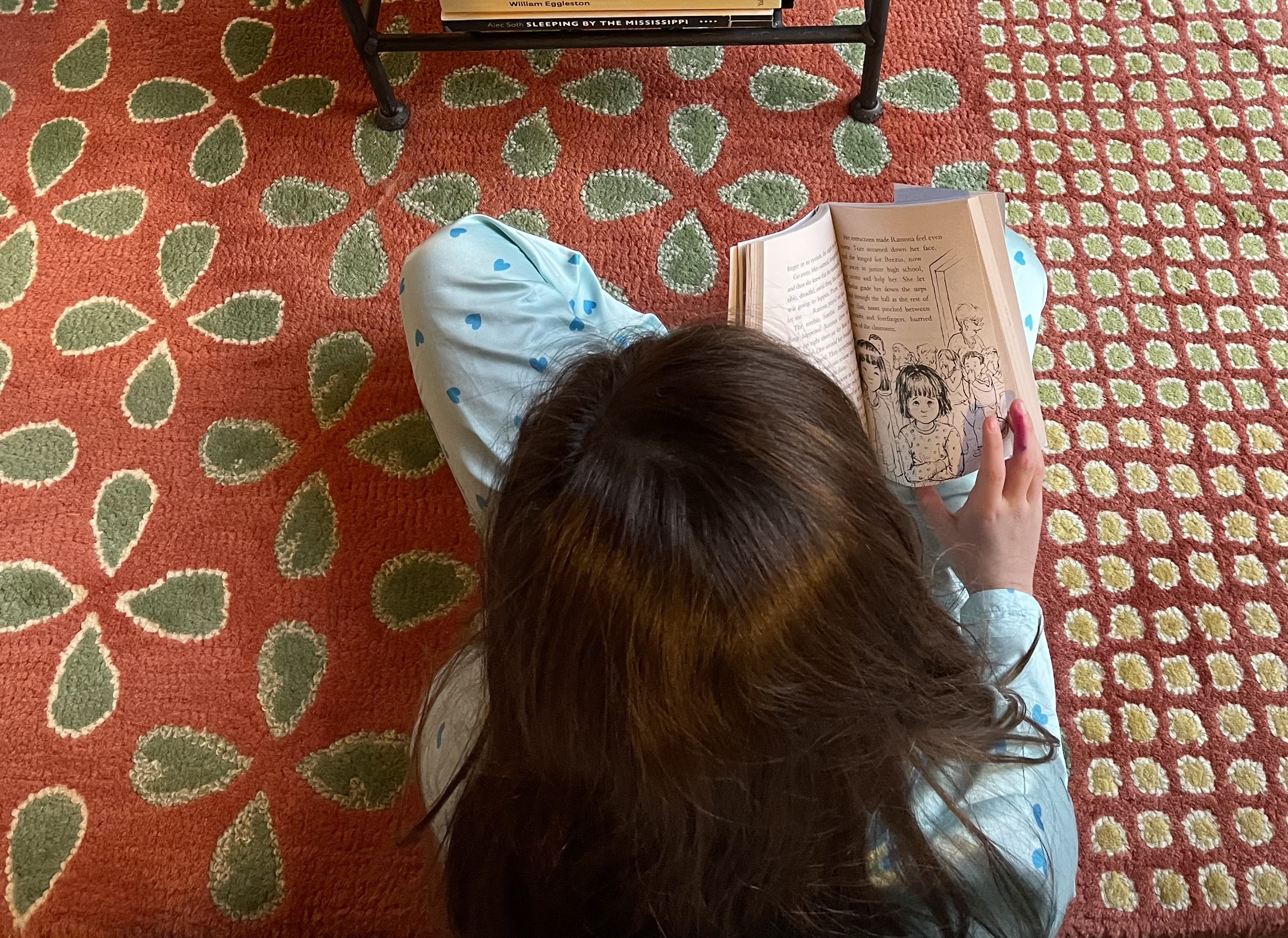
One of the most important things that I felt I should do as an elementary teacher was to encourage children to learn to love reading. Along with the myriad of skills needed to learn the process of reading and comprehending, finding what clicked a child’s interest to learn to read was the catalyst. Interest built the basis for skill which I think is true for adults too.
Our granddaughter, age 7 now, has been immersed in reading and literature since she was born. And now, more independently, she turns to books willingly. Her parents have always encouraged and supported this, which is why she treasures books and reading so deeply. Right now, she devours graphic novels, like Dav Pilkey’s books along with nonfiction books about animals, but she also willingly tries other genres.
Whenever she is visiting, she heads right for the ottoman where we keep picture books that may have started as read-aloud favorites when she was young. Over time, as she’s learned to read, she often reads them for herself. Our granddaughter always knows there will be a new book to read in the ottoman; it’s become a family tradition to share those with each other.
This time I tucked a copy of Beverly Cleary’s Ramona Quimby, Age 8 in the stack.
As a second grade teacher, my partner teacher and the two third grade teachers who were across the hallway from me, used to gather our students in one of the classrooms – the one room with the TV – to watch Ramona every Friday. We’d spend the last 30 minutes of the school week enjoying the antics of Ramona, one of the most relatable and realistic characters in children’s literature. Oftentimes, after being introduced to Ramona and her family through video, students would seek out Beverly Cleary’s books in our classrooms and libraries.
While sometimes adults may forget what it can be like to be a school-aged and learning to negotiate school, life, and newly-discovered independence, Beverly Cleary does not. Most kids find the appeal of Ramona irresistible, even 40 plus years after it was first published. Negotiating life as a school-aged child seems pretty universal and timeless.
With some fond memories of Ramona (and Beezus and Henry Huggins) from my active teaching days, I hoped that my 7-year old granddaughter might find a character that was relatable and enjoyable. Given that she finished reading the book before our weekend stay ended, I think she did.
 After An Educator's Journey