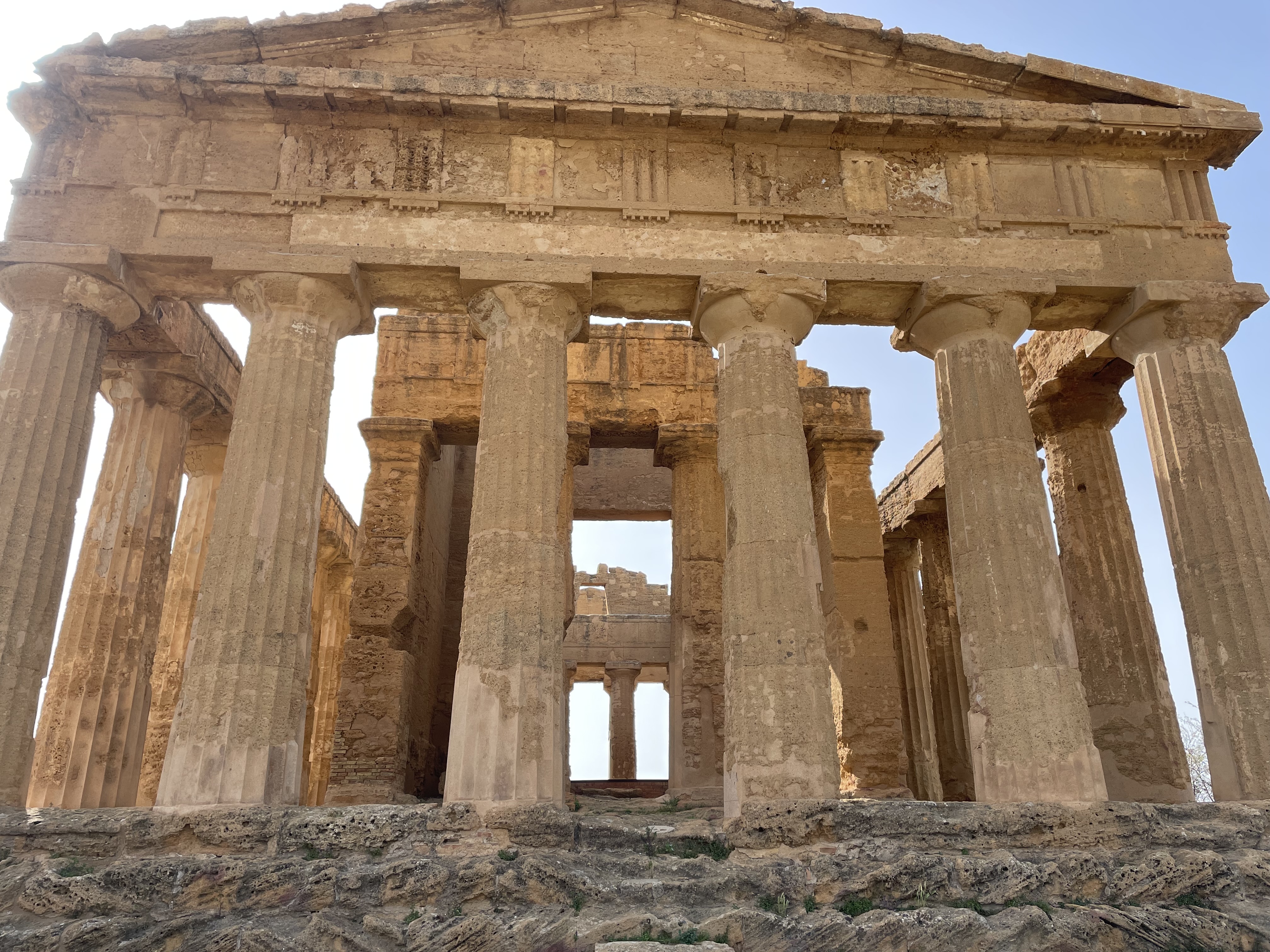
Even in March, before the heat of the summer comes to Sicily, the weather in Agrigento is hot and dry. Already the soil is dry and the sun is unrelenting. But we have come to this UNESCO site on this day to tour the Valle Dei Templi, the Valley of the Temples, and to visit the nearby museum where archaeological artifacts found in this area of Southern Sicily are housed.
Agrigento, settled around the 5th Century BC, was at one time the third largest Greek settlement after Athens and Syracuse. The Ancient Greeks certainly recognized the importance of the Island of Sicily to expanding their global reach and power, and that influence is strongly felt here in Agrigento. Recognizing that two of the three largest cities in Greek civilization were actually in Sicily was new knowledge for me. In ancient history classes, we learned of the city-states of Ancient Greece and Rome, but somehow the knowledge for most of my education never included the expansion of such civilizations to far away lands like Sicily and the turmoil that marked these power struggles throughout centuries. Wars and conquests exchanged one powerful group with another for centuries in Sicily, which was not something I considered much until this recent visit.
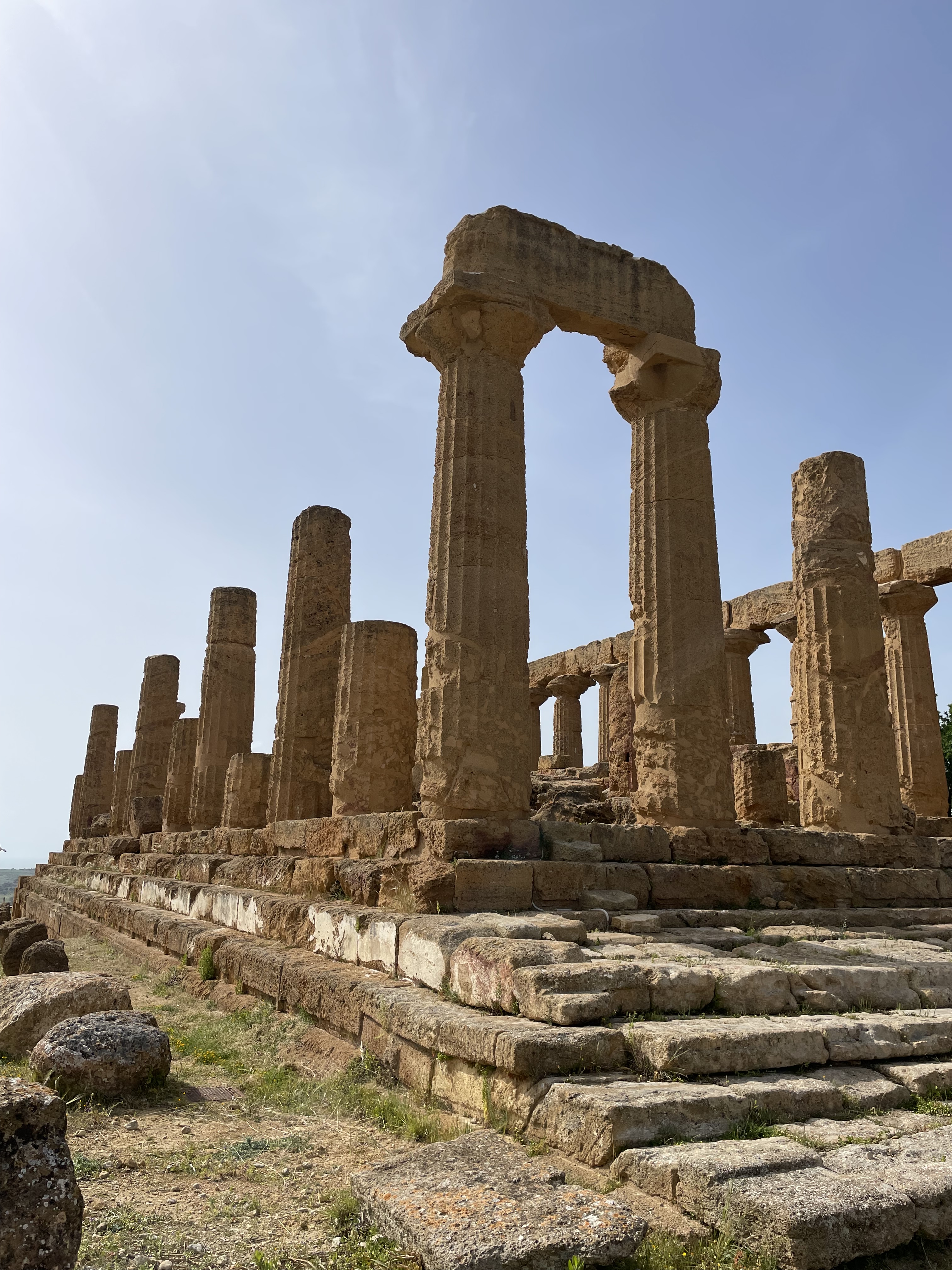
On this afternoon, we walked through the ridge of temples where one temple ruin follows another. The temples, all influenced by Greek and Magna Graecia architecture, were built to honor gods and goddesses of ancient Greece. Seven temple ruins stand in this park, one of the largest UNESCO sites in Europe: Concordia, Hera (later burned by Carthaginians), Hercules, Zeus, Castor and Pollux, Hephaestus and Asclepius. Built between 510 and 430 BC, in addition to the seven temples, one can walk among the ruins of a necropolis and the walls of the ancient city of Akargas where modern Agrigento now stands.
The temples and ruins are imposing; the beauty of their architecture, is still striking despite their condition; that the Temple of Concordia is mostly intact is miraculous. However, my wonderment is tempered by the knowledge that the temples I can visit and admire today were built by enslaved Carthaginians, 30,000 of them, likely the result of the many ancient wars fought between Greeks, Romans, and Carthaginians.
Walking through the Valley of the Temples, I wonder about those forced to perform the backbreaking manual labor that resulted in the beautiful reminders of ancient civilizations today.
 After An Educator's Journey