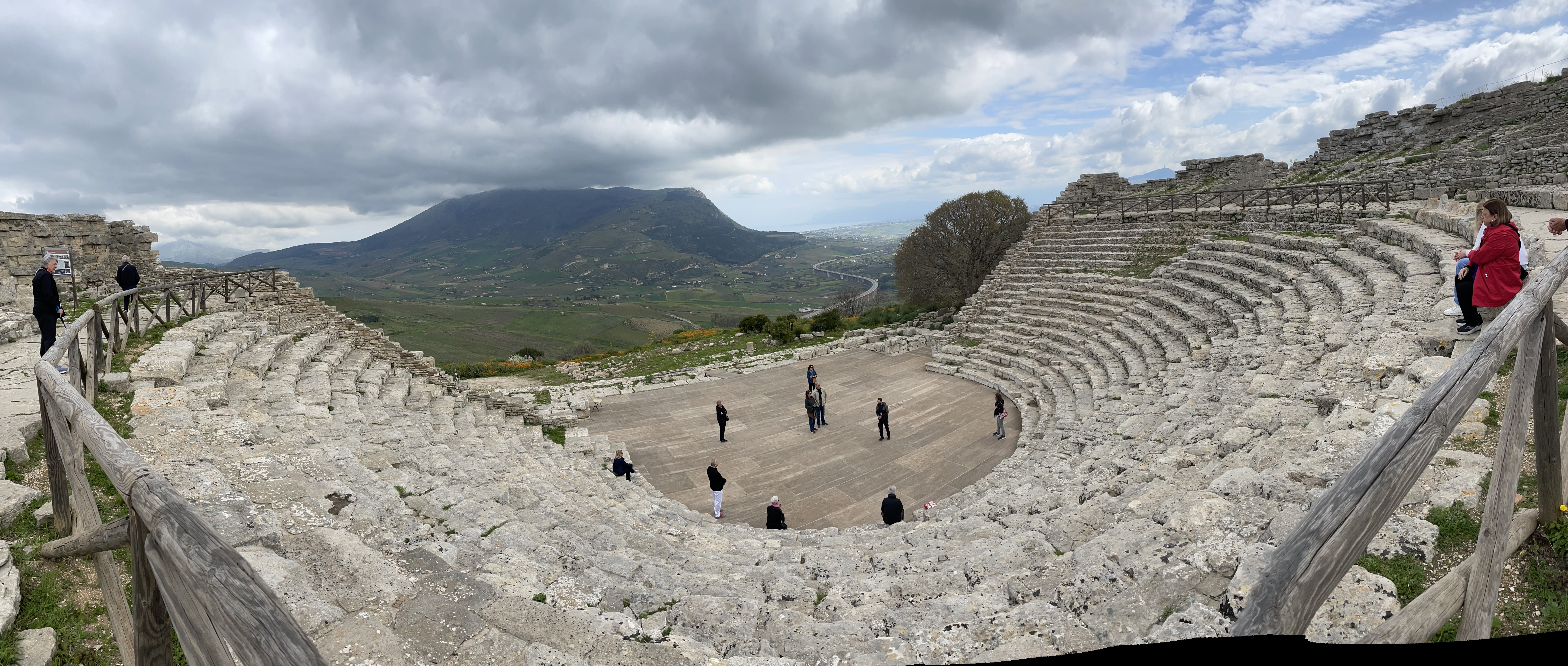
As we explored Sicily, the influence of those civilizations invading Sicily could be found everywhere. At the site of the ancient city of Segesta, the dominant evidence is of the ancient Greeks.
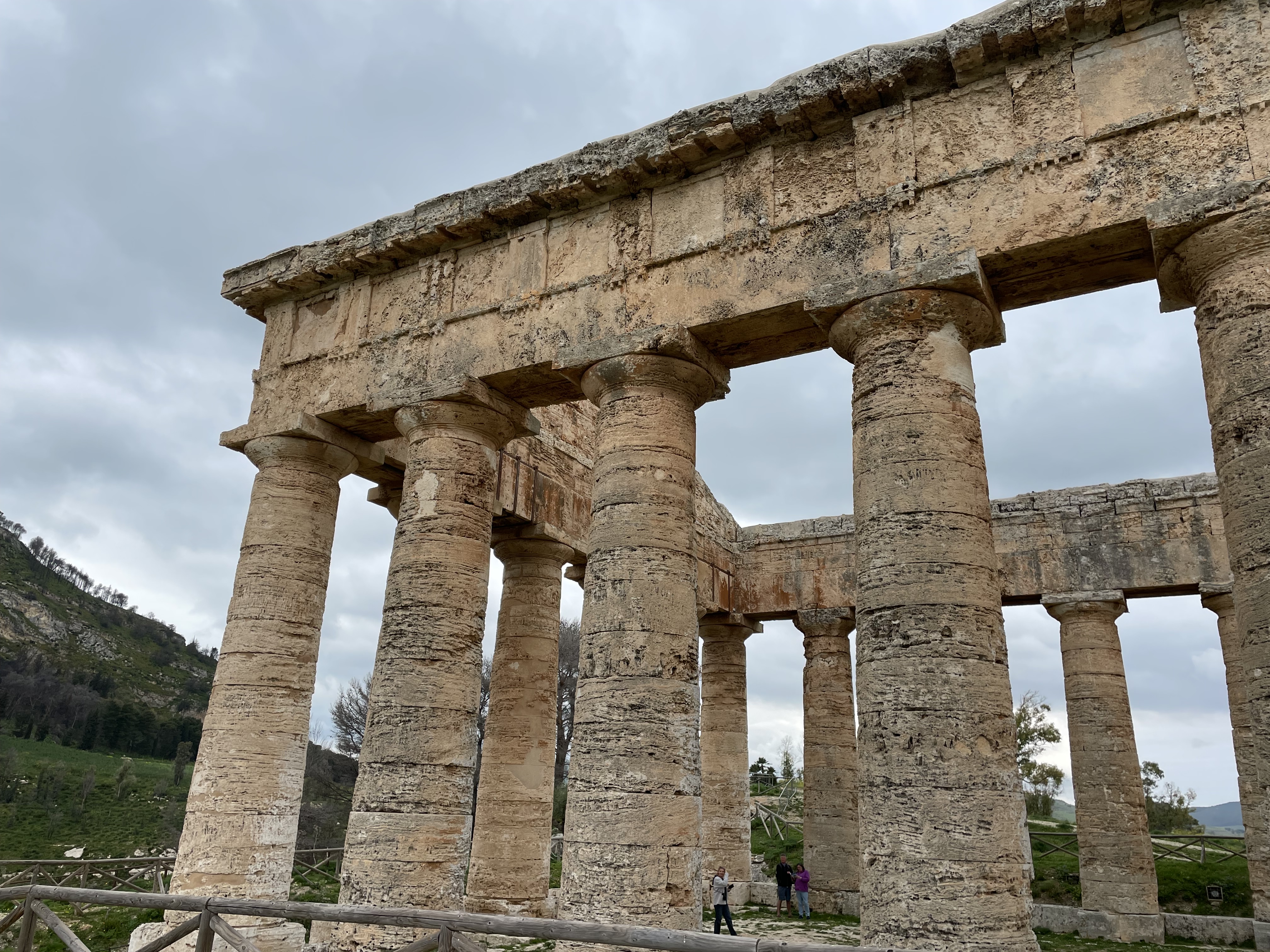
Archaeological Park of Segesta is the site of both an ancient, but unfinished temple, and the site of a “small” Greek theater. The temple, although amazingly intact, was never finished. How do archaeologist know this? The Doric columns are segmented, not fluted to appear as one piece. Finished or not, the columns, massive and the color of sandstone, rise impressively from the base of the unfinished temple and, for me, it was hard to imagine the manual labor that went into raising those columns and the large stones that form both the base and the roofline.
Visitors reach the temple and the nearby theater by foot, albeit in opposite directions. Because the nearby theater is about a half-mile walk uphill, the Archaeological Park provides mini buses to a drop off close to the top of the theater’s site. In the hot Sicilian sun, a ride uphill seems like a wise choice.
Walking on the rock strewn paths around the theater brings one face-to-face with structures that were built a thousand or more years ago representative of those who conquered Sicily over the course of its ancient history. Archaeologists are continuing to make findings here. They have discovered the remnants of a Norman church, a mosque, and the walls of Segesta, remnants of different time periods and the different invaders whose influence make Sicily the amalgam it is today.
The theater has been part of a restoration and is entered from the top of the concentric semi-circle of stone seating, just as would have happened in ancient times. From the top of the theater, one looks down on the stage area and out across the western Sicilian countryside that surrounds what would be ancient Segesta. Acoustically, this theater is a marvel of human engineering. Even at the top of the seating area, we can hear a tour guide standing at the stage area as clearly as if she were directly in front of us.
The countryside around both the temple and especially the theater is rocky. The pathways that wind through the terrain to the visitors’ center are sunny and treeless. Even in the late Spring, with wildflowers just starting to bloom, it can be quite warm. The walk though, is a magnificent opportunity to walk where ancient peoples also walked and to contemplate their contributions to their world and ours.
 After An Educator's Journey